







NTU scientists develop a device that can identify hazardous gases immediately
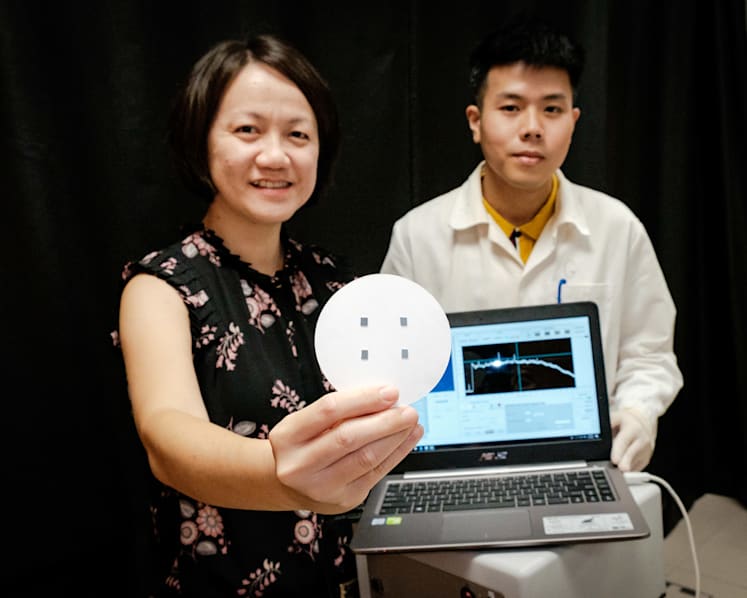
Associate Professor Ling Xing Yi (left) from the Nanyang Technological University and PhD student Phan Quang Gia Chuong (right) holding their specially designed chip that can trap gas molecules.


SINGAPORE — A new prototype device can now be used to immediately identify airborne hazards, allow real-time monitoring of air quality during haze outbreaks and assist in the detection of industrial gas leaks.
The device, which was developed by a team of scientists from Nanyang Technological University (NTU), can replace current laboratory methods of identifying gases in the air which takes between a few hours and days to obtain results.
“Emergency scenarios require a fast and ongoing analysis of potential air contamination, such as following a natural disaster, chemical spill or illegal dumping of toxic waste, so that emergency responders can take appropriate action,” the university said in a press release on Tuesday (Oct 15).
A small patch with a special porous and metallic nanomaterial is used to trap the gas molecules before a laser is shone on the gas molecules from meters away, allowing the light to interact with the gas molecules.





When analysed, it gives a spectroscopic read-out of the makeup of the gaseous sample in a graph chart.
This method is typically used only for the analysis of solid and liquid samples because gaseous chemicals were previously too dilute for the laser and detector to pick up.
Associate Professor Ling Xing Yi from the School of Physical and Mathematical Sciences, who is the lead researcher, said that the invention was inspired by an incident in Singapore where there were reports of a strong gas-like odour over certain parts of the island in 2017.
The cause of the odour was determined only days after and traced to volatile organic compounds released by factories outside of Singapore.
Together with her husband, Dr Phang In-Yee, a project leader and scientist at the Agency for Science, Technology and Research's (A*Star's) Institute of Materials Research and Engineering, they conceptualised the idea of identifying gases instantly from a distance.
Assoc Prof Ling, who is also NTU’s head of the division of chemistry and biological chemistry, said: “Our device can work remotely, so the operation of the laser camera and analysis of chemicals can be done safely at a distance.
“This is especially useful when it is not known if the gases are hazardous to human health.”
The portable laser has been tested to work as far as 10m away and can be engineered to reach further distances, but researchers have not determined the farthest distance yet.




