New index identifies top 300 employers in Singapore that support career growth
The Singapore Opportunity Index gives workers transparency, allowing them to choose employers that offer "pathways aligned with their own aspirations", said Manpower Minister Tan See Leng.
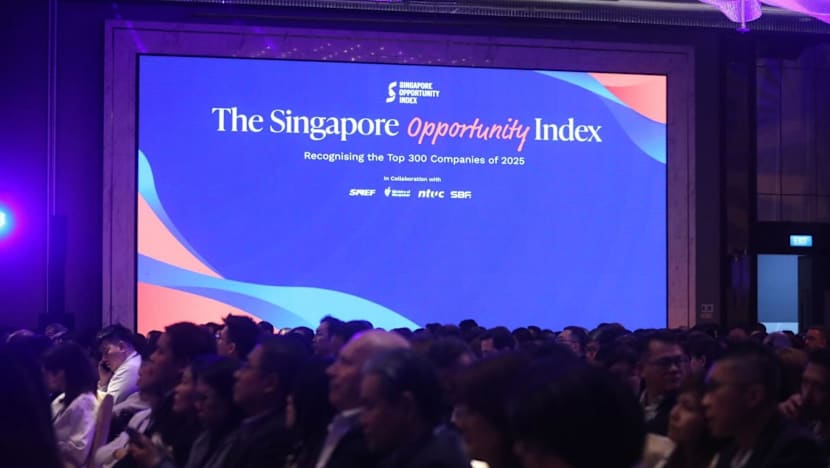
Attendees at the Singapore Opportunity Index launch and recognition event at Orchard Hotel on Jan 21, 2026. (Photo: CNA/Alyssa Tan)

This audio is generated by an AI tool.


SINGAPORE: Jobseekers and workers can now find out which 300 employers have the best track record of supporting career growth in Singapore.
The Singapore Opportunity Index, published on Wednesday (Jan 21), uses data from almost 1,500 companies and 1 million residents to assess how firms perform in progression, pay, hiring, retention and gender parity.
The top-performing organisations are recognised on the index's website. They span multinationals and small- and medium-sized enterprises across various industries.
Social service agency Rainbow Centre, manufacturer Murata Electronics, catering and ground-handling giant SATS, electricity grid operator SP PowerGrid, Big Four accounting firm PricewaterhouseCoopers and the Economic Development Board are among those identified.
The Singapore Opportunity Index is developed by the Ministry of Manpower in partnership with the Singapore University of Social Sciences and think-tank Burning Glass Institute.
MOM previously said that this index differs from other indices by using objective, verified government data rather than survey feedback for its findings.
"It shows that employers shape opportunities on a daily basis through deliberate human capital choices, and it ranges from recruitment, hiring practices, developmental pathways, as well as job design," Manpower Minister Tan See Leng said on Wednesday.
"These decisions have a cumulative effect over the course of an individual's career, and it does make an impactful, real difference on whether our workers progress, or whether they stagnate, or whether they thrive."
Dr Tan highlighted Murata Electronics, which redesigned jobs to create more value-added roles and developed a skills framework so workers know what they need to learn and how they can progress, strengthening staff retention.
He also pointed to Rainbow Centre, which introduced learning grants and mini sabbaticals to give long-serving staff a chance to learn and recharge.
The Singapore Opportunity Index groups top-performing firms into three models.
"Career launchers" create clear pathways for those starting or restarting careers, "career builders" map success paths for employees and "career anchors" build stability and have high retention rates.
How the Singapore Opportunity Index ranks employers
The Singapore Opportunity Index measures how organisations perform in progression, pay, hiring, retention and gender parity. It has a dozen sub-metrics.
Progression is measured through advancement within the organisation based on:
- The average number of promotions per employee-year
- The proportion of leaders who have progressed internally
- The average number of employees who had a change in job title or responsibilities without a change in job level, seniority or pay per employee-year
Progression also factors in advancement beyond the organisation based on:
- The proportion of employees who received a promotion among those who transitioned to another firm
When it comes to pay, the index measures:
- How the wages of workers in similar occupations compare across firms
- How the wages of full-time employees change over time
For hiring, the index measures:
- The percentage of new hires who hold qualifications below a bachelor’s degree, as a proxy for skills-first hiring
- The percentage of new hires who have less than three years of prior work experience
To measure retention, it tracks:
- The proportion of new hires who remain with the firm one year after joining
- The proportion of existing employees, excluding new hires, who remain with the firm one year later
For gender parity, the index looks at:
- Differences in promotion rates between male and female employees in overlapping occupations
- Differences in wages compared to market norms between male and female employees in overlapping occupations
Dr Tan noted the index supports Career Health SG, the national movement for workers to take ownership of their career development and build resilient, fulfilling careers.
It does this by providing the transparency that empowers workers to choose employers offering "pathways aligned with their own aspirations", he said.
At the same time, it enables employers to benchmark their practices against objective standards, Dr Tan added.
Detailed individual reports will be shared with organisations that participate in the index. These will contain data and benchmarks so they can understand how their performance compares with industry peers.
MOM said it will also distil best practices and case studies to create resources that benefit all organisations, including those not covered in the index.