







PAP should draw candidates in their 50s, 60s to inject diversity into leadership: Veteran journalist
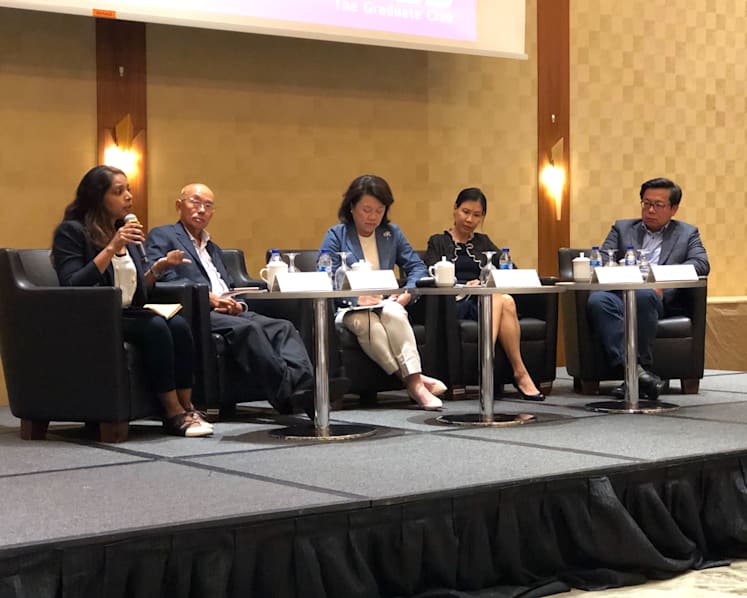
Panellists at the dialogue session (from left) Dr Laavanya Kathiravelu, Mr Han Fook Kwang, moderator Gillian Koh, Dr Leong Ching, and Mr Laurence Liew.


SINGAPORE — To inject diversity into Singapore’s political leadership, the ruling People’s Action Party (PAP) could draw from a wider range of candidates, including those in their 50s and 60s, veteran newspaper editor Han Fook Kwang said.
“It’s okay to get some... in their 50s and 60s. Maybe they have already done well and want to do something more than achieve corporate success,” said Mr Han, editor-at-large at broadsheet The Straits Times.
“They don’t need to shine for their own sake.”
Mr Han, who is also a senior fellow at the S Rajaratnam School of International Studies, was on Wednesday (May 29) responding to a question from Mr Edward Tay, honorary secretary of the National University of Singapore Society (NUSS), on how Singapore can choose its leaders — besides the usual paths such as the civil service.





Mr Han was speaking at an NUSS dialogue on the challenges and opportunities that Singapore’s fourth-generation (4G) leaders would face amid a shifting global order and technological disruption.
NUSS is a club for graduates from Singapore and recognised foreign universities to network.
Mr Han said that Singapore has a long-standing process in selecting its leaders through the government scholarship system, for instance. It handpicks mostly those in their late 30s and 40s to join the PAP.
While this system has many advantages, such as stability and a certain level of competence, Mr Han said that there is always the danger of groupthink, where political figures reach the “same conclusion when given the same set of facts and circumstances”.
He added: “Once they are sucked into the system and inducted, they all want to shine and become outstanding ministers.”
Hence, the party should draw some, but not all, of its candidates from those in their 50s and 60s, who bring different sets of skills from their jobs and “life in general”.
With the clock ticking down to the next General Election, due by early 2021, the PAP’s selection of candidates is intensifying, Deputy Prime Minister Heng Swee Keat had said earlier this month.
Apart from leadership, Mr Han said that Singapore should build strong and resilient people. The odds of society doing well will be much greater as a result, he said.
He cited the example of how countries such as Japan weathered hardships, including tsunamis and earthquakes, despite a political leadership that has been criticised as weak.
To do this, he said Singaporeans must be given the space to grow and try new ideas, such as in the arts or business.
“We cannot have strong and resilient people if we are over-protected by the Government and if society is hugely dependent on the Government to do this and that,” he said.
Another panellist, Dr Leong Ching, co-director of the Institute of Water Policy, referred to a survey by the National Climate Change Secretariat, which found that more Singaporeans felt that the responsibility to deal with climate change rests with the Government.
Dr Leong said there is the danger that when a country has strong infrastructure in place, social resilience may be low.
For instance, when floods happen in Singapore, the people perceive this as “incredibly rare”.
She suggested that to inoculate the people against harm may require exposure to “small amounts of harm”. Australia, for instance, carries out water rationing, allowing its people to experience the effects of a water shortage.
Mr Han recalled a speech he gave at Raffles Institution, his alma mater, where he set the school a challenge: Do away with its paid cleaners and have students clean the school.
But parents retorted that this would be eating into their children’s “education time”.
“They don’t know what education is… Education is knowing your responsibility to the community,” said Mr Han.
Wednesday night’s session was attended by about 150 NUSS members and their guests.
On the panel with Mr Han and Dr Leong were Dr Laavanya Kathiravelu, an assistant professor at the Nanyang Technological University’s division of sociology; Mr Laurence Liew, director of artificial-intelligence (AI) industry innovation at AI Singapore, a national programme by the National Research Foundation; as well as moderator Gillian Koh, deputy director for research at NUS’ Institute of Policy Studies.
Dr Kathiravelu spoke about low-wage migrant workers, including the need to strengthen protection for foreign domestic workers.
She suggested that the provisions of the Employment Act, Singapore’s main labour law, could be extended to them. The law, which has provisions such as rest days, does not apply to public servants, foreign domestic workers and seafarers, who are protected under industry-specific legislation.
Mr Liew felt that Singapore should strengthen its intellectual-property policies because spending months to obtain a patent is no longer relevant in the age of AI. The country should also be bold in building local AI talent, rather than recruiting from overseas, he said.
“If given the opportunity, they will shine,” he added.




