







PM Lee proposes ways to reap more long-term benefits from China’s Belt and Road initiative
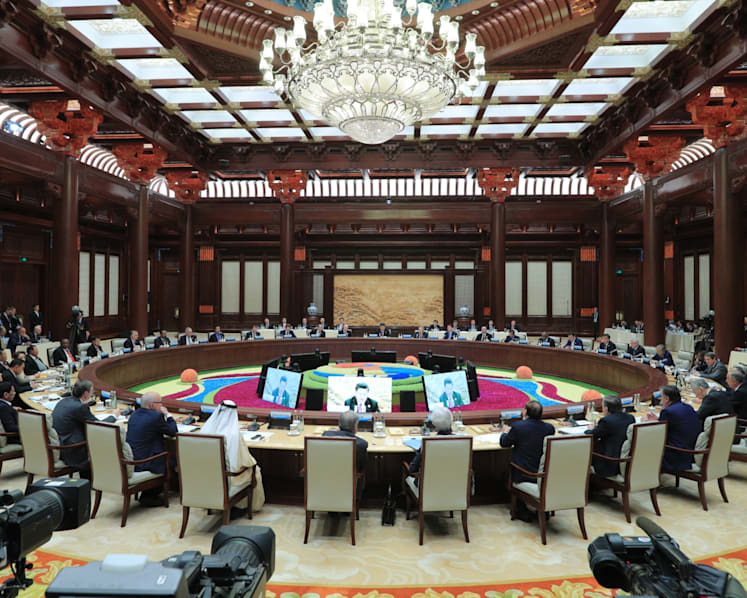
BRI projects can develop more local talent, involve more local businesses and facilitate further technology transfer, said Singapore Prime Minister Lee Hsien Loong.


BEIJING — Into the sixth year of its Belt and Road Initiative (BRI), China can look at ways to maximise long-term benefits of the strategic initiative beyond physical infrastructure, said Prime Minister Lee Hsien Loong on Saturday (April 27).
Speaking at a leader’s roundtable at the Belt and Road Forum for International Cooperation, which he is attending for the first time, Mr Lee suggested three possible ways to reap greater benefits:
1. DEVELOP INDIGENOUS CAPABILITIES
Countries partnering with China will benefit more if BRI projects develop more local talent, involve more local businesses and facilitate further technology transfer, he said.





“This will not only improve the quality and sustainability of the infrastructure projects, but also give local parties a greater stake in the projects’ success,” Mr Lee said.
2. NEW MODELS OF COOPERATION
The BRI – an ambitious undertaking to reconstruct the ancient Silk Road trade route connecting Asia and Europe, through large-scale infrastructure projects – can go beyond traditional bilateral models of cooperation.
Connectivity need not be limited to “hub-and-spoke” arrangements with China, said Mr Lee.
“China can partner other countries on projects in third countries and this can bring together a wider range of capabilities and resources,” Mr Lee said.
Such new models of cooperation may “open new doors” to projects which may otherwise not be feasible, and enhance trade and cooperation not only between other countries and China, but among other countries as well, he added.
3. A TRANSPARENT AND INCLUSIVE APPROACH
The BRI should take an inclusive, transparent and market-driven approach through economically viable and financially sound projects.
Besides improving accountability and risk management, this will “increase the projects’ overall chances of success, and inspire greater confidence in future projects”, he said.
CONTRIBUTING TO PEACEFUL SHIFT IN GLOBAL ORDER
New roads, ports and railways have been built between cities and countries since the launch of the BRI, a major economic and foreign policy initiative that is the brainchild of Chinese president Xi Jinping.
It has helped deepen China’s linkages with other countries, and China is now exporting capital and expertise, Mr Lee said.
Significantly, since 2015, its overseas direct investment has exceeded foreign direct investment into the country, he noted.
“The BRI can contribute much to a peaceful, orderly shift in the global order, and support China’s constructive international role commensurate with its size and potential,” said Mr Lee, one of 37 world leaders attending the forum.
About 5,000 representatives from 150 countries are also at the forum, which is being held for the second time.
China’s international influence has grown along with its share of global gross domestic product, said Mr Lee.
“The strategic balance has shifted and continues to shift,” he said.
“How China performs its prominent global role, and how the international community adjusts to China’s growing influence, will determine whether all of us, and all our countries, can enjoy continued peace and prosperity.”
MORE COOPERATION
Singapore, an early and strong supporter of the BRI, looks forward to cooperating with China and other countries to unlock more opportunities, added Mr Lee.
Both countries are already working on promoting financial connectivity, infrastructure connectivity, as well as professional and legal services under the BRI.
One significant project underway is the Chongqing Connectivity Initiative – in particular, a rail link called the New International Land-Sea Trade Corridor.
The rail link connects Chongqing to Qinzhou Port in Guangxi on the Gulf of Tonkin, which opens a shorter connection for China’s Western provinces out to the world, Mr Lee noted. It strategically links the Silk Road Economic Belt and the New Maritime Silk Road.
Earlier on Saturday, Mr Lee met Chilean President Sebastián Piñera. They agreed to enhance cooperation in the areas of digital trade and smart cities, including agreements to promote digital trade and connectivity, urban planning and population issues.




