







Political system must evolve, but stay founded on 5 core principles: PM Lee
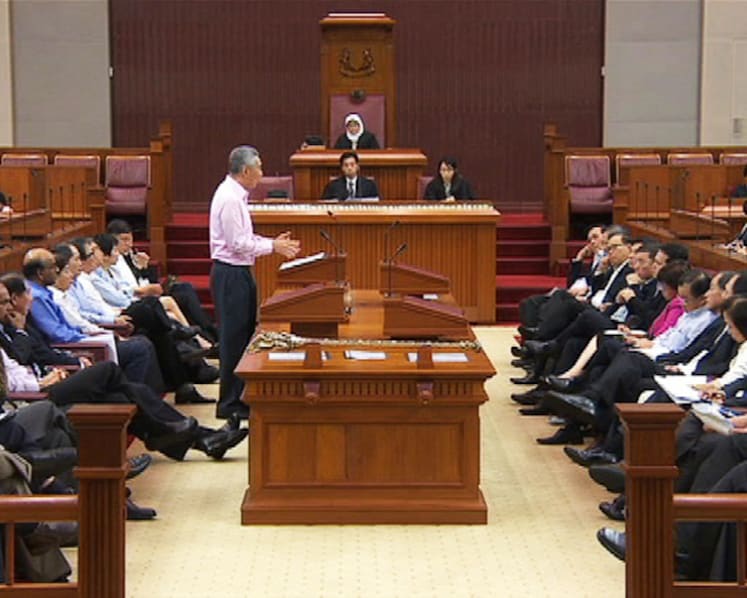
Accountability must be fostered to ensure the Government’s actions are scrutinised and debated in Parliament, said PM Lee, adding that it is not a place where you exchange clever put-downs. Photo: Channel NewsAsia


SINGAPORE — Singapore’s political system has to keep updating itself while remaining founded on five core principles: To have a “high-quality” Government that is honest, competent and effective; to have free and fair elections; to be accountable to its people; to uphold a multiracial society; and to have “stabilisers and checks and balances”, said Prime Minister Lee Hsien Loong.
Speaking in Parliament yesterday, Mr Lee said that as a small country devoid of resources, Singapore’s key competitive advantage has been and must always be grounded in the Government’s excellence and integrity. The system must have a Government that is responsive to its people and able to look beyond the short term.
Paying tribute to the nation’s past leaders and their foresight, Mr Lee said: “I’d put this quite bluntly. If we hadn’t had a first-class Government in Singapore, led by exceptional leaders who were able to foresee problems … seize opportunities, reap dividends for Singapore and mobilise people to support policies, sometimes tough ones, we would not have Singapore today.
“So we cannot ever afford to be gridlocked, paralysed or dysfunctional, like some other countries ... For Singapore, you go down, you are finished.”





Singapore’s political system must also be “open and contestable”. Keeping money out of politics is one key way in which Singapore has kept elections free and fair.
Comparing the S$7.1 million outlay for last year’s General Elections with the US$7 billion (S$10 billion) cost of the United States’ presidential and congressional polls in 2012, he said: “It should not be forbiddingly expensive for people to stand and contest elections.”
The system must foster accountability to ensure that the Government is “kept on its toes” and its actions must be scrutinised and debated in Parliament, he said.
Recalling how Members of Parliament (MPs) of all political stripes have successfully put up cases against the Government’s proposals, he said: “Either the Government has to rebut it and explain convincingly what it is doing and why, or if the MP makes a good case, then you have to acknowledge that, and policies have to be changed.”
In reminding parliamentarians to take debates in the House seriously, Mr Lee said: “(Parliament is not) a place where you exchange clever put-downs ... Our Parliament may not be as entertaining (as others) … but I think in terms of quality and seriousness, we have it and we should keep it.”
Ultimately, the Government is accountable to the electorate, he said.
“If it performs well, it gets the support of voters again, and can continue in office. If it performs poorly, there is an electoral price to pay,” he said, adding that the Government must take care not to become complacent, go soft or, even worse, become corrupt.
The system must also maintain the multiracial fabric of society, said Mr Lee. It must encourage parties to pursue policies in the interest of all regardless of race, language or religion, and discourage parties from forming along racial and religious lines, or championing the interest of one group over others.
“Race and religion will always be fundamental tectonic fault lines for us. If we ever split along one of these fault lines, that is the end of us,” he said.
Finally, the system must have safeguards to prevent the country from being swept off course by a “transient public mood” or an “erratic government”. Such “stabilisers” are needed in two particular areas: In protecting the nation’s reserves so that a profligate may not spend all the reserves and bring it to zero, and to safeguard competence and integrity in the Public Service.
If reserves are not protected, “elections will become auctions, where the parties compete to become more generous than others, offering what it can do for voters by raiding the bank”, said Mr Lee, citing the example of Australia’s deficit crisis.
And if corrupt persons get into key positions in the Public Service, they will subvert and corrupt the system and it will become impossible to root the rot out after it is entrenched, he said.




