







Primary One registration priority for students from MOE kindergartens
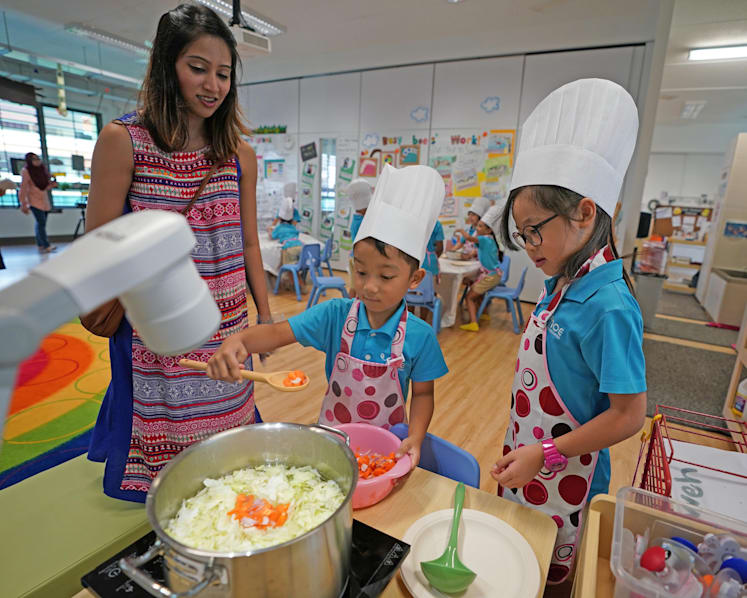
Teacher Geetha V Segar guiding students taking part in making vegetable soup at MOE Kindergarten @ Riverside. A cooking class is just one of the creative ways used to help this Kindergarten 2 class with their “experiential class writing” exercise. Photo: Raj Nadarajan/TODAY


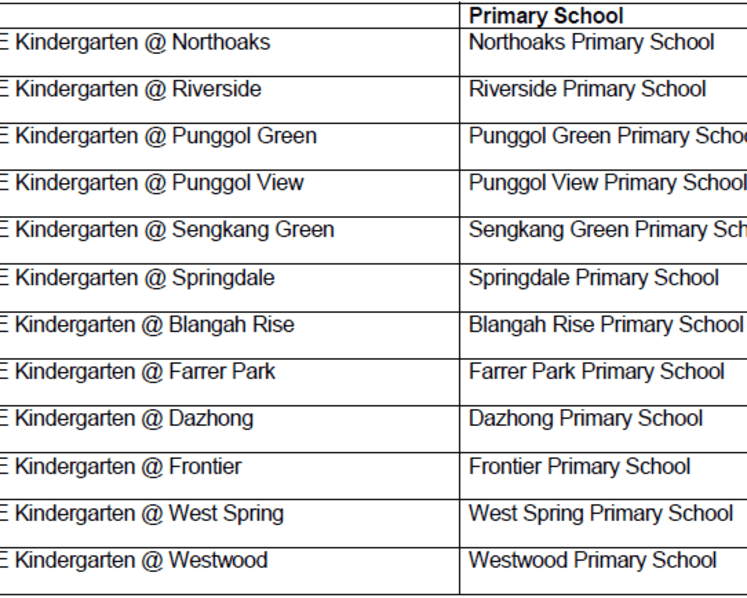
SINGAPORE — From next year, students in 12 of the 15 existing Ministry of Education (MOE) kindergartens will be given priority — under Phase 2A(2) — when they register for admission to the primary schools they are co-located with, under a pilot.
The dozen MOE kindergartens involved in this pilot are already co-located with primary schools. They are mostly in new towns, such as Punggol and Sengkang. The remaining three existing MOE kindergartens, at Fernvale Link, Yishun, and Tampines, will be relocated to nearby primary schools starting in 2019.
HD: Primary One registration priority for students from MOE kindergartens
Phase 2A(2) is the third of seven under the Primary One registration exercise, and is reserved for children whose parents and siblings have studied in that particular primary school, or whose parent works at that school.





The two earlier phases are for those who have siblings in that school (Phase 1); and whose parent is a former student and alumni member for at least a year, or is a member of the school's advisory or management committee (Phase 2A(1)).
Announcing the pilot on Monday (Nov 27), the MOE assured parents that there will still be sufficient places for all primary school-going children because a minimum of 40 places will be set aside for those registering under Phases 2B and 2C. Phase 2B is for children whose parents are volunteers in the school of choice or whose parents are members of churches or clans affiliated to the primary school, while Phase 2C is for children who have yet to secure a place.
At a media briefing, MOE said that extending Phase 2A(2) to students in MOE kindergartens will facilitate smoother transition to Primary One, as the primary school would already have an understanding of their developmental and learning needs, said MOE.
For this transition to take place, students in MOE kindergartens need to be given higher priority so that they have an "earlier opportunity" to apply for a place in the selected primary schools, the ministry added. Currently, about half of the students in the 12 MOE kindergartens move on to the primary schools they are co-located in, said MOE.
Speaking to reporters after the briefing, Education Minister (Schools) Ng Chee Meng said: "The main motivating factor is of course the child ... In this environment we hope to enable the child a smoother learning journey and a more familiar environment."
On whether the move will drive up demand for places in MOE kindergartens and the primary schools which they are co-located with - and as a result, add pressure to the Primary One registration process - the ministry said it was "unable to predict the demand situation", as it differs from year to year.
The number of available Primary One places at the 12 primary schools is between 120 and 270, with most having a considerable number of vacancies left after Phase 2A has ended based on previous registration exercises.
For instance, Punggol Green Primary School — which has a total of 270 places — had 84 places for Phase 2B, based on the results of the registration exercise for 2018 which concluded in July this year. Of the 12 schools, Dazhong Primary School appeared to be the most in demand as it had only 39 places out of 150 left for Phase 2B.
The intake for the 12 MOE kindergartens involved in the pilot ranges from 60 to 120 each. Under the pilot, the number of places could be increased to 160 each to meet demand.
Without specifying the pilot's duration, MOE said that it aims to study its effectiveness and "will monitor and evaluate the admission patterns" in both its kindergartens and the primary schools.
Adding that new MOE kindergartens will be co-located with government schools only, the ministry also reiterated that unlike private kindergartens, there is pedagogical continuity in MOE-run kindergartens and the primary schools which they are co-located with.
At the National Day Rally this year, Prime Minister Lee Hsien Loong announced that the Government will increase the number of MOE kindergartens from 15 to 50 in the next five years.
At MOE kindergartens, a third of the places are reserved for children from low-income families, whose gross household income do not exceed S$3,500 a month or whose per capita income do not exceed S$875 per month. The families also have to live within 1km of the kindergarten.
Mr Lee also said that from now till 2022, 40,000 pre-school places will be added via new centres, bringing the total number to about 200,000. Anchor operators will run the bulk of these new centres.
The Early Childhood Development Agency (ECDA) had said these full-day pre-schools will have capacity for 200 children each, which is twice the size of an average centre today.




