Programme lets others learn from S'pore's development
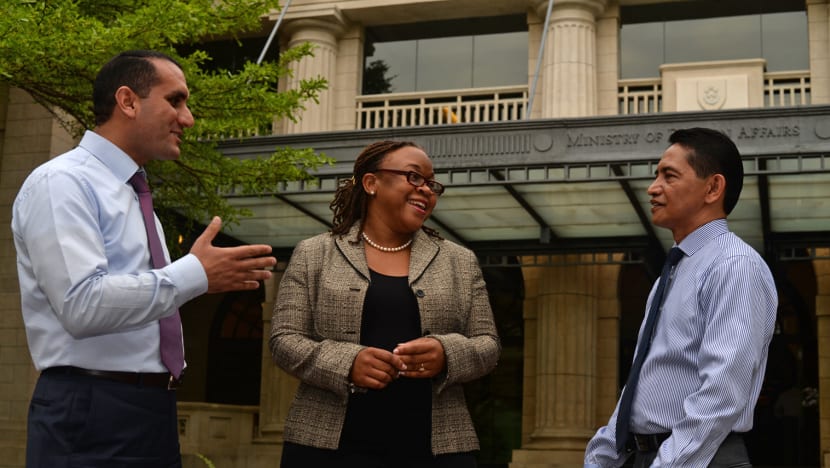
From left: Singapore Cooperation Programme award receipients Mr Ismat Aburabee, 38, from the Palestinian National Authority, Mrs Shelly Nicholls-Hunte, 39, from Barbados and Mr James G. Viernes, 52, from Philippines. Photo: Robin Choo
SINGAPORE — She hails from an island nation without significant natural resources that is aspiring to be a “first-world country”. Barbadian Shelley Nicholls-Hunte was inspired by Singapore’s development as she learnt about Singapore’s anti-corruption strategies in recent days.
“To come and see your Civil Service College in action and to learn of the importance that Singapore has placed on the development of people is exciting because we are in that vein as well,” said Mrs Nicholls-Hunte, director of the financial intelligence unit in the Attorney-General’s Office of Barbados.
A participant of the Ministry of Foreign Affairs’ Singapore Cooperation Programme (SCP), she was one of 28 people from 27 countries here to learn about Singapore’s anti-corruption strategies from the Civil Service College and Corrupt Practices Investigation Bureau (CPIB). She is also the 100,000th participant in the programme, which sees over 6,000 foreign officials from 170 countries attend about 300 courses and workshops yearly. The SCP began in 1992 as a way for Singapore to share its development experience with others.
Singapore does not attempt to teach countries what to do,
said Foreign Affairs and Law Minister
K Shanmugam at the award ceremony today (July 1). “We share our experiences and people take what is applicable and adapt … In the end, the level to which it benefits their society depends on their own systems and structures.”





Courses under the SCP include those on judiciary matters and public administration, and technical skills such as neonatal nursing.
The most popular courses are on public administration, and economic and sustainable development.
In response to changing needs, the SCP will also focus on technical and vocational training, and strengthening public-sector leadership,
said Mr Shanmugam.
Currently, Vietnam, China, Laos, Myanmar and Cambodia send the most number of officials and just over half the participants are from the Association of South-east Asian Nations.
Singapore also conducts training with partners such as United States and United Nations agencies, in areas such as humanitarian assistance and cybercrime. It now reaches out to more distant regions like the South Pacific, Africa and the Caribbean,
said Mr Shanmugam.
The SCP helps Singapore build connections with participants, he said. “(They) go off and become ambassadors for Singapore. They take back good memories about Singapore (and) understand Singapore and know how we work.”
Mr James Viernes from the Office of the Ombudsman in the Philippines investigates public officers suspected of corruption and said he was impressed by the CPIB’s “fast, swift and sure conduct of investigations”. He was interested in its power to detain a suspect or accused.
Mrs Nicholls-Hunte said her key takeaway was that absolute power corrupts. “Being able to manage that for our country is extremely important for our development,” she said.