







Proper for me to deal with PM Lee’s defamation suit, says Press Sec
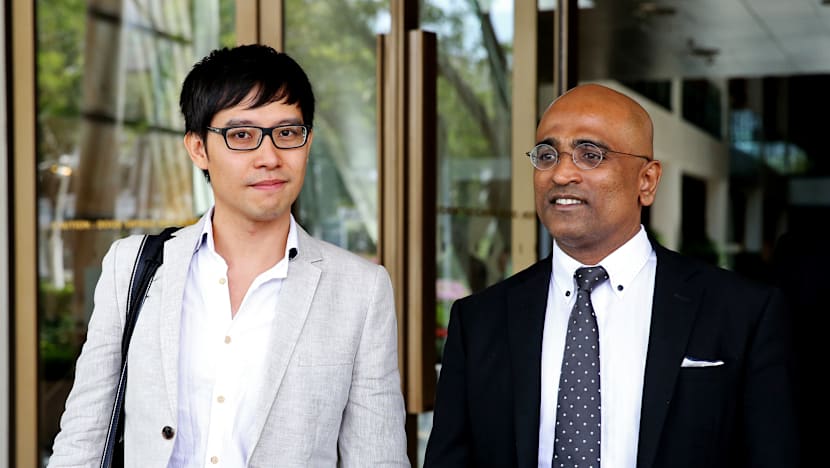
Blogger Roy Ngerng (left) leaving the Supreme Court with his lawyer M Ravi on Jan 12, 2015. Photo: Wee Teck Hian


SINGAPORE — The Press Secretary to Prime Minister Lee Hsien Loong said today (Jan 13) it was “entirely proper” for her to deal with matters relating to his High Court defamation lawsuit against blogger Roy Ngerng, after the defendant’s lawyer questioned why she was involved in what is purportedly a private litigation.
This is because, said Ms Chang Li Lin, the court had found that Ngerng had falsely alleged that Mr Lee, as the Prime Minister of Singapore, had misappropriated money placed by Singaporeans into the Central Provident Fund (CPF). “It is, therefore, entirely proper for me to deal with this matter as the Prime Minister’s Press Secretary,” Ms Chang added.
She was responding to a press release by Ngerng’s lawyer M Ravi, issued this morning and addressed to her, questioning why she was issuing responses to the media on behalf of Mr Lee, a private litigant.
Mr Ravi also said Ms Chang appeared to have been misinformed when she stated yesterday that he had indicated, in a closed-door hearing for the lawsuit, that Ngerng did not want to be cross-examined by Mr Lee’s lawyer. According to Mr Ravi, he had said he would take instructions from Ngerng on whether the blogger would give evidence at the hearing to assess damages to be paid to Mr Lee for defamation.





“The correct position is that Ngerng’s lawyer indicated at the hearing that he would be taking instructions on whether Ngerng would be giving evidence,” said Mr Ravi, who had told reporters after the hearing that his client would be likely to take the witness stand.
His statement was rebutted by Ms Chang, who called Mr Ravi’s allegation “baseless” and produced notes taken by Mr Lee’s lawyers from Drew & Napier during the hearing.
Ms Chang said Mr Ravi had initially said Ngerng would rely on an earlier affidavit as evidence, only to make a U-turn when Mr Lee’s lawyer, Senior Counsel Davinder Singh, said he would cross-examine Ngerng if he gave evidence. “The fact is that after Mr Ravi said that Ngerng would not be giving evidence and even after he tried to end the discussion, the court asked
Mr Ravi to consider the matter and to let the court and Drew & Napier know by Jan 30, 2015, if Ngerng would be giving evidence,” stated Ms Chang.
High Court judge Lee Seiu Kin had yesterday ordered Ngerng to pay S$29,000 to Mr Lee in costs and related expenses for the lawsuit up until Mr Lee’s application last July for a summary judgment on the case.
In his summary judgment issued last November, Justice Lee found that Ngerng’s blog post last May had suggested that Mr Lee was guilty of criminal misappropriation of CPF money.
Assessment of damages to be paid will be heard on a later date.
Here is Ms Chang’s statement in full:
Yesterday evening, Mr Roy Ngerng said in a blog post that I and the media lied in saying that “Mr Ngerng’s lawyer indicated at the hearing that Mr Ngerng did not want to be cross-examined”.
This morning, Mr M Ravi issued a statement to the media saying that the following statement by me is inaccurate, and that I have been misinformed: “…Mr Ngerng’s lawyer indicated at the hearing that Mr Ngerng did not want to be cross-examined. The judge directed his lawyer to confirm this by 30 January 2015. PM Lee stands ready to be cross-examined, a position he has maintained right from the beginning.”
Mr Ravi is wrong, and Mr Ngerng, who was not present during this part of the hearing, has made yet another baseless allegation.
Mr Ravi said his statement was based on his “recollection”. But my statement was based on contemporaneous notes of the hearing taken by Drew & Napier.
Drew & Napier’s notes show that the following exchange took place in Court yesterday:
“P: Will D be filing aff?
MR: No
P: Is D calling any other witness?
MR: I will be seeking to rely on docs filed by my client in lower
proceedings.
J: Unless they ordered to stand as AEICs, not in evidence
MR: I ask that RN’s affidavit stand as AEIC
(Note: According to Drew & Napier, the following shorthand was used in the notes: “P” (Plaintiff) is Mr Davinder Singh SC, “MR” is Mr M Ravi, “D” (Defendant) is Mr Roy Ngerng, “J” refers to the Judge, “AEIC” is affidavit of evidence in chief, “aff” is affidavit, “xxing” is cross-examining, “YH” is Your Honour, “wks” is weeks, “app” is application and “PTC” is pre-trial conference. The relevant extracts are attached.)
J: How many?
MR: 1.
J: Aff he filed in O 14 below to stand as AEIC?
P: I will be xxing if standing as AEIC.
MR: Therefore, I won’t be filing.
Enough YH I won’t be filing
J: I suggest you go through his docs and see if all docs you want to
rely on are there
MR: 2 wks from now?
…………
J: liberty to D to apply within 2 wks, by 31 Jan 2015, leave to submit
AEIC?
…………
J: Might make sense for you to give new aff if only 1-2 docs
P: If D chooses to give AEIC in whatever form, I will be xxing.
J: Until 31 Jan if you have anything you can apply for leave.
…………
MR: If my client decides to file AEIC, does he have to file app?
J: Will be a further PTC.
Write to inform the Registry that D wishes to tender evidence
Write in before 31 Jan. Will schedule PTC for you in Feb to give
necessary leave.
…………
J: Liberty to D to apply to give evidence on or before 31 Jan
Ms Yap tells me 31 Jan is Sat
30 Jan?
MR: Ok
…………”
From the notes, it is clear that Mr Ravi had informed the Court that Mr Ngerng would rely on the affidavit filed by him in the earlier summary judgment application as his evidence for the purposes of the assessment of damages. Mr Davinder Singh then gave Mr Ravi notice that if Mr Ngerng was going to give evidence for the purposes of the assessment of damages, Mr Singh would be cross-examining Mr Ngerng. Whereupon Mr Ravi promptly changed his position, and informed the Court that Mr Ngerng would “Therefore” not be filing any evidence.
This was the clearest indication that Mr Ngerng did not want to be cross-examined.
After saying that Mr Ngerng intended to rely on an earlier affidavit as his evidence, Mr Ravi did a hasty U-turn after Mr Singh said that he will cross-examine Mr Ngerng if he gives evidence. Mr Ravi was so determined that Mr Ngerng not be cross-examined that he even said to the Court “Enough Y[our] H[onour] I won’t be filing”.
In his statement, Mr Ravi said that if “the client choses [sic] to give evidence…he will be liable to cross examination. If he does not, he will not”. That explains why Mr Ravi changed his position at the hearing.
As is also clear from the notes, Mr Ravi’s statement that “If my instructions had been that my client did not wish to give evidence and I had indeed conveyed that fact to the Court, it would have been illogical for the learned Judge to have asked me to confirm this by 30 January 2015” is also incorrect. The fact is that after Mr Ravi said that Mr Ngerng would not be giving evidence, and even after he tried to end the discussion, the Court asked Mr Ravi to consider the matter and let the Court and Drew & Napier know by 30 January 2015 if Mr Ngerng would be giving evidence.
My statement that the Prime Minister stood ready to be cross-examined right from the beginning and had previously informed the Court of that position is also correct.
There are two parts to this case.
The first was the application for summary judgment. That application was decided on the basis of affidavit evidence, and the issue of cross-examination did not arise. Judgment was given in favour of the Prime Minister on 7 November 2014.
The second is the assessment of damages where evidence is given on the stand and the witnesses are subject to cross-examination. That process began with the Prime Minister’s application for directions that was filed on 18 November 2014.
At the very first hearing of that application, which took place on 19 December 2014, Mr Singh informed the Court in Mr Ravi’s presence that the Prime Minister will give evidence and that any suggestion that the Prime Minister is not to be cross-examined should be dispelled.
Drew & Napier indicated to the Court and to Mr Ravi on at least two more occasions before yesterday’s hearing that the Prime Minister stands ready to be cross-examined. The first was by a letter dated 22 December 2014 and the second was in submissions which were filed in Court and served on Mr Ravi on 9 January 2015.
Finally, Mr Ravi has asked whether it is appropriate for the Prime Minister’s Press Secretary to issue statements in connection with this case. He appears to have forgotten that, as the Court has found, Mr Ngerng falsely alleged that “the plaintiff, the Prime Minister of Singapore… is guilty of criminal misappropriation of the monies paid by Singaporeans to the CPF”. It is therefore entirely proper for me to deal with this matter as the Prime Minister’s Press Secretary.
Press Secretary to the Prime Minister
13 January 2015




