







Protecting against stock market losses with the ‘stop limit’
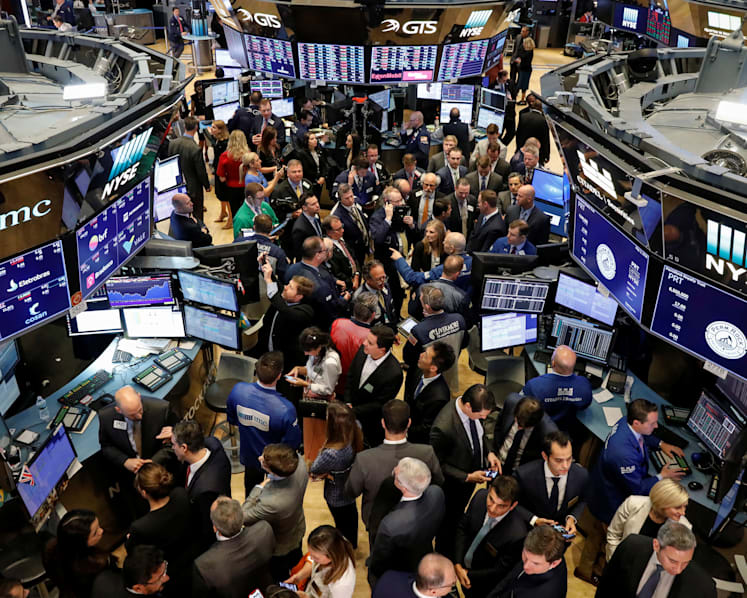
The floor of the New York Stock Exchange in New York. To protect themselves, investors can consider setting "stop limit" orders to sell their shares if prices fall, so that they may avoid big losses.


Stock markets have been bouncing up and down this year, dramatically at times. To protect themselves, investors can consider setting "stop limit" orders to sell their shares if prices fall, so that they may avoid big losses.
Very simply, a stop-limit order is a directive to a brokerage firm to sell a stock once the price drops to a certain level. When the price hits that amount, the brokerage firm will sell the stock.
At most brokerages here, stop limits can be set for up to 30 days.
If you buy a stock at S$10 per share and set a stop limit at S$8, for example, you'll keep your shares if the price goes up or declines a little and your brokerage firm will sell them if the price drops to S$8.





The key reason for using a stop limit is that it can reduce your losses if the stock price falls, making it helpful for risk management.
"Using a stop-loss strategy can help you identify the right place to put stops to ensure your trades are reaching their potential," online trading platform IG explained, " while helping to protect you against escalating losses."
Mr Alexander Green, chief investment strategist at investment advisory firm Oxford Club, said the value of using stop limits is that "they keep us from selling our stocks while they're in a major uptrend — and prevent small losses from becoming unacceptable losses. Anyone can buy a stock. Using trailing stops and knowing when to sell a stock is the true art of investing".
A risk, of course, is that a stock might bounce back up after it hits your stop limit and you sell it. While that possibility is frustrating, Nasdaq contributor Martin Tiller opined that "in the grand scheme of things, (it) is a small price to pay for the protection offered by stop loss orders. You just have to accept it and move on".
USEFUL STRATEGY?
There are varying views on whether stop limits work, with supporters saying they prevent losses and detractors saying investors can get shut out of gains if they sell too soon.
Studies seems to show, though, that the benefits outweigh the costs.
Research on the Swedish market published in 2009 by Bergsveinn Snorrason and Garib Yusupov at Lund University in Stockholm, for instance, found strong indications of stop-loss strategies being able to outperform a buy-and-hold portfolio strategy. "The empirical results indicate that the stop-loss strategies can do better than the buy-and-hold, even when compared in terms of the risk-adjusted returns," the study concluded.
A 2013 paper written by professor Andrew Lo from the Massachusetts Institute of Technology similarly found that "stop-loss policies can generate positive economic premia" for the strategies many investors use, such as momentum or regime-switching models. A key reason, he explained, is that losses and gains are processed by different parts of the brain. In particular, in the event of a significant drop in aggregate stock prices, investors who are generally passive will become motivated to trade because mounting losses will cause them to pay attention when they ordinarily would not.
Mr Green, the investment adviser, also noted that a study by three finance professors at the State University of New York at Albany showed that institutional managers who did best used restrictive rules that did not allow leeway for hanging on to stocks for emotional reasons. The managers who relied on "flexible" sell strategies did far worse.
Schwab's former director of global equity research Greg Forsythe said that "without any kind of sell strategy, emotions come into play. And emotions are almost always wrong. Using trailing stops protects both your profits and your principal".
SETTING YOUR STOP-LOSS PRICE
If you want to set a stop limit, you will need to decide on the price and set that dollar amount with your brokerage firm.
Many investors have a standard practice that they use, such as setting the limit at 10 or 20 per cent below the price where they bought the shares.
Mr Tiller from Nasdaq suggested that investors should consider two things in deciding on the stop limit. First, he said, "do not place a stop too close to your entry point. It makes no sense to create a stop loss within the range of normal volatility". The second thing is to look for simple, easily visible levels of support. If a stock has bounced off a level multiple times, it is likely to do so again, he added.
American brokerage firm Schwab also advised that "you don't want to place the stop price too far from the current price or you may sustain a sizable loss before you exit the position".
If you buy a volatile stock that frequently rises or falls 5 per cent a day, for instance, placing a stop order 5 per cent below your purchase price may well result in an unfavourable outcome. On the other hand, a 5 per cent stop limit may be perfectly appropriate for a stock that fluctuates far less.
Regardless of the price you set, it is important to stick with the stop limit rather than letting emotions rule your decisions.
While market volatility may cause sleepless nights for some investors, using stop limits can help manage your investments better and improve your long-term results.




