







Public servants should have questioning minds to find best solutions to problems: PSC chairman
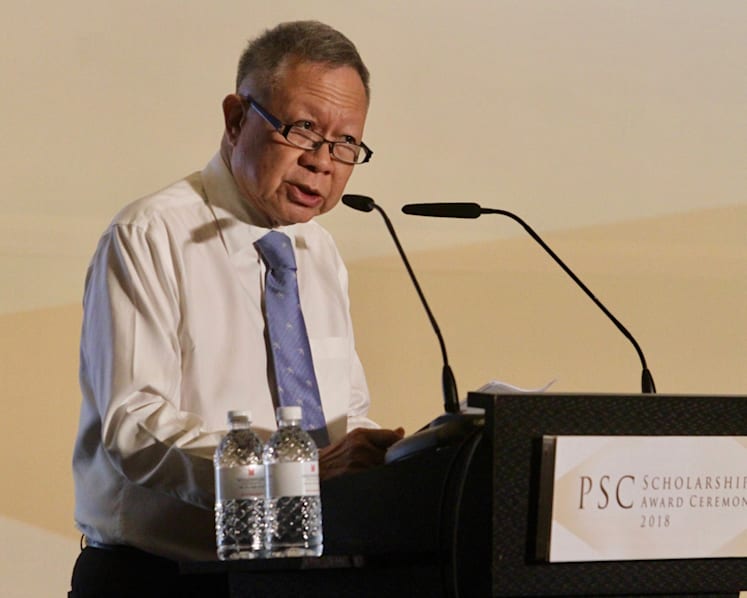
Chairman of the Public Service Commission (PSC) Eddie Teo gives a speech at the PSC Scholarship Ceremony 2018, on Wednesday (18th June).


SINGAPORE — Outgoing Public Service Commission (PSC) chairman Eddie Teo has urged public servants to be prepared to "speak truth to power" when they spot a wrong decision or policy.
Instead of blindly following orders, they should also question and challenge assumptions to seek the best possible solutions to problems, Mr Teo said in his opening address at the Public Service Commission Scholarships Award Ceremony on Wednesday (July 18).
The ceremony, held at the Grand Copthorne Waterfront Hotel, was attended by some 400 people, including the 93 scholarship recipients this year, their parents, teachers and principals.
A former President's Scholar, Mr Teo, 71, will retire at the end of this month after 48 years of public service. He will be succeeded by Mr Lee Tzu Yang, 63, deputy chairman of the PSC.





Having served 10 years as PSC's chairman, Mr Teo said that one of the joys of his job is to catch a glimpse of Singapore's future by listening to what the best and brightest students think about the country, what needs to be fixed and changed, and the role they hope to play.
"I come away hopeful and optimistic, because many of our best future public sector leaders show the courage to express their own views, even if they contradict current thinking and existing policies," he said.
Mr Teo also spoke about the importance of having diversity in the public service talent pool, so that the public servants may connect with Singaporeans from all walks of life and hold different points of view to tackle complex issues.
"To remain relevant and effective, the public service must challenge old assumptions, and be open to experimenting with novel ways of tackling difficult problems and delivering services to the people," he added.
PSC scholarships are awarded on merit regardless of candidates' backgrounds, Mr Teo said. There is a "multi-dimensional selection process" that looks at a person's qualities, and identify those who show the potential to take on leadership roles in the public service.
Seven scholarships were awarded to students who are from educational institutions including Anglo-Chinese Junior College, Pioneer Junior College, Saint Andrew's Junior College, and the Singapore Polytechnic. These schools are not part of the Integrated Programme (IP), where secondary school pupils skip the GCE O-Level examinations and work towards the A Levels and other higher certifications directly.
Others received the PSC scholarships despite their challenging family and personal circumstances.
Some scholarship holders have chosen "non-traditional countries" for their studies, such as Peking University in China and German universities, and Mr Teo hopes that their learning experiences will add to the diversity of views when they return to serve.
This year, the PSC gave out 22 awards under the PSC Scholarship (Engineering) scheme, three times more than last year. This scheme was introduced last year to strengthen the public service's talent pipelines in the engineering and technology sectors.
Mr Chan Chun Sing, Minister-in-charge of Public Service, reminded the scholarship holders that it was not just their hard work and intelligence that got them here today. "We are here because of the support given to us by our families and the opportunities given to us by society," he said.
It was also down to the values and system in Singapore, where "one will be able to succeed regardless of one's ancestry and one's personal connection", he added.
If the scholarship holders felt that the system provided them with such opportunities, Mr Chan urged them to challenge themselves and build an even better system, to "inspire generations of Singaporeans to continue to serve".
Like Mr Teo, he stressed the importance of having diversity within the public service leadership, noting that the PSC "spares no effort to continuously build diverse leadership teams for Singapore".
"Diversity comes with resilience. If we are uni-dimensional in our search for leadership potential, then we'll become fragile in our leadership capacity," Mr Chan said.




