







Reclaimed 'Long Island' will be about twice the size of Marina Bay, tripling length of existing East Coast waterfront: Desmond Lee
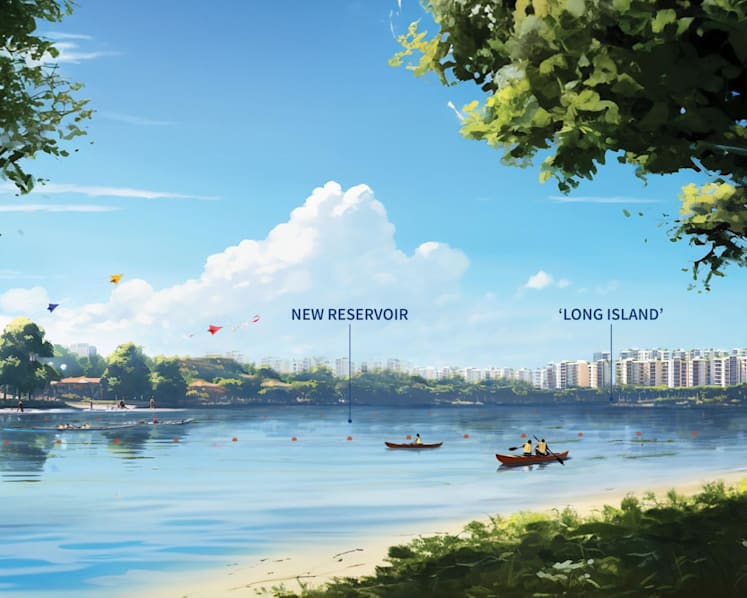
An artist’s impression shows a possible view from East Coast Park towards the upcoming Long Island.


SINGAPORE — The upcoming “Long Island”, to be reclaimed off Singapore’s eastern coast, will be about twice the size of Marina Bay, tripling the length of the existing East Coast Park waterfront.
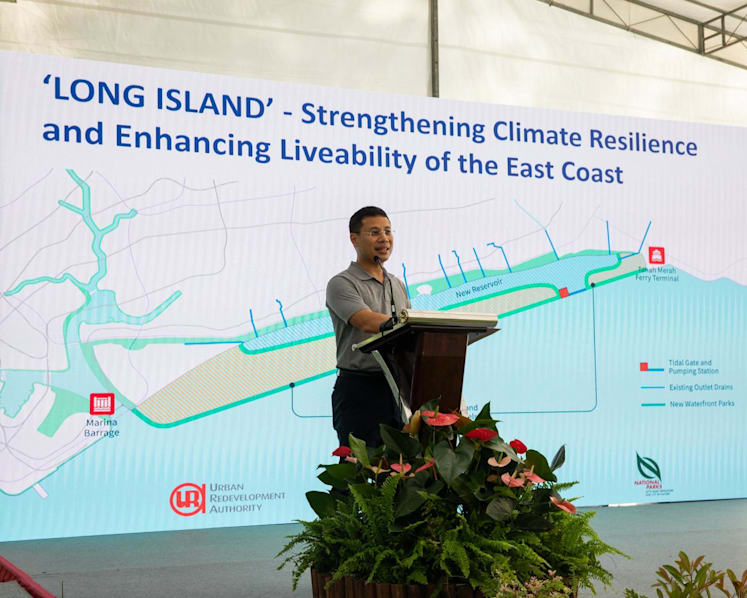
This was revealed by National Development Minister Desmond Lee on Tuesday (Nov 28), along with details on other potential features of the decades-long project.
Mr Lee was speaking to attendees including the media and stakeholders at a habitat enhancement event at East Coast Park.
The project was first raised by Prime Minister Lee Hsien Loong at the National Day Rally in 2019, and was showcased at an exhibition last year by the Urban Redevelopment Authority.





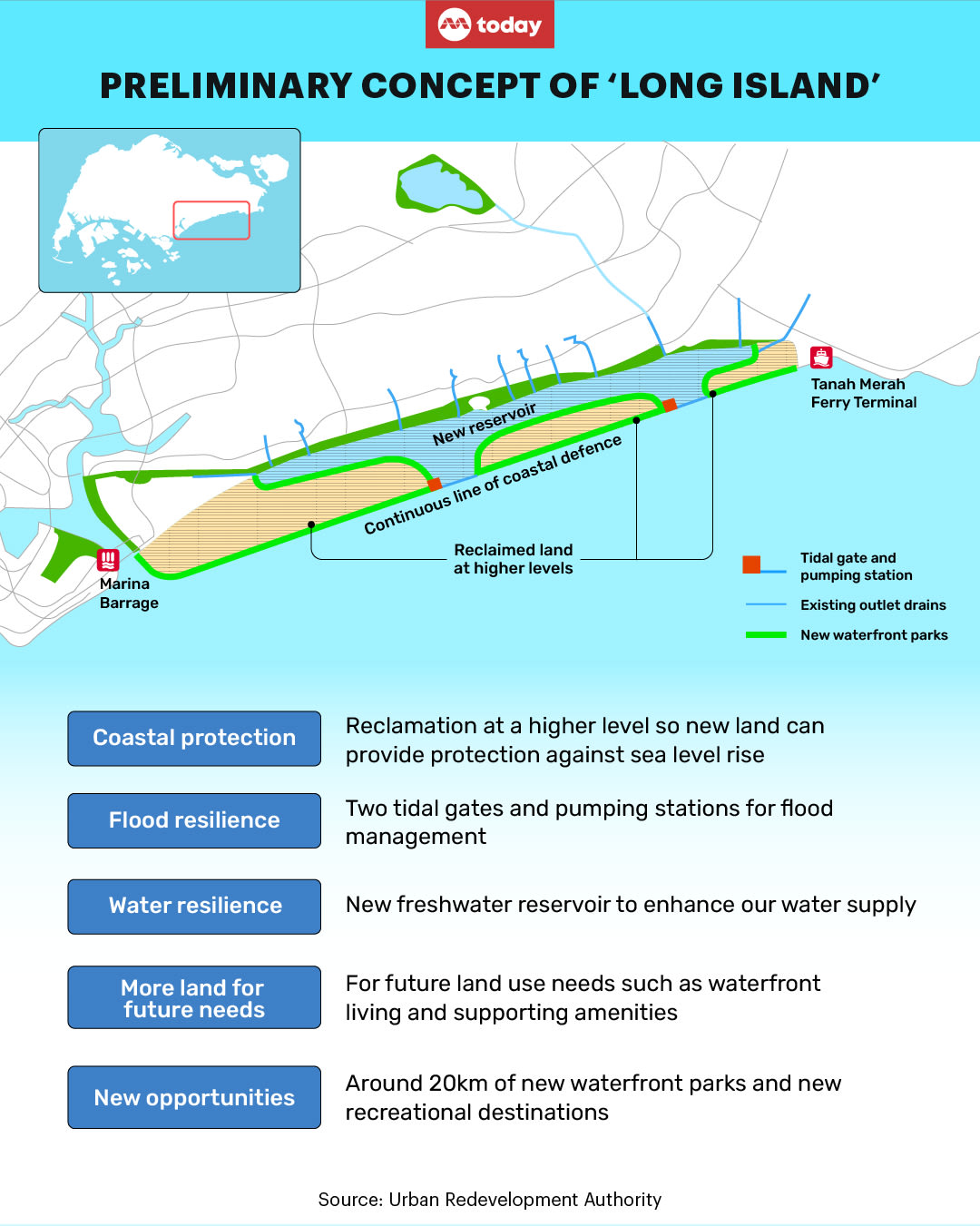
Providing an update on Tuesday, Mr Desmond Lee said that the project will involve reclaiming three new tracts of land at a higher level, and away from the current coastline.
This will “project coastal protection seawards”, allowing for the existing East Coast Park to largely be retained as it is, he added.
The reclaimed land will measure about 800ha, or twice the size of Marina Bay.
It will also create a new freshwater reservoir, which the public may use for water activities such as canoeing and dragon-boating.
Other features include two tidal gates and pumping stations to “keep the sea out”, and to pump out rainwater when heavy rain coincides with high tide. Such measures are necessary because rising sea levels pose an “existential threat” to low-lying Singapore, Mr Desmond Lee added.
The project will also add around 20km of new coastal and reservoir parks, extending from the current East Coast Park. This will triple the length of the existing waterfront area along the park.
Expected to take “decades” to implement, the planning for Long Island must begin now, so that it “can be realised in time to protect the area from rising sea levels”, Mr Desmond Lee said.
This includes conducting extensive environmental and engineering studies — to assess the feasibility of the “conceptual reclamation profile” — which will take about five years, while a public consultation is also held concurrently.
WHY IT MATTERS
As a low-lying island state, Singapore must contend with rising sea levels and the long-term impact of climate change, Mr Desmond Lee said.
Mean sea levels around Singapore are projected to rise by up to 1m by the end of the century. When high tides coincide with storm surges, sea levels could rise by up to 4m to 5m above mean sea level, he added.
“This is a very serious problem, because around one-third of our island is under 5m above mean sea level, and at risk of being inundated by the sea.”
In particular, the East Coast area faces a high risk of flooding since it is low-lying, and parts of East Coast Park were flooded for around two hours in January this year, he noted.
Therefore, coastal protection measures are needed to protect homes and livelihoods in the area.
Although protecting low-lying areas is important, the public had expressed the desire to retain unimpeded access to the waterfront, and for heritage and recreation spaces along the coast to be preserved, Mr Desmond Lee said.
This feedback was taken onboard in developing the latest concept for Long Island, he added.
'LONG WALL NOT IDEAL'
An alternative to Long Island that had been considered was a “Long Wall” — or a continuous seawall built along the entire East Coast waterfront, from Marina East to Tanah Merah.
It would measure up to 3m in height.
To provide coastal defence for that stretch of coastline, 12 tidal gates and pumping stations — instead of the two anticipated for Long Island — would also have to be built along each of the existing outlet drains at the park.
Such an option, while possible, is “not ideal” for the area, National Development Minister Desmond Lee said.
Doing so would mean large stretches of the park would have to be closed during the seawall’s construction.
Even after the construction is completed, the seawall would permanently limit park users’ access to the waterfront for recreation and sports.
The 12 tidal gates and pumping stations would take up significant space as well — around the size of 15 football fields — which would mean forfeiting existing greenery and recreational facilities at the park.
“In essence, this approach means that we implement coastal protection along the existing East Coast Park, but lose significant portions of the park and recreational use of the coastline,” Mr Lee said.
Long Island would thus be a “more optimal solution” because it integrates coastal protection measures with future reclamation plans for the area, he added.
WHAT’S NEXT
Long Island’s planning and implementation will take decades, beginning with technical studies that will take about five years, and a public consultation, Mr Desmond Lee said.
For a start, the Government will embark on “extensive environmental and engineering studies” to assess if the conceptual reclamation profile is feasible.
It will also begin to “formulate innovative and cost-effective nature-based solutions to reclaim and develop Long Island”, he added.
Concurrently, the authorities will engage residents and stakeholders — including businesses, the nature and heritage community, sports and recreational interest groups, and more — on their feedback and ideas for the reclaimed stretch.
After the technical studies are completed, the authorities will engage the public on Long Island’s “design and masterplanning”.
Ultimately, Long Island will hold “tremendous opportunities and possibilities for Singaporeans to come together, and lead the way in showing what can be done, and what can be possible in dealing with climate change and rising sea levels”, the minister said.
“As we protect our homes, our infrastructure, our livelihoods, and our cherished East Coast Park, we will collectively create new opportunities for quality living and recreation, for the benefit of Singaporeans today and for our future generations.”
To find out more about Long Island, visit go.gov.sg/Long-Island.




