







Researcher who solves navigation problems wins top defence award
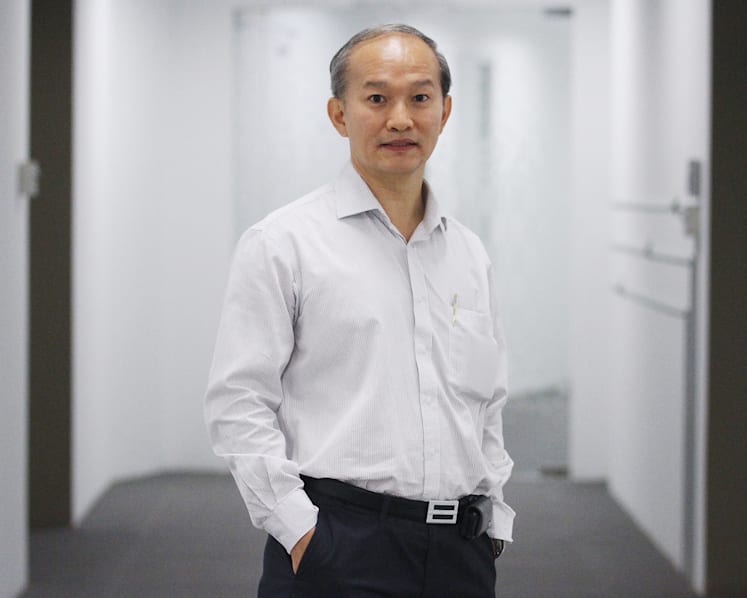
One area of Dr Poh’s work involves developing navigation solutions that are resilient to all types of disruptions. Photo: Daryl Kang
SINGAPORE — Two years ago, American investigators took two months to find the truck driver who had disrupted the air-traffic control system at Newark airport in New Jersey with his cheap, cigarette-pack-sized global positioning system (GPS) jammer. If they had used Dr Poh Eng Kee’s navigation solution, the culprit could have been identified in seconds.
Dr Poh, 54, a Distinguished Member of Technical Staff and laboratory head for guided systems at DSO National Laboratories, has devoted 30 years of his life into the research of navigation problems. One of the main areas of his work involves developing navigation solutions that are resilient to all types of disruptions.
For his efforts, Dr Poh has been named one of the six winners of this year’s prestigious Defence Technology Prize, which is given by the Ministry of Defence to those who have contributed to the strengthening of Singapore’s defence. The six, comprising four individuals and two teams, received their awards from Defence Minister Ng Eng Hen yesterday.
In an interview on Tuesday, Dr Poh, who won the award in the research and development individual category, said: “GPS is very ubiquitous, we have it in our mobile phones. However, the GPS signal is very weak, so it makes it very susceptible to interference ...





“... In battlefields and hostile environments, the enemies will try to interfere with the GPS operations and if they are successful, it will cripple or slow down our operations.”
Referring to the Newark airport incident, Dr Poh noted that the anti-jamming solution developed by his team can not only defend an area against interferences, such as those caused by a jammer, but also locate the source of the interference.
“It would have taken us only seconds, instead of two months, to catch him (the truck driver),” he said.
Apart from developing cheaper materials for navigation solutions, Dr Poh and his team are exploring ways to strengthen signal-tracking algorithms to improve the sensitivity of the navigation system’s receiver.
In his speech at the awards ceremony, which was held at The Chevrons country club at Boon Lay Way, Dr Ng said: “Increasingly, we will need to leverage our scientific and technological expertise to address threats, whether it is terrorism, biological pandemics and cyber-security.
“And we will continue to invest in technologies such as satellites and sensors that help us see farther and quicker, in analytics and robotic systems that can respond autonomously, or with few men in the loop. Because it is with these capabilities that the SAF will stay sharp and strong as an effective fighting force, even if we have fewer people,” he added.




