







Review on giving young offenders ‘best shot in life’ to start in next few months
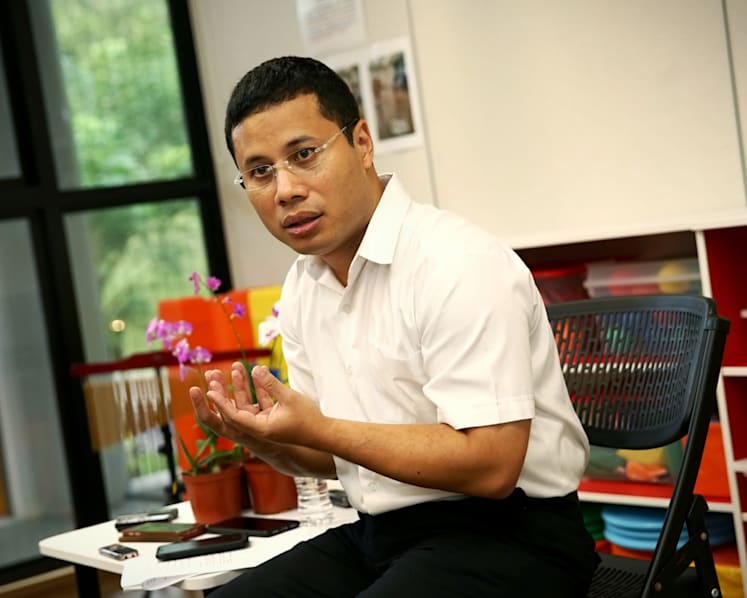
Minister for Social and Family Development Mr Desmond Lee at the PCF Sparkletots @ Marsiling on Jan 2, 2018. Photo: Nuria Ling/TODAY


SINGAPORE — The Social and Family Development, Home Affairs, and Education ministries will be jointly forming a committee to look at how to better steer youths away from crime, so that those at risk of committing offences or who are repeat offenders will still have "the best shot in life".
Mr Desmond Lee, who recently took over the Ministry of Social and Family Development (MSF), announced the move on Tuesday (Jan 2) as he laid out his ministry's focus for 2018 to the press, noting that youth offending rates are "still higher than we like it to be", while reoffending rates also "continue to be high".
Called the Committee on Prevention, Rehabilitation and Recidivism, it will be set up in the next few months to "make sure that we marshall all the resources of the Government, of the community, and, of course, families, to make sure that they have the best shot in life even though they may have been youths-at-risk or youth offenders", he added.
"Our recidivism rates across the board are better than any other societies', but every one (person) who gets into trouble is one life, one opportunity wasted, so we need to knuckle down and see how we can continue to drive the numbers down," said Mr Lee.





"Because it's not just a percentage, these are lives. We shouldn't rest on our laurels and say, 'Our recidivism rates are fairly low, so let's let it be'," he added.
Latest statistics available on the MSF website, as of April 2016, showed that 16.7 per cent of juvenile offenders — children older than 7 and younger than 16 — committed an offence within three years, the second lowest proportion of six most recent cohorts. The lowest was 16.6 per cent, for cases closed in 2008, while the highest was 20.3 per cent, for cases closed in 2007.
Separately, the recidivism rate of youths up to the age of 21 who have gone through rehabilitation programmes under MSF fell from 13.8 per cent in 2010 to 10.7 per cent in 2012, a ministry spokesperson said. The recidivism rate calculates the proportion of offenders who commit fresh offences within three years after completing MSF's rehabilitation programmes.
A study on social services for youth-at-risk conducted in 2012 showed that 81 agencies that provide programmes for this group served about 70,000 clients a year, the spokesperson added.
Mr Lee said the new committee will build on the work of the National Committee on Youth Guidance and Rehabilitation, which was set up more than two decades ago to bring together self-help groups and Voluntary Welfare Organisations (VWOs) that are involved in youth work to better support youths-at-risk, and youths in institutions.
"I think the way forward is better coordination and integration so that (we can) do more preventive work upstream when youth offenders are in the system ... that we intervene with a more rehabilitative stance and after they have completed their probation (or) sentence that VWOs, community and other government agencies provide better wrap-around to support them and more importantly to work through their family difficulties that might be a negative influence on them," he added.
Mr Lee said his interest in tackling recidivism rates partly derived from his work previously as Second Home Affairs Minister.
He saw that keeping a young person from relapsing into drug abuse after being released from an institution requires intervention from many angles, such as to mitigate the influence from a poor environment at home.
"Within the institution, they are cared for, they are kind of in a sterile condition, they are provided support, they go through programmes, and once they come out, there's mandatory after-care, there's halfway house, there's a lot of care and support, but eventually, the state has to let go its hand. It cannot intervene in a mandatory way in an individual's life for excessively long," said Mr Lee.
"But once you see that a person returns to a negative environment, friends, faces difficulties, he or she may relapse to drugs or drug-related offences."
This is where MSF and its partner agencies — family service centres and VWOs — can come in to provide that "scaffolding" outside of an institution, Mr Lee noted.
Noting that youths respond to the trust built with their social workers, Mr Lee also announced that the ministry will appoint nine integrated service providers in April to provide a suite of programmes which “wraps around a youth. This will enable young persons to move from one programme to another seamlessly, interacting with a familiar face in a familiar setting, instead of requiring the individuals to move “from place to place, service to service, with the pendent disruptions”. More information on the providers will be made available on Jan 18.
PROTECTING CHILDREN OF BROKEN MARRIAGES
Commenting on the newly-started review of the family justice system to make divorces less adverserial and more child-centric, Mr Lee said that with nearly two-thirds, or about 4,000 out of 6,300 divorces every year, being contested, feuds over child custody and child support are not uncommon.
In these contested divorces, "harmful, hateful words are exchanged with each other (in court) and the children sometimes get caught in between, get used, get brainwashed, get used as pawns against the other side", said Mr Lee.
Even after divorce, "you see long-drawn maintenance fights, custodial fights — whether the child was sent to me late, sent to me with bruise marks — and often the children get caught up in the middle", Mr Lee added.
The committee, which also comprises the Ministry of Law and Family Justice Courts, was announced in Parliament in November last year.
Mr Lee said it aims to come up with "an approach that is more therapeutic and more restorative", such as by helping couples resolve their differences outside of court as much as possible.
"We hope that through this, fewer children will have to go through the trauma of a long-term acrimonious parental relationship, because even though couples are divorced, many of them are still responsible for the upbringing of their children," he added.




