







Ride globalisation wave to move S’pore forward: PM
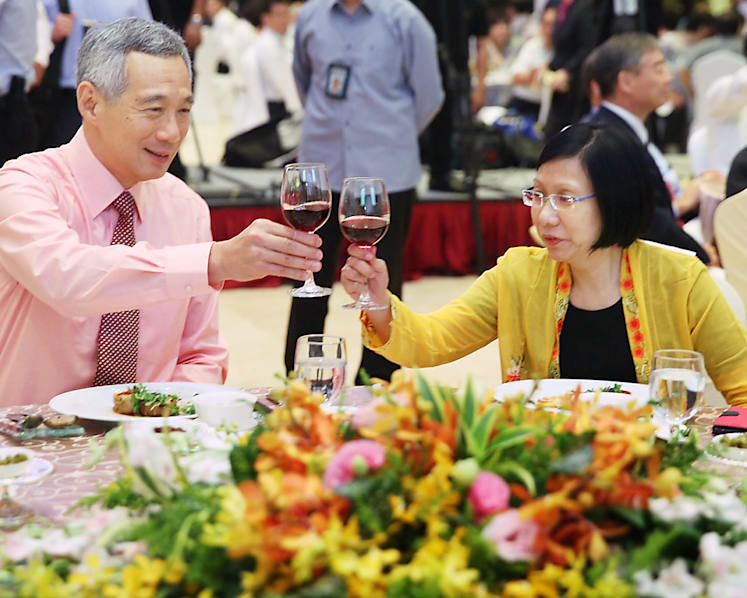
Mr Lee called on delegates to give the new union leadership a strong mandate, while paying tribute to the contributions of outgoing leaders such as NTUC president Diana Chia (right). Photo: Don Wong/TODAY


SINGAPORE — Amid headwinds in the global economy and competition from developing countries as well as advanced economies, the way forward for Singapore is to ride the wave of globalisation and use the power of free markets, said Prime Minister Lee Hsien Loong today (Oct 26).
Speaking at the Labour Movement’s National Delegates’ Conference opening dinner tonight, PM Lee said governments cannot create wealth by themselves while centrally planned economies cannot compete against free markets and open competition. Only a market-based system is efficient and nimble enough to deliver growth, even while the state mitigates any negative effects of such a system, he added.
Giving examples of the effects of globalisation and technology in his speech, Mr Lee said the fortunes of countries and economies have become more interdependent and workers everywhere are facing competition from all sides, including from technology.
The disruption these cause to economies is most keenly felt in Singapore because of its size and open economy but despite the anxieties and insecurities workers are facing from downward pressures on wages or jobs becoming obsolete, Singapore cannot resist globalisation or hold back the progress of technology, or its economy will stagnate and workers will become uncompetitive, said Mr Lee.





Cyclical headwinds at present include a soft United States economy, a stagnant Europe and a China that is slowing down, he added.
Noting that Singapore’s own exports are flat and gross domestic product in the third quarter grew only 1.4 per cent on-year, Mr Lee warned: “So we have to be prepared for a slowdown, possibly a downturn.”
While Singapore is today a developed economy, but “the truth is we have not solved for all time the problem of how to make a living for ourselves” and have to keep looking for new solutions, he said.
The Singapore government is doing its part by upgrading the economy so that businesses and workers stay competitive, said Mr Lee. Finance Minister Heng Swee Keat is leading a committee on the future economy, to review Singapore’s economic strategies.
The broad direction to grow the economy by improving productivity in order to sustain higher wages and improve workers’ lives is not in doubt. But specific measures need to be reviewed, such as how to grow domestic sectors, how to attract investments and help companies develop new markets, and how to make the best use of foreign workers and talents.
Port operator PSA is, for instance, using robots to create new opportunities for workers. It is now using automated rail-mounted gantry cranes to load and unload containers, instead of operator-operated cranes. This means one supervisor oversees three to four cranes, enabling the port to handle more volume with the same number of workers.
Mr Lee said that in the changing environment, tripartisim remains the right formula for Singapore, and Singapore must maintain the trust that has been built into the next generation of tripartite partners. The National Trades Union Congress will elect a new central committee on Thursday at the delegates’ conference held once every four years. Mr Lee called on delegates to give the new union leadership a strong mandate, while paying tribute to the contributions of outgoing leaders like NTUC President Diana Chia.
The Government has helped displaced workers find new jobs, and helped others acquire more skills, said Mr Lee. It has strengthened safety nets, rolling out the Progressive Wage Model and the MediShield Life universal medical insurance scheme, he added. It is also implementing the Silver Support scheme to provide assurance for Singaporeans in the retirement years.
“If I list all the challenges it sounds like a lot to do, and challenging, daunting. But if we compare ourselves to other countries, Singapore is well-placed to tackle these problems and I think we can look forward to our future with confidence,” said Mr Lee, pointing to a well-educated people, an outward-looking ethos, a tech-savvy society and “good unions” that will help to accomplish what needs to be done.
About 1,100 unionists and tripartite partners, as well as international guests such as International Labour Organisation director-general Guy Ryder attended the dinner — catered by NTUC Foodfare — at Orchid Country Club.




