







Robot cures human headache: Putting together Ikea furniture
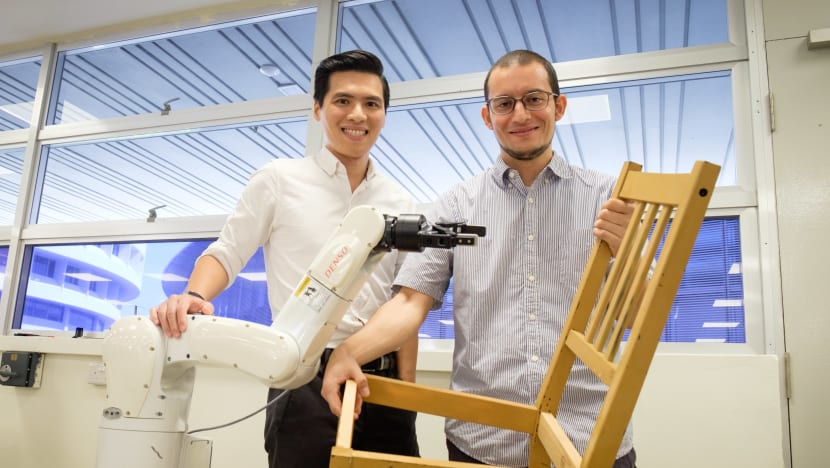
NTU Singapore scientists have developed a robot that can autonomously assemble IKEA’s Stefan chair. From left: NTU’s Assistant Professor Pham Quang Cuong and research fellow Dr Francisco Suárez-Ruiz
SINGAPORE — Robots have taken our jobs, learned our chores and beaten us at our own games.
Now researchers in Singapore say they have trained one to perform another task known to confound humans: figuring out how to assemble Ikea furniture.
A team from Nanyang Technological University (NTU) programmed a robot to create and execute a plan to piece together most of Ikea's US$25 (S$32.76) solid-pine Stefan chair on its own, calling on a medley of human skills to do so. The researchers explained their work in a study published on Wednesday (April 18) in the journal Science Robotics.
"If you think about it, it requires perception, it requires you to plan a motion, it requires control between the robot and the environment, it requires transporting an object with two arms simultaneously," said Dr Quang-Cuong Pham, an assistant professor of engineering at the university and one of the paper's authors.





He and the others who worked on the study, his NTU colleagues Francisco Surez-Ruiz and Xian Zhou, are not alone.
In recent years, a handful of others have set out to teach robots to assemble Ikea furniture, a task that can mimic the manipulations robots can or may someday perform on factory floors and that involves a brand many know all too well.
"It's something that almost everybody is familiar with and almost everybody hates doing," said Dr Ross A Knepper, an assistant professor of computer science at Cornell University, whose research focuses on human-robot interaction.
Chairs, with backs, stretchers and other parts, pose a complex challenge; hence the interest of the NTU researchers.
Their robot was made of custom software, a three-dimensional camera, two robotic arms, grippers and force detectors. The team chose only off-the-shelf tools, in order to mirror human biology.
Like humans, the robot had a little help to start: It was fed a kind of manual, a set of ordered instructions on how the pieces fit together. After that, though, it was on its own.
The robot proceeded in three broad phases, spread out over 20 minutes 19 seconds.
First, like humans, it took some time to stare at the pieces scattered before it.
The robot spent a few seconds photographing the scene and matching each part to the one modelled in its "manual."
Then, over more than 11 minutes, the robot devised a plan that would allow it to quickly assemble the chair without its arms knocking into each other or into the various parts.
Finally, it put the plan in motion over the course of nearly nine minutes. The robot used grippers to pick up the wooden pins from a tray and force sensors at its "wrists" to detect when the pins, searching in a spiral pattern, finally slid into their holes. Working in unison, the arms then pressed the sides of the chair frame together.
Of course, the robot did not succeed right away. There were several failed attempts along the way and researchers tweaked the system before the robot was finally able to assemble the chair on its own.
The accomplishment was the culmination of three years of work, but the team is eager to see what else it can automate, Dr Pham said. THE NEW YORK TIMES




