







Robots, augmented reality among ideas to transform retail industry
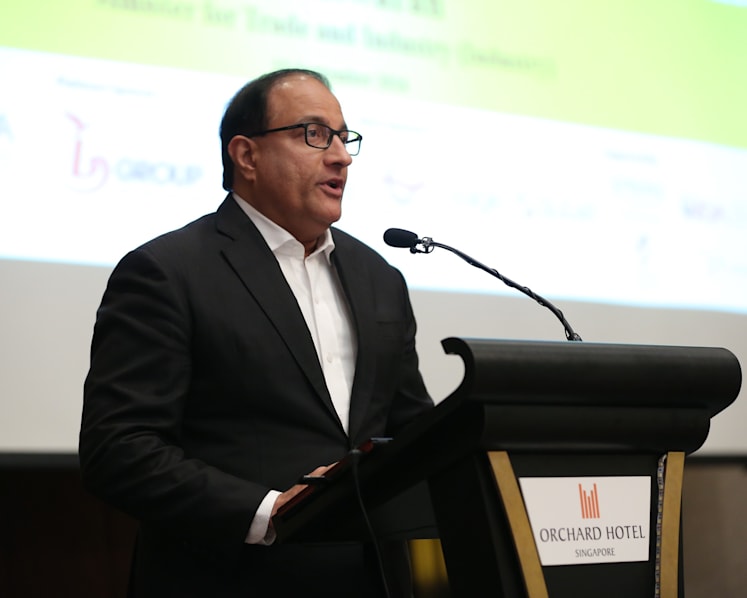
Minister for Trade & Industry (Industry) S Iswaran. Photo: Singapore Productivity Centre
SINGAPORE — Cashier-less shops, humanoid assistants and augmented reality. These are some of the technological advances retail shops in Singapore can consider embracing to combat the multiple challenges they face, such as manpower constraints and rising competition from e-commerce players, Mr S Iswaran, Minister for Trade & Industry (Industry) said on Thursday (Sept 15).
“The retail industry transformation map (ITM) envisions a pathway towards a vibrant future for our retail industry. It is not just about overcoming challenges but also how we can seize the exciting opportunities that lie ahead. It is an effort that requires the collective will and effort of all stakeholders — industry, workers, unions and the Government — in order to succeed,” Mr Iswaran said as he announced the launch of the retail ITM at the Singapore Retail Industry Conference.
Developed by enterprise development agency Spring Singapore in partnership with trade associations, unions, and the industry, it is the second ITM after the launch of the Food Services ITM by Deputy Prime Minister Tharman Shanmugaratnam last week.
The 2020 vision for the retail ITM is for Singapore to have an industry comprising a mix of highly productive omni-channel retailers and local brand owners with global footprints, supported by a professional and skilled workforce, Mr Iswaran said.





Innovation-led growth, productivity improvement with technology, building a future-ready and productive workforce and helping Singapore retailers internationalise are the four key strategies identified in transforming the retail industry. Spring Singapore, he said, will bring together a multi-agency team within the Government, which will work with tripartite partners to implement the ITM.
“Our goal is for the retail industry to achieve an average annual productivity growth rate of 1 per cent from now till 2020 without increasing the sector’s overall reliance on manpower … This will call for aggressive deployment of manpower-saving technologies at the store-front and back-end,” Mr Iswaran said, pointing to examples including radio frequency identification for inventory management, automated retail services and cashier-less stores.
These solutions, he said, have been widely implemented in Europe, Japan and the United States with proven manpower savings. Through Spring’s Automation Support Package, the target is for 50 per cent of large retailers to adopt these established technologies locally by 2020.
“Our retailers should also be bold in piloting emerging technologies which have been experimented with elsewhere. For example, Ikea has launched an application with augmented-reality features in selected countries, which allows customers to virtually place and view some 400 products in their own homes … Humanoid assistants are another example. Earlier this year, Softbank, the third-largest public company in Japan, launched Pepper, a smart, friendly, unintimidating robot that helps customers wanting to buy a mobile phone,” Mr Iswaran said.
The Republic also aims to grow the e-commerce share of total retail receipts from the current 3 per cent to 10 per cent by 2020, with Spring and the Infocomm Development Authority of Singapore helping small- and medium-sized enterprises (SMEs) with e-commerce under the Enhanced iSprint programme. More than 500 SME retailers are expected to benefit from the programme, which identifies online platforms that the SMEs can use, by the end of next year, Mr Iswaran said.




