







Singapore’s military completes first solar farm at Sembawang Air Base
The military also set its sights on a higher clean energy target, with Defence Minister Chan Chun Sing calling the solar farm a “proof of concept” that may follow in other air bases.
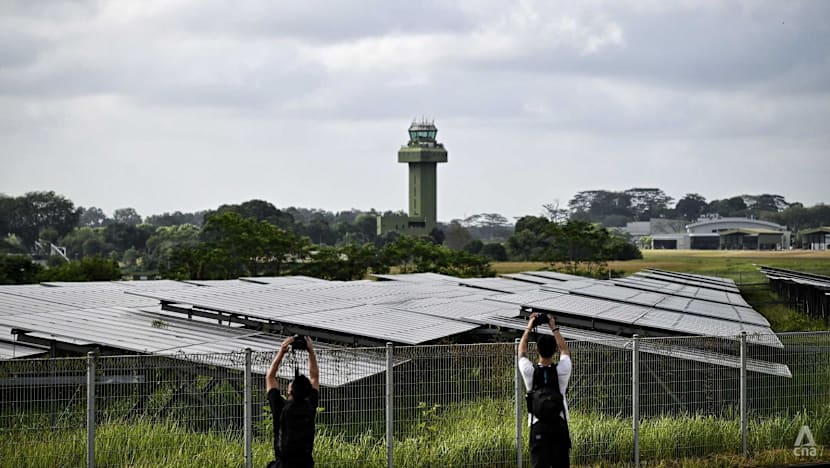
Photographers take photos of a solar panel farm situated on a field in Sembawang Air Base with the control tower in the background, Jan 30, 2026. (Photo: CNA/Wallace Woon)

This audio is generated by an AI tool.


SINGAPORE: The first solar farm in a military base in Singapore was launched at Sembawang Air Base on Friday (Jan 30).
Its completion in December brought the Ministry of Defence (MINDEF) and Singapore Armed Forces (SAF) to their solar output target of 50 megawatt-peak (MWp), announced in 2021.
On Friday, a new target of 68 MWp by the end of next year was revealed.
Launching the Sembawang Air Base solar farm, Defence Minister Chan Chun Sing said it was part of the larger national drive to strengthen energy resilience.
“It is also a proof of concept for a larger issue, which is that if we can overcome some of the safety, security and technical challenges to install solar panels in places or parts of the airfield, then potentially this concept can also be enlarged to other airfields or air bases,” said Mr Chan.
“It does not mean that we can do this for each and every one because each and every air base will have its own unique requirements and operational challenges, but to be able to start off with Sembawang Air Base is something of an achievement.”
Noting that there are detractors who say Singapore would not be able to meet a percentage of its energy use even after covering the entire country with solar panels, he emphasised that “there is also another way to look at it”.
“Every bit that we can do to diversify our energy needs; every bit that we can do to strengthen our energy needs, every bit counts, and that is what we are determined to do,” he said.
AIRFIELD CHALLENGES
Mr Chan shared that the idea had emerged “a few years back”, even before he took on his current portfolio, when the government was looking at ways to generate more energy and reduce reliance on fossil fuels.
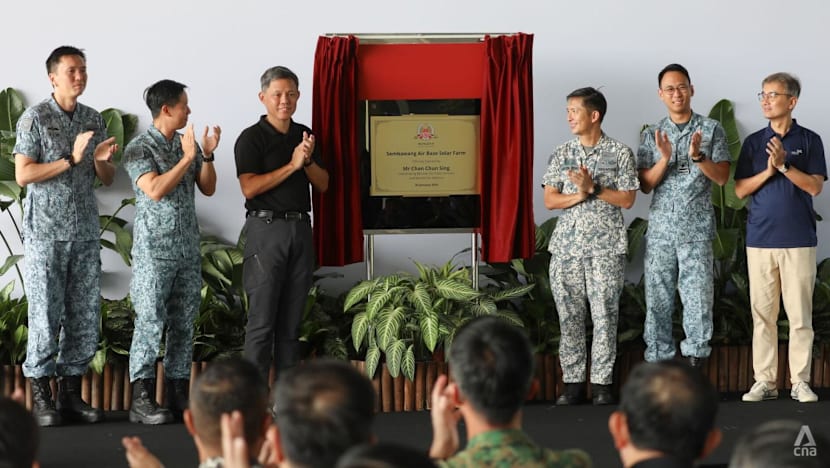
Besides roads and cemeteries, airfields were suggested locations to place solar panels, said Mr Chan.
“It was not an easy challenge because, coming from a military background, I know that installing solar panels in an airfield has its own risks and limitations,” said Mr Chan, who was Chief of Army before his political career.
This included safety requirements and technical challenges, such as light reflection from the panels affecting the pilots.
For such a land-based solar project, analysis was needed to ensure aviation safety for pilots, said Senior Lieutenant Colonel Koh Tong Choon Timothy, head of plans and strategy at the SAF Sustainability Office.
A glare analysis was done to determine the best place to install the panels, in terms of height, direction and tilt angle.
The panels were then deliberately placed, tilting away from operational areas, to avoid glare to pilots, said SLTC Koh.
“Because it's situated in the air base, we need to account for the helicopter downwash,” he added.
Sembawang Air Base is home to all of the Republic of Singapore Air Force’s helicopter squadrons.
The solar farm’s infrastructure needed to be stronger, with supporting pillars installed about 20 per cent deeper than usual, said SLTC Koh.
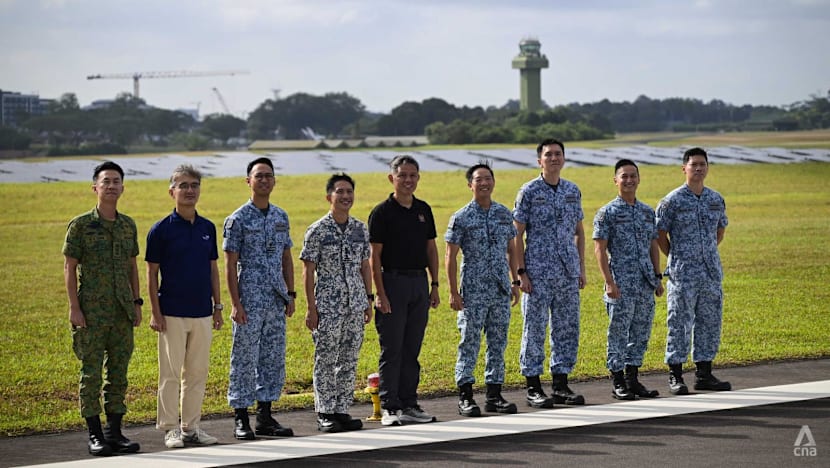
The new solar farm forms three-quarters of Sembawang Air Base’s targeted solar output of 18 MWp by the end of this year – enough energy to power around 4,700 four-room HDB flats annually.
The remainder will be fulfilled by rooftop solar panels.
Overall, the solar infrastructure will offset the base’s energy demands, saving potentially S$1.9 million (US$1.5 million) in costs per year.
OTHER INNOVATIONS
Mr Chan also said that moving forward, the SAF needs to design its new systems to minimise the need for energy.
It must also look at how to best manage the distribution of energy across the entire SAF’s operating systems and how to store energy for operational purposes, he added.
“Climate change also impacts the SAF in our operations and training, and for the SAF, we must learn to operate in this new environment,” said Mr Chan.
Sembawang Air Base, for instance, has to deal with more days with unpredictable weather, he said.
On the training front, the SAF needs to be acclimatised to new weather patterns, with hotter days and more unpredictable temperature changes, said Mr Chan.
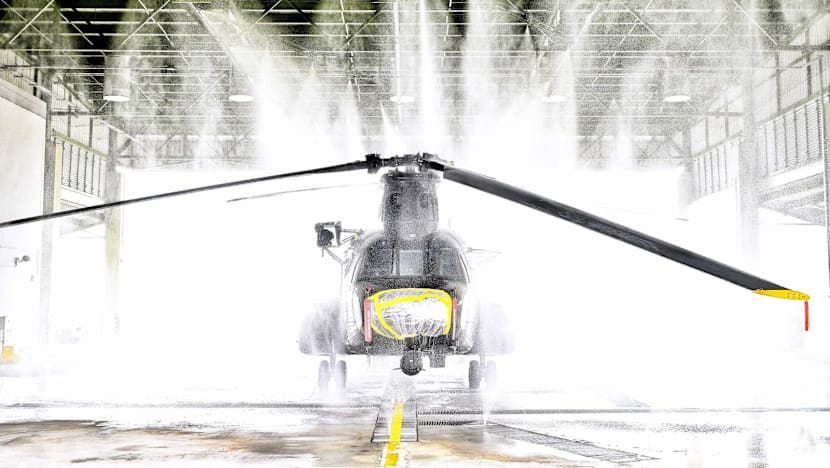
On Friday, Mr Chan also received briefings on the progress of other sustainability initiatives by MINDEF and the SAF, including the use of eco-asphalt for runway repair training and an automated wash shed for Chinook helicopters.
Air Force engineer ME1 Ng Jing Wei said the previous wash shed required a five-person team to clean each helicopter manually.
“The new automated wash shed enables a single operator to efficiently manage the whole aircraft wash, which reduces 80 per cent of the manpower requirement,” she said, adding that it reduces the time taken from five to three hours.
It also leads to 60 per cent in water savings by incorporating water treatment and recycling technology, while solar light tubes and energy-efficient LED lighting halve the energy consumption for lighting, she added.




