SGH's healthcare facilities to triple in size, will move closer to public transport nodes
The Singapore General Hospital (SGH) campus will undergo a major overhaul spanning two decades, where its healthcare facilities are set to expand by about three times. Photo: SGH
SINGAPORE — The Singapore General Hospital (SGH) campus will undergo a major overhaul spanning two decades, where its healthcare facilities are set to expand by about three times.
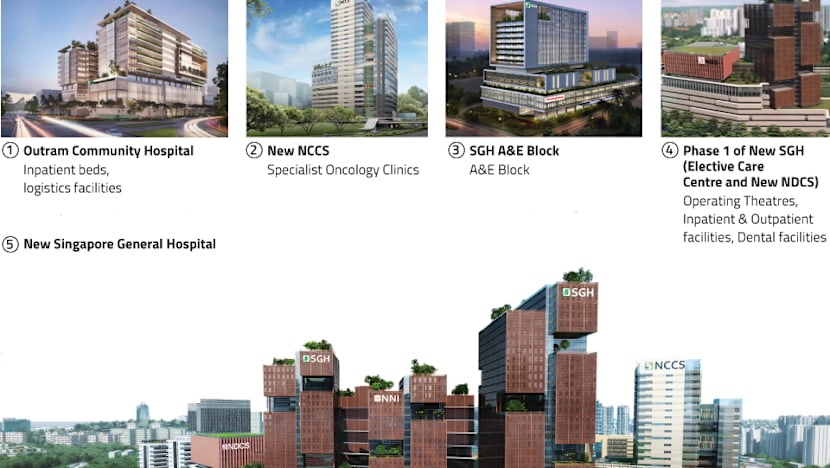
The current Accident & Emergency (A&E) facility will be replaced by a larger block with more facilities by 2026 at its interim site. It will eventually join the new SGH hospital complex in the subsequent 10 years, where the entire hospital will move closer to public transport nodes along Eu Tong Sen Street.
Among the other changes expected within the next 10 years include a new National Cancer Centre Singapore building, an SGH Elective Care Centre that will also house the National Dental Centre Singapore, and the Outram Community Hospital.
Revealing its plans in a media briefing on Tuesday, SingHealth’s Group Chief Executive Officer Professor Ivy Ng said the campus redevelopment will not just expand spaces for healthcare facilities, but also provide the opportunity to “evolve the space to meet (current and future) healthcare challenges”.
“What we are moving towards are new models of care, so it really isn’t keeping what we have and tripling it exactly in that way,” she said. “For the ordinary Singaporean, it means better access to high-quality care in a single location.”
The first model SingHealth will be developing is the Regional Health System to provide seamless care from the hospital to community and home for residents in southern Singapore.
The second model will look at providing integrated care by bringing together different specialities, as was done for diabetic patients, for example, who can be treated for a variety of conditions within a single Diabetes and Metabolism Centre, added Prof Ng.
With the number of patients coming through the A&E more than doubling since it was first built in 1977, Prof Ng said its expansion is “timely”, with more facilities such as resuscitation bays, consultation rooms and observation beds to be added.
“And it will also help us to prepare for national outbreaks of disease, as well as more decontamination facilities as and when we need them,” she added.
When completed, the redevelopment will see the healthcare zone take up 60 per cent of the 43-ha campus, with the education zone anchored by the Duke-NUS Medical School and research zone marked for commercial use.
When asked if there will be an increased bed count, Prof Ng noted that with more community hospitals, patients no longer needing acute care can be transferred to such hospitals, which will allow more focused use of hospital beds at SGH.
The Outram Community Hospital, which is slated to open by 2020, will add 550 beds on the SGH campus.
The community hospital will be connected to the existing SGH building by a link bridge for patients to be easily transferred between the two, and have access to coordinated specialist and rehabilitation care.
Pedestrian and traffic flow across the whole campus will also be improved with a separate pedestrian concourse, which will also be directly accessible from nearby train stations.
With the hospital continuing to serve patients amid redevelopment plans, Prof Ng assured that minimising disruption to patients will be a priority. Issues such as dust and noise will be closely monitored, and construction sites will have clear hoarding, she added.
Road networks in the campus will be expanded with a more direct route cutting across the campus from Jalan Bukit Merah to Outram Road, and lead to drop-off porches at the different buildings.
Where emergency vehicles currently have to ply through the campus’ internal roads to get to the existing SGH building, the new hospital complex will allow these vehicles to “come into the A&E as quickly as possible” through external roads like Eu Tong Sen Street, said Mr Philip Heng, SingHealth’s director of SGH Campus Developing (Planning).
On improving the carpark situation, Prof Ng said: “The plan is to create more integrated carparks within the campus. As we relocate our healthcare facilities closer to main transport nodes, patients and visitors will find that it’s easier to commute from the MRT stations to the new hospital complex. We hope to encourage more to take public transport.”
(Click to enlarge)
Source: TODAY
Sign up for our newsletters
Get our pick of top stories and thought-provoking articles in your inbox