







Shared conviction, unity of citizens ‘key to Singapore’s future’
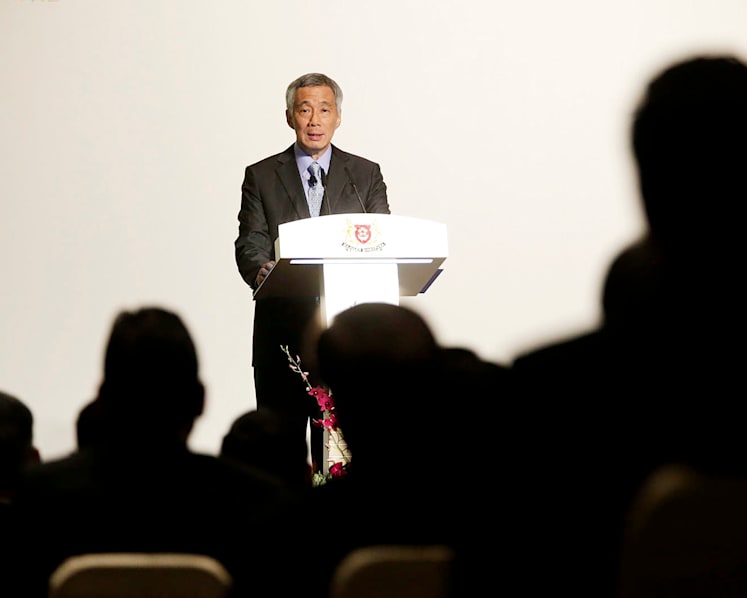
PM Lee Hsien Loong speaking at the S Rajaratnam Lecture 2015 on Nov 27. Photo: Wee Teck Hian


SINGAPORE — For Singapore to continue its domestic success and exert international influence far beyond its physical size, individual citizens must hold a shared conviction that the country will endure and prevail, Prime Minister Lee Hsien Loong said today (Nov 27).
Speaking at the 8th annual S Rajaratnam lecture — named after Singapore’s former Deputy Prime Minister and Foreign Affairs Minister — Mr Lee detailed the Republic’s foreign policy considerations and underlined its vulnerabilities as a small nation in an uncertain, volatile world.
Addressing about 800 diplomats, students and academics at the Raffles City Convention Centre, Mr Lee said: “We must be determined that we want to be Singaporean, to stand up in the world, to be a shining red dot ... Others (outside Singapore) are watching us too.”
Citing a Chinese phrase, Mr Lee noted that “small states have no foreign policy”. “They cannot shape events, but have to take the world as they find it,” said Mr Lee. He also brought up Thucydides’ History of the Peloponnesian War as a Western equivalent. Athens was the hegemon of the Delian League, one of two superpowers in the Greek world, Mr Lee said. Athens wanted to force Melos, a weak island state, to join the League. “The Athenians invaded Melos, and sent envoys to persuade the Melians to submit and pay tribute, or be destroyed,” said Mr Lee, who titled his 45-minute speech Choice and Conviction - The Foreign Policy of a Little Red Dot.





The Melians put up practical and moral arguments why Athens should not attack them. “The Athenians gave this brutal answer: The strong do what they will and the weak suffer what they must’,” Mr Lee added.
Melos was subsequently wiped out. While this happened 2,400 years ago, Mr Lee said such a situation “would not be completely unfamiliar in the modern world”. “Look at what happened when Iraq invaded Kuwait and Russia annexed Crimea,” he said.
To advance its national interests, Singapore must be a constructive player in the international arena and make common cause with its neighbours and other countries, especially other small states. “Individually, our voices may be small. But collectively, our voices are amplified,” he said, citing the United Nations’ Forum of Small States and the Global Governance Group - both of which the Republic is member of - as examples of platforms where small countries can discuss their positions on various issues. “We have to have the nimbleness during these conferences, to influence discussions where we can, and where it is important to us,” he said.
Amid uncertain times, it is also key to anticipate developments so that Singapore is positioned to protect its interests, whichever way events may head, he said.
He added that the Republic must also bring constructive ideas to international fora, citing its role in the negotiations centred on the UN Convention on the Law of the Sea, which was established in 1982.
The Trans-Pacific Partnership (TPP) was another significant outcome that originated as a “small initiative” among four small countries: Brunei, Chile New Zealand, and Singapore, he said. It has since become a grouping of 12 countries - comprising 40 per cent of global Gross Domestic Product - including the United States and Japan.
Closer to home, Singapore must sustain good relations with its neighbours in Southeast Asia, such as by working with ASEAN partners to make ASEAN an effective and credible player in multilateral forums. But Mr Lee noted that ASEAN diplomacy also involves managing friction, such as what the Republic is doing on the South China Sea dispute. Singapore is not a claimant state, but it has important interests at stake, he said.
Adding that Singapore also undertakes a coordinating role for ASEAN-China Dialogue Relations, Mr Lee said: “We aim to be an honest broker, dealing fairly and openly with all parties, so that we not only preserve peace and stability in the region, but establish our reputation as a reliable country.”
In particular, the Republic has “complex and intense” relations with its closest neighbours Malaysia and Indonesia, which are also its largest economic partners, said Mr Lee. “Problems will inevitably arise every now and then. When they do, we aim to resolve them passionately without affecting our wider relationship or raising the temperature,” he said, pointing to how its dispute with Malaysia over Pedra Branca was referred to the International court of Justice in 2003.
Mr Lee stressed that a successful foreign policy hinges on Singapore’s success as a country. Diplomacy has to be backed by actions and outcomes, he said. “The diplomats may be brilliant, they can make eloquent speeches at the UN. Often they do. But if the country is in a mess, nobody will take them seriously.”
Mr Lee emphasised that Singapore must never let its success “go to our heads”. “We must never believe that we are superior to others or that we know better than others how to solve their problems...Other countries have strengths that we lack...their circumstances are different. Just as others hope to learn something from us, we too must always be eager to learn (from them).”
Stressing the need to stay united as a people across political and racial lines, Mr Lee said that ultimately, Singapore’s external influence and domestic success boil down to individuals.
Citing Mr Rajaratnam’s famous quote that “being Singaporean is a matter not of ancestry, but it choice and conviction”, Mr Lee said: “If we have that conviction, then others will follow. We will be one united people, we can achieve success for Singapore. Singapore can have an effective foreign policy, and we can keep our little red dot shining bright in the world.”




