







Authorities step up surveillance on ships firing flares in S'pore waters for non-emergency purposes; 5 warnings issued in 2021
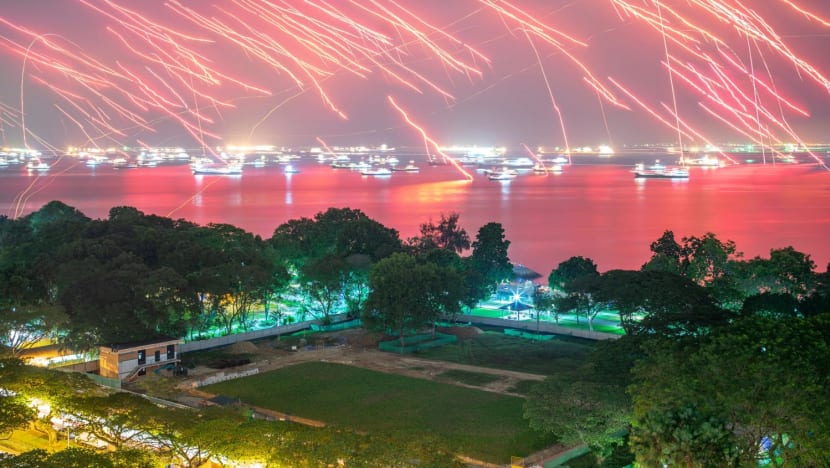
Ships in the Eastern Anchorage off Marine Parade firing flares at the stroke of midnight on Jan 1, 2015.
SINGAPORE — Aviation and maritime authorities have stepped up surveillance on the firing of flares by ships in Singapore’s waters for non-emergency purposes due to the danger it poses to aircraft operations.
The Civil Aviation Authority of Singapore (CAAS) and the Maritime and Port Authority (MPA) told TODAY in a joint statement on Friday (Jan 6) that they take a “serious view” of the matter and that they have reminded the maritime community that it is illegal to do so under the Air Navigation Order.
Five warning letters were issued to offenders caught in 2021, said the authorities.
The joint statement also said that the CAAS has “noticed an increase in such activities” in recent years, particularly during New Year’s Eve.





“An increased number of calls were made to the authorities from members of the public raising potential safety concerns posed by the firing of flares. Fortunately, none of these activities have resulted in disruptions to aircraft operations or pilots having to seek medical attention,” they said.
The statement comes days after renowned Singaporean photographer Darren Soh, 46, highlighted the conspicuous absence of flares from the ships dotting the Republic’s coastline when he tried to capture the brief annual display on New Year’s Eve.
Mr Soh wrote in his Facebook post on Monday, which has since gone viral: “The setting off of flares from ships at the stroke of midnight is supposedly a maritime tradition observed in many parts of the world including the Eastern Anchorage off East Coast Park for as long as I can remember.”
In Singapore, the tradition has been documented as far back as 1960, when the Straits Times on Jan 2 that year included a line about how Singapore ushered in the New Year that read: “As the shouts of ‘Happy New Year’ rang out all over the island, Verey flares exploded over the harbour…”. The Verey flare, sometimes spelled Very, is a type of flare gun.
Prime Minister Lee Hsien Loong similarly referenced it in his Facebook post on Dec 30, 2015 when he wrote: “These breakwaters will be a good place to catch ships firing off their flares at midnight tomorrow to mark the new year”.
It was accompanied by a photograph he took of the silhouettes of two individuals sitting on a breakwater with ships seen in the distance. Mr Lee did not name the location in his post.
In his post, Mr Soh wrote that when he arrived at his vantage point — a block of flats around Marine Crescent — to get ready to photograph the event, nothing happened after he counted down to midnight.
It was only about 10 minutes later that two flares were fired off “then that was it”, he said.
“Did all the mariners receive a memo I obviously would not have gotten? For years, I could depend on the ships to do this one thing at the stroke of midnight on New Year's Day but my faith was suddenly shaken,” he wrote.
Curious, Mr Soh dug around and found that the MPA had issued a notice on its website from the CAAS dated Dec 9 last year.
Addressed to the marine community, the notice warned that it was an offence to direct laser lights at aircraft and to fire flares for non-emergency purposes under the Air Navigation Order.
The penalty for breaching the law, it said, is a fine of up to S$20,000.
On why it is an offence to fire flares for non-emergency use, the authorities said in their statement to TODAY that “these actions can confuse, distract, or cause discomfort to pilots, and can be hazardous to aircraft operations, especially during take-off and landing”.
They added that while the carriage of pyrotechnics, including flares, is a requirement under the International Convention for the Safety of Life at Sea, they are visual aids to send signals to inform ships in the vicinity that help is needed in cases of emergencies.
“However, the firing of pyrotechnics in non-distress situations can create confusion and be mistaken as distress signals which could tie up resources needed for real emergencies,” they said.
‘PREPARED TO SEE TRADITION DIE’
Speaking to TODAY on Wednesday, Mr Soh said one would argue that aviation safety in a country with such high air traffic is “surely more important than a tradition”.
“However, like many other traditions, we look forward to witnessing and photographing them, especially if they only happen for a brief few minutes every year,” he said.
He added that he was disappointed more than anything else that it did not happen this year, after witnessing it since he was a child living in Ang Mo Kio in the 1980s.
“At midnight on New Year’s Day, they would pop up from the horizon and light up the sky,” said Mr Soh of the view he got from his childhood home.
Mr Soh said he did not photograph the firing of the flares in 2021, and the last time he did so was in 2020.
Mr Soh suggested that a small window of time — about 10 minutes starting at midnight — could be allocated every Jan 1 for mariners to continue the practice of firing of flares while air traffic can be briefly diverted so as not to compromise on safety.
Otherwise, he said he is “prepared to see the tradition die”.
Said Mr Soh: “I think many things are becoming more and more regulated in Singapore, which in itself isn’t a bad thing especially if genuine security or safety concerns are involved.”
Be that as it may, he said it does change the way photographers such as himself approach their work.
“I guess we learn to treasure what we’ve been able to capture in the past, which we will no longer be able to do in the future.”




