







Simulators to help bolster Home Team frontline training
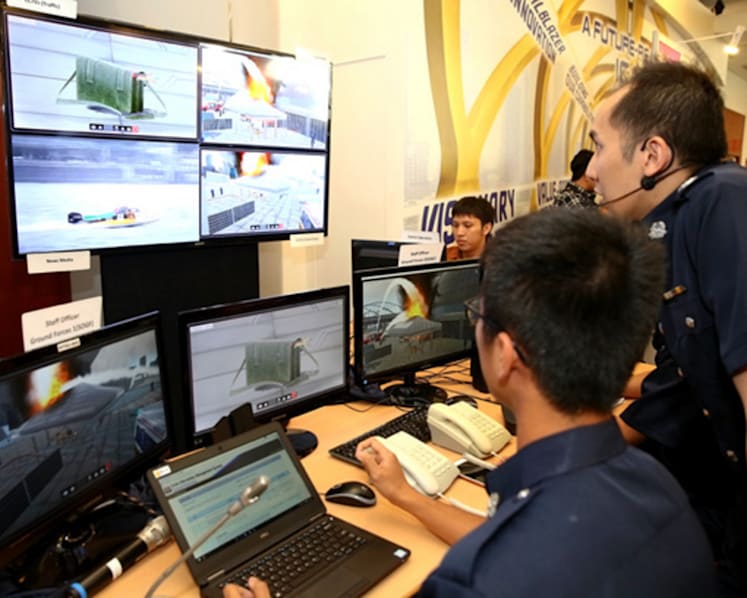
A demonstration of a Home Team Simulation Centre that provides realistic training for Home Team commanders. Photo: Nuria Ling/TODAY


SINGAPORE — Given heavier public demands and tight manpower constraints, training the Home Team has “become an essential ingredient” for successful operations, said Home Affairs and Law Minister K Shanmugam yesterday.
And the use of simulation technologies will help the Home Team Academy to strengthen its frontline training, he added.
Noting that training must mirror frontline operational realities even in a resource-tight environment, he said simulators will be rolled out at the frontline and within training institutions.
“(The officers) must experience it, so that when they are faced with a real situation, they know, ‘This is familiar to me, I know what to do’, their reflexes kick in — instinctive and decisive,” Mr Shanmugam said at the Home Team Academy’s workplan seminar held at the ICA Building.





He added that the value of simulators lies in how they are highly immersive and interactive, being able to expose officers to a range of scenarios and to provide immediate feedback through sensors.
The simulators will come in handy in today’s security environment, where the Home Team must be trained to respond to a terror incident that “can take place very quickly ... with little or no warning, with the loss of many lives”.
Citing recent attacks in the city of Marawi in the Philippines, United Kingdom and Jakarta, Mr Shanmugam said: “Many attacks are being carried out by lone wolves, and the attacks can take place anytime and anywhere. Anyone can be a target, even when you are walking down the road, you may be a target.”
One such simulator, which comes in the form of a “mobile classroom” fitted in a truck, has been developed over six months and tested at Bedok Police Division for about three weeks. It can train up to 16 police officers in about 15 minutes just before their shifts start.
Back at the training institute, simulation technology in the form of a virtual command post will be integrated to train commanders in the way they assess complex situations, plan operations and deploy resources.
It will help them hone decision-making skills over a range of situations, so that they can “improve and pass”, Mr Shanmugam told his audience of Home Team trainers.
Laying out more plans during the seminar, he said a mobile application is being developed to complement access to an online learning portal introduced in October last year.
With it, over 38,000 Home Team officers, civilians and full-time national servicemen will be able to access bite-sized training materials on the go, via their personal handheld devices instead of office desktops, so the high tempo of the officers’ day-to-day operations will not be disrupted.
Mr Shanmugam said reflexes and instincts could not be developed without quality training, citing recent examples such as the huge fire at Tuas View Circuit in February.
During the blaze, Singapore Civil Defence Force responders “did a great job in the face of danger”, even though the commander said he felt like “there was no time to think”.
In his speech, Mr Shanmugam urged commitment to the Home Team Transformation 2025 journey so as to build a Home Team “greater than the sum of its parts”, with officers who display “deep thinking skills ... are adaptable and have the confidence to tackle future challenges”.
“The transformation is an ongoing journey. If we get it right, the results will come,” he said.




