







Singapore and China reaffirm longstanding ties
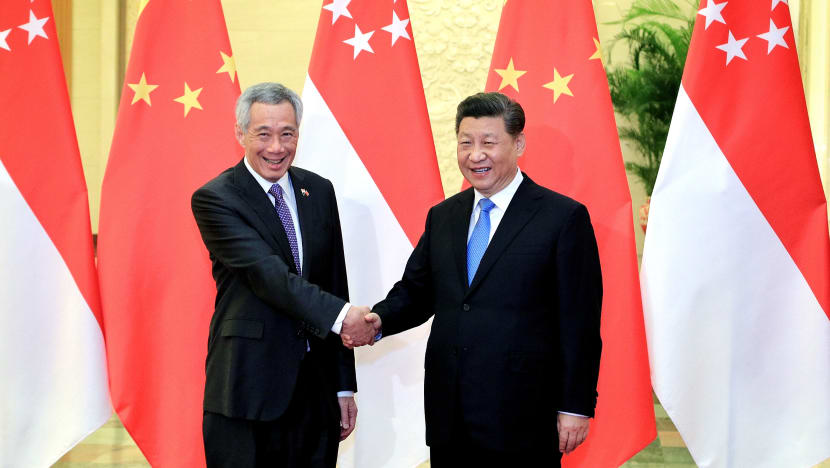
Singapore Prime Minister Lee Hsien Loong and Chinese President Xi Jinping met on Monday, April 29.


BEIJING — Singapore and China reaffirmed their longstanding relations and multifaceted co-operation on Monday (April 29) during meetings between their leaders, with Chinese President Xi Jinping lauding the “close and broad-based co-operation” between the two countries under the Belt and Road Initiative (BRI).
Mr Xi also welcomed Singapore’s participation in the 2nd Belt and Road Forum for International Cooperation, which the city-state’s Prime Minister Lee Hsien Loong is attending for the first time, the Prime Minister’s Office (PMO) said.
On Monday, Mr Lee held separate meetings with Mr Xi and Chinese Premier Li Keqiang.
The brainchild of Mr Xi, the BRI is an ambitious project to reconstruct an ancient trade route connecting Asia and Europe — known as the Silk Road — through large scale infrastructure projects.





In an interview with the Singapore media to wrap up his five-day visit to China, Mr Lee said that Mr Xi has set out the “right objectives” for the BRI, which include developing economic projects that are clean and sustainable, among other things.
“Of course, the critical thing is to see them implement it in the actual projects which come to fruition,” he said.
Mr Lee noted that at the forum, the various world leaders had ideas on what they would like to do under the BRI and these proposals were well received by China.
“I hope it will have some influence on the Chinese thinking, as well as the thinking of the individual countries which are participating,” he added.
At the forum, Mr Lee gave two speeches: During a high-level meeting on Friday, he said that the BRI plays an important role in strengthening multilateral co-operation amid a pushback against globalisation. The following day during the leaders’ roundtable, Mr Lee proposed ways on how participating countries in the BRI can maximise long-term benefits.
During their meeting on Monday, both Mr Lee and Mr Xi also noted the good progress made in the new trade route — called the New International Land-Sea Trade Corridor under the Chongqing Connectivity Initiative (CCI) — which connects Western China and Singapore, as well as the potential for companies on both sides to explore a joint project in one of the member countries of the Association of Southeast Asian Nations (Asean).
AGREEMENTS INKED
Mr Lee’s meeting with Mr Li saw both leaders witness the signing of five Memoranda of Understandings.
One of them involved the setting up of a Comprehensive Cooperation Council between Singapore and Shanghai, and it was inked by Trade and Industry Minister Chan Chun Sing and Shanghai Mayor Ying Yong.
The council would see the two economic hubs set up a ministerial-level platform to deepen co-operation in Belt and Road projects, financial services, technology and innovation, as well as urban governance, among other areas.
The council is Shanghai’s first comprehensive institutionalised platform with a foreign country, and it will be co-chaired by Finance Minister Heng Swee Keat and Mr Ying. Its inaugural meeting is scheduled for May 24 in Shanghai.
This is Singapore’s eighth co-operation council with a Chinese city, with the first one established with Shandong in 1993.
In another agreement signed by Mr Chan and the Vice Chairman of China’s National Development and Reform Commission, Mr Zhang Yong, both countries will be working on projects in logistics, e-commerce, infrastructure and professional services in third-party markets, such as those in Southeast Asia.
A US$500 million (S$681 million) co-investment platform for infrastructure is also expected to be set up, with a framework agreement inked between infrastructure consultancy Surbana Jurong and the Silk Road Fund. It will take equity provisions in infrastructure projects in Southeast Asia to promote infrastructure upgrade and connectivity.
Singapore was China’s largest overseas investment destination among the Belt and Road countries, accounting for close to 23 per cent of its total investment to countries participating in the project, said MTI.
During their respective meetings, Mr Lee and the Chinese leaders also discussed the good progress made in the three government-to-government projects between both countries. Besides CCI, the Suzhou Industrial Park and the Tianjin Eco-city are the other two projects.
They welcomed the elevation of the China-Singapore Guangzhou Knowledge City to a state-level bilateral co-operation project and discussed about the potential to co-operate on the Guangdong-Hong Kong-Macao Greater Bay Area initiative.
The leaders affirmed the importance of the annual Joint Council for Bilateral Cooperation (JCBC) to guide and coordinate bilateral ties between both countries.
During the interview with the Singapore media, Mr Lee noted that Mr Heng will take over from Deputy Prime Minister Teo Chee Hean as the Singapore chair of the JCBC, as the finance minister prepares to assume his position as deputy prime minister from May 1.
Earlier this month, it was announced that Mr Heng will be promoted to DPM, with the incumbent DPMs — Mr Teo and Mr Tharman Shanmugaratnam — stepping down but remaining in the Cabinet as senior ministers.
Mr Lee said China welcomes Mr Heng as co-chair of the JCBC.
“They know him because he has interacted with them on many occasions, including when President Xi and Premier Li came to visit Singapore and he was the accompanying minister. So they have direct feel of him,” he added.
Mr Lee also said he hopes that relations between Singapore and China will not be affected even as the city-state prepares for the next generation of leaders to take over. He added that several younger ministers have been serving on the JCBC and are active in several provincial- and national-level projects through the JCBC.
“So I hope that this will go smoothly and I think the Chinese side very much want the relationship and the friendship to continue,” Mr Lee said. “It’s in the interest of both countries. It is not personal, to a few or particular leaders.”




