







Singapore not affected by pollution incidents in Pasir Gudang: Masagos
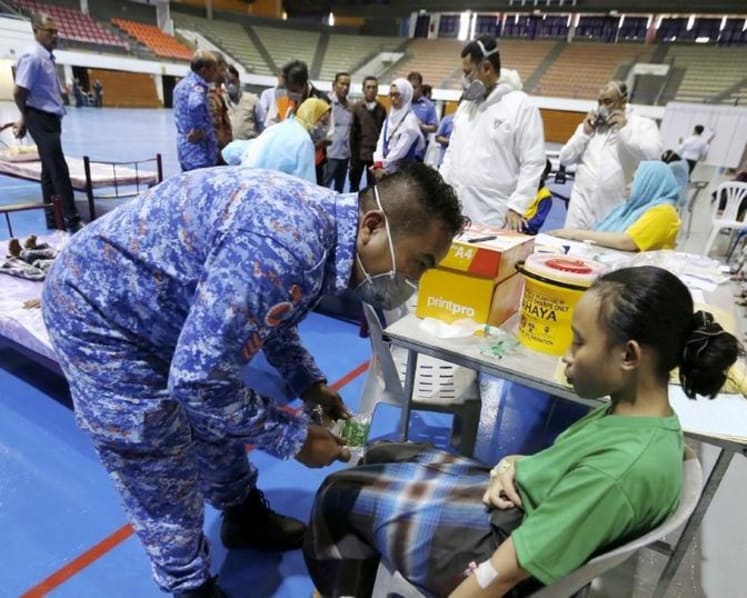
A student receives treatment during the recent pollution incident in Pasir Gudang. Singapore's air and water quality was not affected by the pollution incidents in Johor state, Parliament was told on Monday (July 8).
SINGAPORE — The air and water quality in Singapore has not been affected by the recent pollution problems in Pasir Gudang, Johor, said Environment and Water Resources Minister Masagos Zulkifli in Parliament on Monday (July 8).
Mr Masagos was responding to a question from Mr Melvin Yong, Member of Parliament (MP) for Tanjong Pagar Group Representation Constituency (GRC), who asked if the ministry was monitoring the recent air pollution incident in Pasir Gudang and if it would affect Singapore.
Pasir Gudang was hit by air pollution in June, forcing more than 400 educational institutions to be shut after several teachers and students experienced breathing difficulties and nausea. The area faced widespread problems of a similar nature in March after a chemical spill.
Mr Masagos said that the National Environment Agency (NEA) monitors and reports on the air quality through five national air quality monitoring stations across the island.





The stations monitor the ambient air quality of the north, south, east, west and central regions.
Pollutants such as sulphur dioxide, nitrogen dioxide and carbon monoxide, among others, are continuously monitored and reported on an hourly basis as the Pollutant Standards Index (PSI), he said.
“In addition, NEA monitors the coastal water quality continuously through buoy-based monitoring sensors deployed in eight locations around Singapore, including the Straits of Johor,” he said.
“This is supplemented by monthly collection samples from 48 sampling points around Singapore,” said Mr Masagos.
He said ambient levels of chemicals known as volatile organic compounds (VOCs) in the northeast region were well within safe limits. The Singapore Civil Defence Force (SCDF) also deployed chemical gas detectors in the northeast and did not detect any toxic chemicals in the air.
Mr Masagos also responded to a query from Mr Pritam Singh, MP for Aljunied GRC, on how the air and water quality in northeast areas of Singapore compared with the rest of the country from 2008 to 2018.
He replied: “From 2008 to 2018, the air and water quality in the northeast region was comparable to the rest of Singapore, including during the northeast monsoon period.”
In the March incident in Pasir Gudang, thousands of students, staff and residents were affected by chemical waste that was illegally dumped into the Kim Kim River in Johor.
Mr Masagos added that NEA and SCDF was also in contact with Malaysia’s Department of Environment and Fire and Rescue Department, and would continue to monitor the situation and provide updates.
“Our agencies have put in place precautionary measures to guard against any potential pollution impacts arising from chemical incidents, including those from transboundary sources,” he said.
“NEA’s existing air monitoring stations in the northeast region are able to measure the ambient concentration of a variety of VOCs including benzene, toluene and xylene in the parts per billion range. These capabilities and with the support of SCDF’s portable detectors should allow us to detect a transboundary plume and to alert our population accordingly.”
Responding to Mr Yong’s supplementary question on whether Singapore was ensuring that Johor’s plans to relocate its high-risk chemical factories would not place the Republic at a higher risk of air pollution, Mr Masagos said both NEA and the SCDF were aware of the kinds of chemical industries that exist in Pasir Gudang and that Singapore would be informed of any relocation by Malaysia.
“It’s in our existing arrangement to inform each other to ensure that if there are any movements of major complexes, we inform each other,” he said.




