







Singaporeans in South Korea planning to stay put even as Covid-19 outbreak intensifies
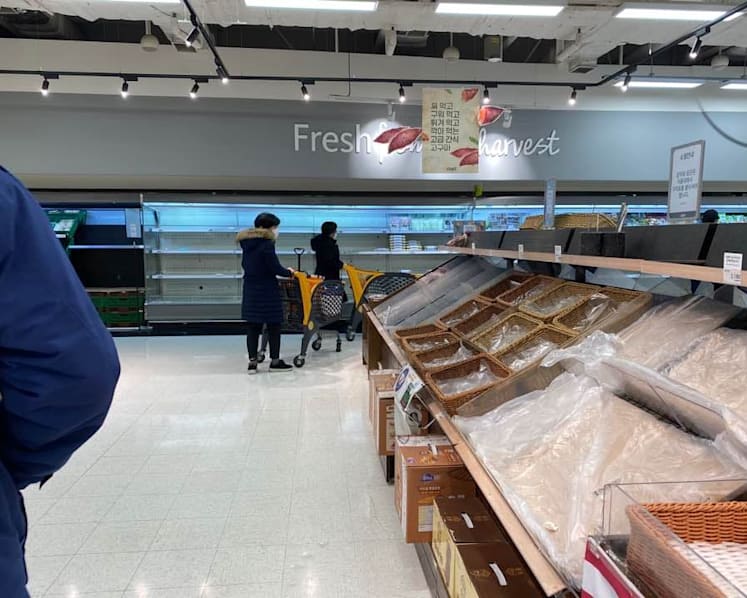
Empty shelves and freezers at an e-mart in Gangnam, Seoul, near the Coex Mall.


SINGAPORE — After placing an order at a restaurant in Seoul, freelancer Elizabeth Toh, 30, was told by a waiter that she could not dine in.
“The waiter told me he was sorry but the boss did not want to accept foreigners,” she said. “I was shocked, but I understand why they are doing this.”
Ms Toh is one of five Singaporeans living in South Korea who spoke to TODAY about what it has been like to witness firsthand a country grappling with a Covid-19 crisis that is second only to China’s.
With over 2,000 confirmed cases, South Korea has the highest number of Covid-19 patients outside China and its death toll has passed 10.





These Singaporeans, including one living in Daegu, the epicentre of the outbreak, said that while life is mostly going on as per normal, supermarket shelves are emptier, deliveries are taking longer and there is a heightened sense of fear in the air, marked by a touch of suspicion of foreigners.
Ms Toh, who has been in Korea since last August, said she has been seeing signs saying “No Foreigners” at restaurants in Seoul since last week.
But apart from that, the city’s dwellers have not discriminated against her or indulged in any panicked behaviour, she said.
“Everyone here is still calm. They just have started to take notice of their hygiene more by washing their hands more often and wearing masks.”
Ms Toh, who is currently enrolled in a language exchange programme at the Geumgang University in Daejeon, said her parents are worried about her remaining in Korea, but she is choosing to stay as she is not too worried about the situation there now.
Another Singaporean who has been living in South Korea is homeschool teacher Syasya Luna, who said that supermarket shelves are emptier in her city of Mapo-Gu.
“There are few packets of rice and ramen on the shelves,” said the 21-year-old, who has been living in South Korea for the past three years. “You need to go early in the morning to the stores to buy them.”
She added that online grocery delivery sites such as G-market is also overwhelmed with orders and now take two days to deliver packages, where before they would have done so within a day.
But Koreans have not been hoarding or panic-buying, she said.
“People are buying one, maybe two basketfuls (of groceries),” she said. “Not trolleys of stuff.”
Ms Luna also described emptier streets when she visited Hongdae, a popular shopping district in Seoul.
“The streets are almost like a ghost town now,” she said. “Usually any day of the year it’s filled with tourists and the traffic is crazy.”
In the high-end Gangnam district, some schools, offices, shopping malls and a public library have closed for the time being, she added.
The rapidly intensifying outbreak has her worried, she admitted.
“It’s so sudden. In one day the numbers (of confirmed Covid-19 cases) climbed to 200 and the next day when I opened my eyes it reached about 800,” she said. “I’ve also become paranoid, even when I’m lightheaded I will go and have it checked.”
She said that her parents have also been worried.
“My parents call me everyday and ask me to come back,” she said, adding that her mother has even cried over the phone once.
But she intends to remain in South Korea, as she has to complete her teaching contract with the family she works for, which lasts till the end of July.
LIFE IN THE EPICENTRE
In Daegu, which has over 60 per cent of South Korea’s confirmed cases, Singaporean engineer Godfrey Ho, 33, said life has not changed all that much.
More people are wearing masks in public and avoiding large group gatherings, and about a third of the shops and businesses in the city since the outbreak began, he said.
“More people are choosing not to leave their homes,” he said, adding that there are also fewer cars on the roads.
Some kindergartens and schools there have closed as well but most people are still going to work, he said.
Unlike in Mapo-Gu, supermarkets in Daegu remain fully stocked and food and grocery deliveries also seem to be operating as usual without much delay, he added.
“People don’t panic buy,” he said. “Maybe some panic bought ramen but there are always more on the shelves.”
Mr Ho is not worried about the situation there and intends to stay put as he is taking the necessary health precautions.
“I am frankly not worried,” he said. “I definitely take precautions such as not hanging out downtown and when I’m queuing I usually leave a space between me and the other person.”
He has also started wearing a mask everyday and avoids going out often. He has stopped going for his usual Friday night dinners with friends since last week and has been working from home.
He added that if he were to fly back home, he might be exposing himself to the virus even more.
“I don’t want to be on the plane with people when I don’t know where they have been,” he said. “I’m trying to avoid being close to people.”
He also added that his family members in Singapore are worried about him being there, but added: “They know that I know how to take the necessary precautions.”
— Additional reporting by Matthew Loh




