







Singaporeans must ‘step up to keep country safe’


SINGAPORE — Spelling out the worrying developments in the region and in the Middle East, Home Affairs Minister K Shanmugam yesterday warned that the country — considered as infidels and unacceptable by zealots, as he put it — faces significant threats, as he called on Singaporeans to ramp up the collective efforts to protect the country from harm.
On its part, the Government will also do more to strengthen its security forces, intelligence and border controls security measures. Over the next few months, the Ministry of Home Affairs will announce initiatives on this, as well as making society more prepared.
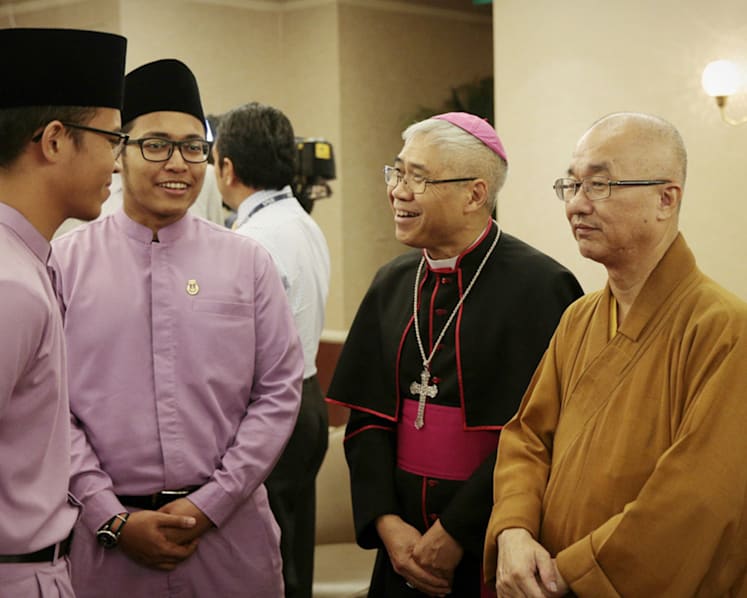
“In addition to strengthening our hard security, we have to do one more thing which is very urgent. We have to now move to change mindsets. Our people must realise that everyone is responsible for our collective security. Every one of us,” said Mr Shanmugam, speaking at the second annual Inter-Religious Relations in Plural Societies Distinguished Lecture and Symposium.
There are various existing ground-up initiatives, such as Religious Rehabilitation Group and a community accreditation initiative for religious teachers, but some of the approaches have to be re-examined to deal with the waves of terrorist ideology sweeping the region, said Mr Shanmugam, who is also the Law Minister.





Outlining developments in South-east Asia, Mr Shanmugam noted that religion has “again risen with renewed vigour” in the past 15 years, both as a force for good and “also, in the hands of some, as a tool for terror”. For example, extremists in neighbouring countries have capitalised on issues that Muslims are concerned about to achieve political ambitions, he said. He cited studies on Malaysia which found that 71 per cent of Malays there support hudud, a set of Islamic criminal laws which include stoning for adultery and amputation of the hands for theft.
He also noted that civil servants, police officers and personnel from the armed forces were among those arrested by Malaysian authorities for alleged involvement in terror plots.
“Malaysia as a whole has become much more Islamic ... Religion and politics will become even more closely linked ... The developments are obviously very, very troubling,” he said.
In Indonesia, the lack of prevention detention laws means that hundreds imprisoned — including terrorists linked to the Jemaah Islamiyah — have either been released since 2014, or are eligible for release or parole by the end of this year. Elsewhere, Thailand, Myanmar and the Philippines face possibilities of inter-religious strife with their ethnic Muslim populations, whose grievances with their socio-economic conditions “add to the potency of the terrorism threat”.
The regional landscape is “fusing perfectly” with international events — such as the rise of Islamic State — to perpetuate violence and terror, said Mr Shanmugam. “These ideas will not win in the end. But the cost in terms of blood and misery will be high. And that price has to be paid, unfortunately.”
He outlined four growing and urgent threats the Republic faces: Direct terrorist attacks, radicalisation of part of its Muslim population, Muslims growing distant from the “mainstream” community, and Islamaphobia among non-Muslim populations. In his comments, Mr Shanmugam was also more explicit about the threat to Singapore than other ministers have been recently, and laid out in stark detail some brewing divisions that the Government has already taken note of.
Mr Shanmugam also laid out the broad strokes of what is needed to counter the terror threat: Religious leaders have to help the population understand the “true nature of terrorist ideology”, which includes countering Islamic State ideology doctrinally through simple messages including on social media. Community leaders also have to help lead the “fight for hearts and minds” for a united Singapore.
The Government will continue to stay vigilant and uphold tough laws to prevent divisions perpetuated by race and religion. The Government will also ensure equal opportunities for everyone in Singapore, and give each individual “maximum possible space” to practise his or her religion.
New policies to achieve these objectives will be rolled out over the course of this year, Mr Shanmugam said. “The ultimate aim of terrorism is to create a sharp and violent division between ‘us’ and ‘them’. If we remain resolutely ‘us’, one united people, regardless of race, language or religion, no force can divide us,” he said. “And terrorism will be defeated.”




