







Singapore’s very own Atlantis
SINGAPORE — It seems almost like a modern-day take on the underwater city of Atlantis: Beneath the tall skyscrapers that rise above the sea lies a metropolis, filled with amenities such as cinemas and shopping centres.
But in land-scarce Singapore, where an enthusiasm for land reclamation has seen the Republic’s land area grow by about 23 per cent since independence, and where underground space is being mined more extensively in recent years, going underwater may not be a such a big stretch.
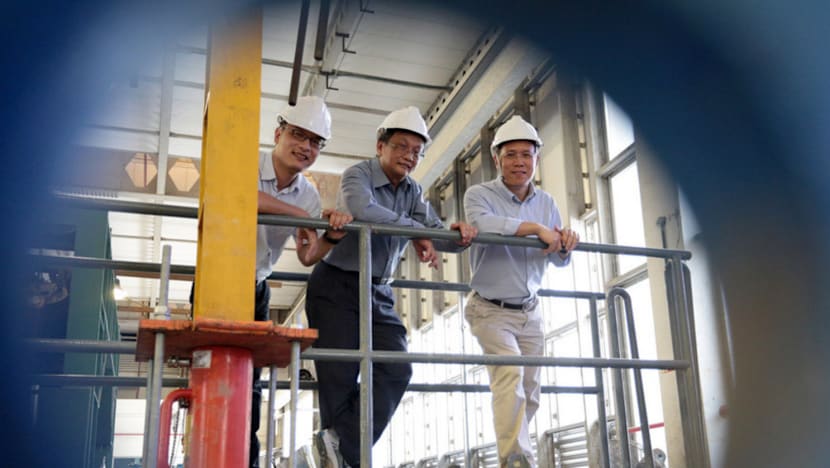
Already, a team of researchers from Nanyang Technological University’s (NTU) School of Civil and Environmental Engineering is working on this, in a project that received funding from the National Research Foundation. Called New Underwater Space, or NEUSpace, the project sought to develop cylindrical structures that can be used to build caverns to form underwater space for infrastructure or other developments. Above this cylindrical structure, land can also be reclaimed without using a large amount of material to fill the sea.
The team is led by associate professors Tan Soon Keat and Chu Jian. The idea that led to this concept was a simple one, as Dr Tan and Dr Chu told TODAY: “We are building structures on land to store things. We are going underground to dig a hole to store things.”





Dr Tan added: “We forgot we don’t have to dig a hole … (that) there is plenty of space in the water. The land is on the seabed. We bring the land down to the seabed. We don’t have to spend money to excavate.”
It is “three-dimensional space”, as Dr Chu put it, that can be used more efficiently — space above and within the structures.
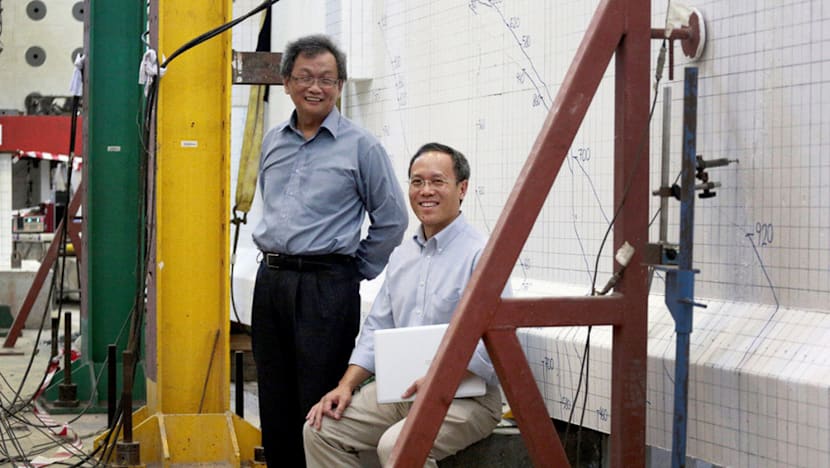
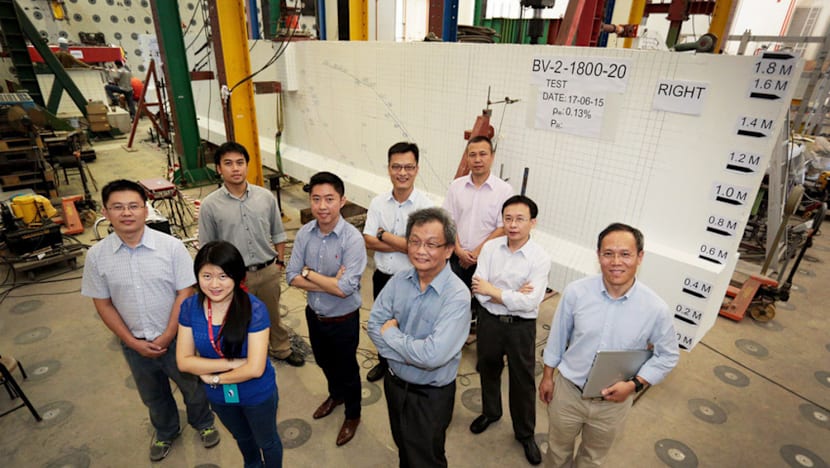
And because it is far more costly to repair structures underwater than above ground, the team created an Ultra Durable High Performance Concrete (UDHPC), which will be used to build the cylindrical structures.
Dr Tan, who is also director of NTU’s Maritime Research Centre, said their research had shown that the new concrete would be four to five times stronger than conventional concrete, and the probability of failure in 200 to 300 years, even 500 years, is fairly low.
The structures will be placed into the seabed using suction caisson technology, where it will be embedded using suction power.
The team’s research began five years ago, when Dr Chu and Dr Tan noticed that land reclamation work in deep waters was often too costly. Together with their research team, his idea was to “have concrete boxes to occupy the sea space and, at the same time, have land on top”.
Within these boxes — which are now cylinders — will be space to build facilities such as shopping malls, casinos and cinemas — places for which natural light is not essential. Access to the underwater facilities would be via lifts.
The hunger for land
Since the 1960s, Singapore has added more than 100 sq km to its land area, to reach its current size of 718.3 sq km. The Population White Paper released in 2013 outlined a need for a land area of 766 sq km to accommodate a larger projected population by 2030. The Government has also outlined plans for land reclamation beyond 2030, including in Marina East, Changi East, Sungei Kadut and around the Western Islands.
In recent years, the Government has also tapped underground space more extensively, notably with the establishment of the S$950 million Jurong Rock Caverns as a storage facility. Developed by JTC, the caverns, located under Jurong Island — itself created from reclaimed land — translates to savings of 60ha of land. This land could then be used for higher- value-added activities such as petrochemicals manufacturing.
In June, national water agency PUB called for a tender for a 24-month study on the technical and economic feasibility of developing an underground drainage and reservoir system. Last month, the Government issued a grant call under the Land and Liveability National Innovation Challenge (L2 NIC) programme for research that could reduce the cost of underground developments by 50 per cent.
The underwater project was a long time coming, said the NTU researchers, who noted that its largest potential will be realised in deep water, where the water is calmer.
The material developed can also be used to build sea walls, and once the water is drained, it can free up land for storage use, said Prof Chu.
The team is concerned with testing the durability of the material, especially its resistance to corrosion. Prof Tan also noted that underwater structures would have bigger structural elements than those used on land. “We worked out what is the loading or forces acting on these structures,” he said. The team is also working on developing design methods and guidelines specific to their specially-created concrete.
Fear of going under
But while the researchers spoke of towns and city centres built in the middle of lakes and seas, they acknowledged a significant challenge: Psychological barriers.
Going underground and underwater means forgoing daylight, which has been shown to affect people’s psyches. In societies that are shrouded in 24-hour darkness in winter, depression rates run high, the researchers noted.
A study by another team of researchers looking into this is ongoing. Led by NTU Civil and Environmental Engineering professor Soh Chee-Kiong, the three-year study, which is funded by the L2 NIC initiative, will involve 150 participants and look into questions such as whether people are more creative in dimmer working conditions underground, and the impact of being underground on sleep patterns and stress levels.
Added Dr Tan: “If you work underground, in the casino for six months, I don’t know what will become of you after you come out.” As such, it will probably take some convincing to move under the ocean. But, he added, “if the world develops in such a way that this becomes the norm, then I think there is no issue”.
Dr Chu said the only way to move is forward. “(We) need to be more progressive in embracing technologies such as these. As with any new technology, there are, and will be, risks involved. We need to adopt them, then we can progress,” he said.




