Sir Stamford Raffles statue near Boat Quay 'disappears'
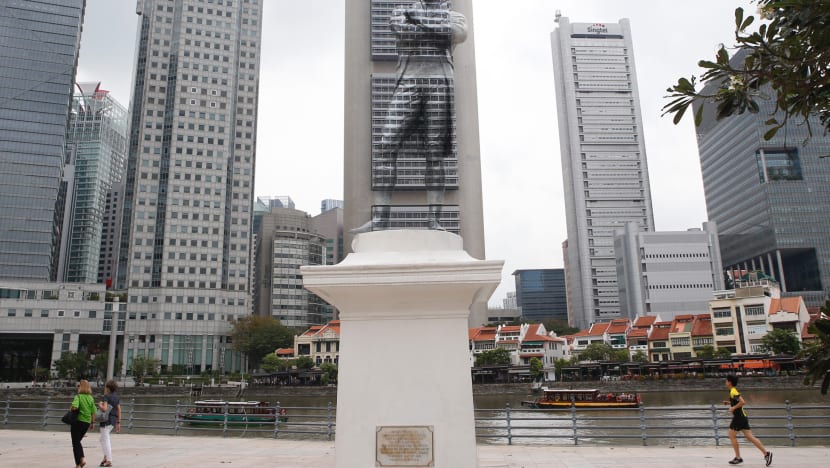
The optical illusion involving the statue of Sir Stamford Raffles, on display from Dec 29, 2018 to Jan 3, 2019, is meant to get Singaporeans to reflect on the country’s history.


SINGAPORE — Now you see him, now you don’t.
The Sir Stamford Raffles statue located along the Singapore River has been given a coat or two of paint since Saturday (Dec 29) to create a “trick-eye” effect, where the statue will look like it is “disappearing” into the OCBC office tower behind it when viewed from a particular position.
This optical illusion was commissioned by the Singapore Bicentennial Office (SBO) and will remain on display until Thursday evening.
The SBO was set up in 2017 to coordinate nationwide events commemorating 200 years since Raffles arrived in Singapore.





Its deputy director Wong Chock Fang said that the main purpose of making the statue “disappear” is to get Singaporeans to reflect and start conversations on the country’s history.
Ms Wong said in an interview with TODAY: “When people think about 1819, they remember it as the year Raffles arrived in Singapore… We want to get Singaporeans to think more deeply about history — is it just about one man or one date? There were many men and women who arrived in Singapore in 1819. How about their contributions?”
The statue has been painted with outdoor acrylic paint over a layer of liquid masking that was applied before. Artist Teng Kai Wei from Hong Hai Environmental Art, a company specialising in designing and fabricating landmark sculptures and environmental art, did the painting works with a team over 2.5 weeks last month.
The white, polymarble statue, built in 1972, was chosen because its location on the north bank of the Singapore River near Boat Quay is believed to be the landing site when Raffles arrived in Singapore in 1819.
The other bronze statue of Raffles, located in front of Victoria Concert Hall, was originally installed at the Padang in 1887. It moved to its present location in 1919, because it was often hit by flying footballs or used as a seat to watch a game at the Padang, the National Library Board’s Infopedia webpage stated.
Mr Teng told TODAY that he and his team took three months to brainstorm and conceptualise the artwork after being commissioned by SBO four months ago.
They had to take into account various factors such as the weather and the shadows that would be cast on the statue at different times of the day. They also had to think of ways to avoid using the sky as part of the backdrop, among other considerations.
One of the challenges Mr Teng faced when painting the statue was its various curvatures and angles.
“It took a lot of time to adjust carefully… to make sure that it was a straight line when seen from the viewing point. Just a minor misalignment would be very obvious when taking a photo,” he added.
Mr Teng admitted that he was under pressure when he first received SBO’s brief, because it is a “very monumental sculpture” and there is the responsibility to execute the work “as perfectly as possible”.
On how SBO would assess whether it achieved the intended goal of getting the public to reflect on Singapore’s history, Ms Wong said that there are “some activities on social media” relating to the event.
Asked if six days of display is too short a time to allow for a wider reach, SBO’s public relations team said that “it’s just a temporary effect”.
On the Singapore Bicentennial’s Facebook page, a video on the statue’s “disappearing” act received 3,500 views and 63 shares as of 9pm Wednesday.
Some Facebook users commented that the artwork is stunning while others joked that it is vandalism. There were also those who dismissed it as propaganda.