







Small steps the best approach to two-state solution, says PM Lee
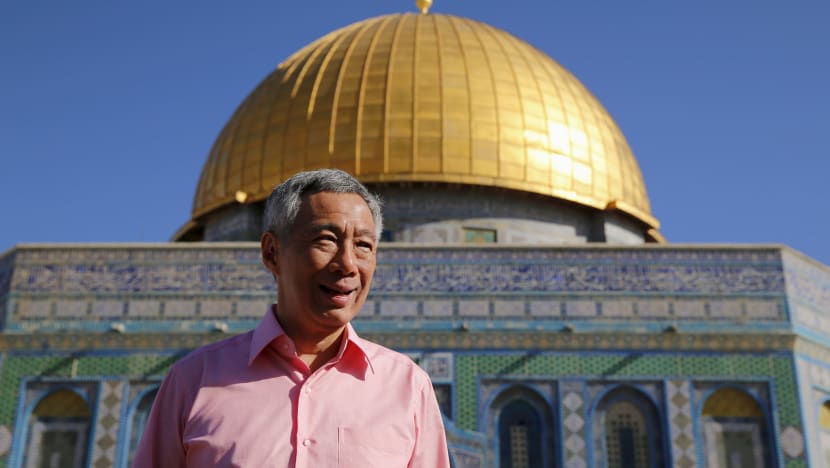
Prime Minister Lee Hsien Loong stands in front of the Dome of the Rock during a visit to the compound known to Muslims as Noble Sanctuary and to Jews as Temple Mount in Jerusalem's Old City April 20, 2016. Photo: Reuters


TEL AVIV — There is no overnight solution to the Israeli-Palestinian conflict, and what is needed is for both sides to take small steps and build confidence towards a two-state solution, said Prime Minister Lee Hsien Loong.
Speaking to Singaporean media on Wednesday evening (Israel time) (April 20) towards the end of a week-long trip to Jordan, Israel and the Palestinian Territories, Mr Lee noted that both sides are aware that there is no other solution to the long-running conflict, but it has not been easy to make progress on the issue.
“It is one of those situations that if you try to do everything at once, you will fail. Because some of the problems are just too hard to solve straightaway. It is not just a matter of what deal we can make but also of the trust and mutual confidence that exist and the goodwill that must be built up in time so you can do a deal together,” said Mr Lee.
“I encourage both sides to walk towards a deal and begin to make steps so you can progressively advance and then you build on each step and the next step you can take it further. I think they understand it and both sides would like to do it but realising it is hard.”
Multiple efforts have been made to broker an agreement on a “two-state solution” in which Israel would exist peacefully alongside a new Palestinian state created in the West Bank and the Gaza Strip, lands seized by Israel in the 1967 war. Such a solution has proved elusive due to ongoing Jewish settlement building; a split between the Palestinian Fatah and Hamas factions; preoccupation within the Palestinian National Authority (PNA) about who might succeed ageing President Mahmoud Abbas; and a wave of Palestinian stabbings, shootings and car rammings of Israelis.





Efforts led by the United States to broker peace collapsed in April 2014, and France is now making another push by convening an international peace summit to work towards a two-state solution.
While on his first official visit to Jordan, Israel and the Palestinian Territories this week, Mr Lee met various leaders in the region, including Jordan’s King Abdullah II Bin Al Hussein, Jordanian Prime Minister and Minister of Defence Abdullah Ensour, Israeli President Reuven Rivlin, Israeli Prime Minister Benjamin Netanyahu and the PNA’s Mr Hamdallah.
“With Jordan we have good relations and in particular, we exchanged notes on the security situation, especially terrorism,” said Mr Lee.
He noted that some Jordanians have joined the Islamic State terror group, also known as Daesh.
“They (Jordan) worry about the implications of Daesh not just in the region but wider. They have a good understanding of what is happening in Daesh and I think between governments and security agencies, we quietly exchange information and deal with problems,” he said.
Commenting on ties with Israel, Mr Lee noted that both sides “have a long friendship” going all the way back to Singapore’s independence and the Singapore Armed Forces’ connection with the Israel Defense Forces.
In a speech on Monday at the Hebrew University, Mr Lee had expressed Singapore’s gratitude to Israel in helping the Republic to build up its defence capabilities. Israel was the only nation that responded to Singapore’s call for help to set up a military when it became independent in 1965.
Mr Lee added in the media interview that bilateral ties have expanded beyond the security sphere and now include technology cooperation, among others. Mr Lee also said that he had a good discussion with Mr Netanyahu on the situation in the Middle East and the Israeli-Palestinian issue during the visit.
The Prime Minister added that relations are friendly with the PNA.
“They are very interested in learning from Singapore, or at least picking up ideas from Singapore. We have been cooperating with them, giving them assistance where we can,” said Mr Lee, who announced on Tuesday that the Republic has doubled an enhanced technical assistance package for PNA officials from S$5 million to S$10 million.
“They (PNA) are interested in developing the middle level of their educational system — the equivalent of our polytechnics and our Institutes of Education (ITE) — because, as they told me, they have a lot of graduates, but the graduates are unemployed. They don’t have enough people at the middle level and they need to produce more,” he said, adding that both sides will do a study to identify how relevant projects can be started.
Mr Lee said that he was struck by the historical significance of the cultural sites he had visited during the trip, including the Yad Vesham Holocaust memorial, Dome of the Rock and Al Aqsa Mosque.
He noted that the Dome of the Rock and the Al Aqsa Mosque are in Jerusalem — in territory technically occupied by the Israelis but administered by the Jordanian authorities.
“So whose should it be? I think this will be a problem that will take a long time to solve. But once they are resolved, I think all faiths can share, can have access to it, and can consider it sacred and deeply meaningful and learn to live in peace and harmony with one another,” he said.




