







SMRT director fined S$55,000 for role in fatal 2016 train accident
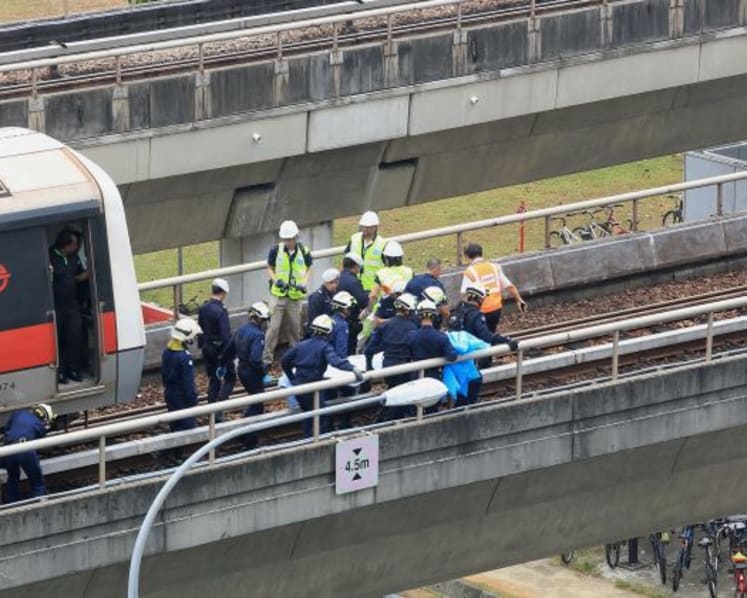
SCDF officers removing a body from the scene of the train accident at Pasir Ris MRT Station, March 22, 2016, which left two SMRT employees dead. TODAY file photo


SINGAPORE – An SMRT control operations director, convicted for failing to take the necessary measures to ensure employees’ safety that led to the death of two trainees in a fatal track accident last year, was fined S$55,000 on Friday (Sept 29).
In sentencing him, District Judge Chay Yuen Fatt agreed with the prosecution that 41-year-old Teo Wee Kiat bore a significant degree of culpability since he knew that the employees accessing the train track had flouted safety rules and that the harm caused by the accident was “high”.
On March 22 last year, SMRT trainees Muhammad Asyraf Ahmad Buhari, 24, and Nasrulhudin Najumudin, 26, were killed by an oncoming train travelling between Tampines and Pasir Ris MRT stations in the morning.
They were part of 15-man team that went onto the tracks to check on a warning signal from a monitoring device.





Arguing for Teo to be handed a S$60,000 fine on Friday, Deputy Public Prosecutor Anandan Bala said Teo, who was in charge of the operations control centre which oversees track access activities, knew that the employees were permitted to conduct track access despite them not abiding by the safety procedures.
DPP Bala noted that apart from his significant degree of culpability, the potential for harm is high considering that accessing train track during traffic hours when passenger trains were operational is “highly dangerous”. He said as head of department, Teo “failed to stop such practices from continuing when it came to his knowledge”.
“It becomes patently clear that the accused has fallen far short of the standard expected of him, when we consider that on top of being a long-standing employee of SMRT and its related entities, he has also in fact held important appointments relevant to the workplace safety breach in question,” he added.
In February this year, train operator SMRT was slapped with a record S$400,000 fine for its role in the accident. District Judge Chay, who also presided over the case, had noted that lapses in numerous safety protocols were “systemic” and took place on many levels.
Investigations had revealed that on at least 200 occasions in 2015, staff had access to train tracks with limited clearance during traffic hours, but safety rules were flouted in the bulk of them.
In Teo’s case, DPP Bala noted that his “failure to discharge his duty” had significantly contributed to the safety breaches at the workplace, which led to the deaths of two workers and endangering other employees.
Calling for the court to send a strong deterrent message on workplace safety and health, DPP Bala said that officers in managerial positions not only play a role in ensuring employees achieve operation excellence, but they also “bear a legal and moral responsibility towards all their employees to look after their safety and health at the workplace”.
Submitting Teo’s mitigation plea, Mr Adam Maniam said that following the accident, his client had taken steps to ensure safety compliance even before he was charged. For instance, Teo had pushed for stricter control of track access, among other measures.
“It was not taken to belatedly bolster his defence. Rather there was genuine desire to improves systems and processes,” said the defence lawyer.
He added that Teo had provided full cooperation during investigations, which include providing transcripts of radio communications, footages from closed-circuit television and records of all past track access dating back to 2002.
He called for a fine of between S$30,000 and S$40,000 for his client, saying this is not a “slap on the wrist” as it is not “too far off” from what the prosecution had asked for.
For his offence, Teo could have been jailed for up to two years and receive a maximum fine of S$200,000 or both.
Mr Chan Yew Kwong, Director of the Occupational Safety and Health Inspectorate at the Ministry of Manpower, said: “As Director of Control Operations, Teo Wee Kiat has the ultimate responsibility to ensure SMRT employees complied with the mandated operating procedures.
"Despite knowing that the operating procedures for track access have not been complied with, he did not take any action to ensure compliance or to review the operating procedures. He has failed in his duties, and must be held accountable for his negligence.”
Teo is still employed by SMRT. Asked about the case, SMRT vice-president for corporate communications Patrick Nathan said SMRT respects the court’s decision and has taken “the necessary disciplinary actions related to the incident”.
Meanwhile, the case of former SMRT assistant engineer Lim Say Heng, who had led the trainees onto the track when the accident happened, is still before the courts.
Lim, who has been charged with causing death by a negligent act, will have his case heard on Jan 16, where he is expected to be plead guilty. If convicted, Lim could be jailed up to two years, fined or both.




