







Some Iranians in Singapore hit by OCBC bank account closures

OCBC was tight-lipped when asked how many accounts belonging to its Iranian customers it had cancelled in the last three months, and why.


SINGAPORE — Less than halfway through a 10-day holiday to Sri Lanka with his wife this month, Iranian Alireza Javadian found himself unable to pay his bill at a coffee shop with his OCBC credit card.
When the Singapore-based senior researcher called the bank, it replied that it had sent him a letter saying his accounts would be closed in 14 days.
With no ATM card to withdraw cash with, the couple spent the next day confined to their hotel as Dr Javadian’s wife scrambled to activate her American Express credit card.
Dr Javadian, 33, soon learnt that at least 15 of his countrymen living in Singapore had faced the same predicament of having their OCBC bank accounts terminated.





In the letter of notification, copies of which were seen by TODAY, no reason was given. OCBC merely said it had conducted a review of accounts maintained with the bank.
Another Iranian in Singapore, Dr Amir Shahroudy, received the notification letter on Aug 14.
“I was expecting to receive it since I knew all of my Iranian friends who had OCBC accounts (were) getting the same letter gradually,” said Dr Shahroudy, 36, a senior engineer who said about 20 friends have been affected and estimates the total number to be higher.
A week after receiving the letter, he went to the bank to close his FRANK account and was charged S$2 for closing it.
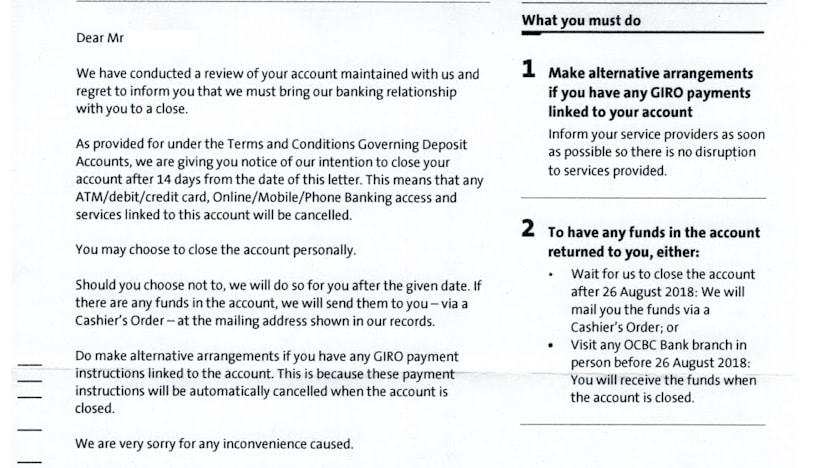
OCBC was tight-lipped when asked how many accounts belonging to its Iranian customers it had cancelled in the last three months, and why. Ms Koh Ching Ching, its head of group corporate communications, said: “For risk management purposes, we constantly review our customer accounts and may close these accounts for various reasons.”
While the Iranians cannot be sure that the move was due to their nationality and the sanctions imposed on their country, they were disappointed by the bank’s actions and some felt discriminated against. They are not on any list of blacklisted individuals and use their personal accounts for local transactions, they said.
“Ordinary normal people like us should not be affected. We don’t have anything to do with the (Iranian) government and we use these accounts for only personal matters,” said Dr Javadian, who has been living in Singapore for 11 years.
Asked about OCBC’s actions, the Monetary Authority of Singapore (MAS) said the decision to open or maintain a banking account is a commercial one. Banks are generally not required to inform MAS upon the closure of a bank account, its spokesperson said.
However, banks are required to comply with laws that seek to prevent bank accounts from being used for illicit purposes such as money laundering, terrorism financing or proliferation financing, she said.
The laws include:
The MAS’ regulations to implement United Nations Security Council Resolutions (UNSCR), including those dealing with Iran, which prohibit banks from granting financial services to specific individuals or entities identified by the UN as contributing a particular threat to international peace and security;
the Terrorism (Suppression of Financing) Act, which prohibits banks from dealing with terrorists; and
The MAS’ regulatory requirements, which require banks to conduct effective customer due diligence and transaction monitoring to mitigate money laundering, terrorism financing and proliferation financing risks.
She said: “While we do not tolerate the misuse of bank accounts for illicit purposes, it is important for banks to strike a balance between managing such risks and meeting basic banking needs. MAS expects banks to take a risk-based approach, and assess each customer’s profile and transactions on a case-by-case basis.”
The spokesperson added: “Banks would also need to consider and adequately mitigate the reputational, legal or operational risks arising from infringing sanctions that have been imposed by other countries.”
She did not elaborate on other countries’ sanctions. However, the United States said on Aug 6 it was re-imposing economic sanctions against Iran that were lifted under a 2015 international nuclear accord. The 2015 accord had sought to limit Iran’s nuclear programme in exchange for some economic relief.
US President Donald Trump’s decision to re-impose sanctions came in spite of international inspectors finding that Iran was complying with the accord.
Its sanctions ban any transactions with Iran involving US dollar bank notes, gold, precious metals, aluminum, steel, commercial passenger aircraft and coal, according to the New York Times.
Some Iranians in Singapore said this was not the first time they have encountered banking problems here.
The Iranian community here is estimated to be 400 to 500-strong, and many are researchers and working professionals.
Civil engineer and business owner Hadi Golabi, 44, who had his OCBC account closed about two weeks ago, previously had his Maybank and Bank of China accounts closed without clear reasons given.
As far as he knows, he is one of the rare Iranians with a UOB personal account.
He has another with DBS, although a business account with the same bank was previously closed. Mr Golabi, who has lived in Singapore for 14 years and owns a company that supplies construction equipment imported from Europe to South-east Asia, said he has moved all his company bank accounts to Germany.
This has resulted in some hassle because companies have to make wire transfers to Germany to pay his company. This incurs extra costs and the “Singapore dollars they pay get converted to euro which we also lose 1 to 2 per cent on”, he said.
Dr Shahroudy said he and his wife have had applications rejected by four banks.
Recounting one occasion, he said: “At first the teller was very warm and welcoming and she started doing the registration procedure. After few minutes a manager came to her to do some approval.”
He added: “(When) he saw the passport, he got shocked! Started talking to the teller in a local language and then left. After that the teller told us, ‘Unfortunately we cannot process your application due to the limitations we have in opening accounts for Iranians.’”
The only account he and his wife have had without any problem is a joint account at DBS, for which they have debit cards to do basic daily payments, said Dr Shahroudy, who came to Singapore in 2012 to pursue his doctorate studies.
In 2007, DBS apologised to some Iranian customers after it sent them letters saying their accounts had to be closed because of UN sanctions. It later called some up to say the cancellation of accounts was no longer necessary, Reuters reported.
Sign up for TODAY's WhatsApp service. Click here:




