







Some sellers from Sungei Road market keen to relocate to hawker centres
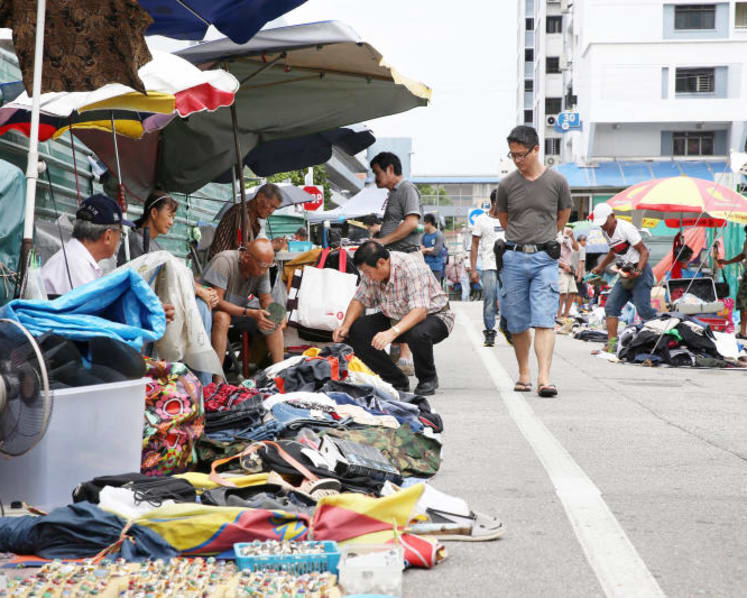
Singapore’s oldest and largest flea market at Sungei Road, popularly known as Thieves’ Market, will shut for good on July 10, 2017, but some vendors are keen on relocating. TODAY file photo


SINGAPORE — Five of the original 11 vendors who hold permits at the Sungei Road flea market have shown interest in relocating to hawker centres in the city area, when the famous landmark is shut down for good on July 10.
In the first year, rental for these vendors would be waived, and a 50 per cent rebate off the subsidised rent would be given for the second year on a “goodwill basis”, should they take up the offer.
Giving an update on the redevelopment plans in Parliament on Monday (April 3), Mr Masagos Zulkifli, who is Minister for the Environment and Water Resources, added that one out of the 11 permit-holders was given financial aid, while talks with the rest of the permit-holders are ongoing.
The market, popularly known as Thieves’ Market, has been in operation since the 1930s, but got smaller to make way for the construction of the new Sungei Road MRT Station.





In February, the Government announced that the site would be used for ground preparation works for future residential development use, and the original permit-holders trading at the market would be invited to set up shop at Golden Mile Food Centre and Chinatown Market.
The National Environment Agency told TODAY that piece-and-sundry stallholders eligible for subsidised rental at Chinatown Market on Smith Street pay S$184 a month, and those at Golden Mile Food Centre on Beach Road pay S$110.40 a month, but the 11 permit-holders would get waivers and rebates should they take up the offer to have a stall at either of these places.
In the 1970s and 1980s, 31 rag-and-bone men were given permits to peddle their wares at the Sungei Road flea market — located between Jalan Besar and Rochor Canal Road — when the Government carried out a massive programme to resettle street hawkers into purpose-built markets and hawker centres with proper amenities. Of these 31, only 11 permit-holders still operate at the roadside market today.
In asking about the help given to the affected vendors, Nominated Member of Parliament Kok Heng Leun said that such a “micro-economy” forms an important livelihood for hawkers, and he also asked whether other sites could be opened to them to trade, because having such outdoor markets is pivotal in preserving Singapore’s cultural landscape.
While Mr Masagos acknowledged that the move means Singapore “(stands) to lose something very important and memorable”, there is a balance to be struck in line with the country’s needs.
Mr Masagos pointed out that the residents in the area had been “accommodating” to the hawkers over the years, even when there were obstructions of public roads, goods being stored in public places, and people found sleeping around the estate.
For those who need to peddle their wares, they can do so at trade fairs where they pay rent and are well-managed, he added.
“There are alternatives,” Mr Masagos said, “but should we put up another site like this ... deemed to be like Sungei Road but not at Sungei Road ... I don’t think this is something we want to dwell on (further).”
Speaking to TODAY, long-time vendor Koh Ah Koon, 76, who sells antiques and radios at the market, asked what would happen to sellers who do not hold permits.
For now, many of them are waiting for the Government to give more details before they decide what to do next, he said.
Mr Koh said many of the regular customers like the outdoor market because it offers a more authentic experience and they value its heritage.
“The Government says it wants to help the pioneer generation, but what about (those) who have nowhere to go and no livelihood? It has to think carefully before imposing such changes,” he said.




