







Special care to help men in prostate cancer journey
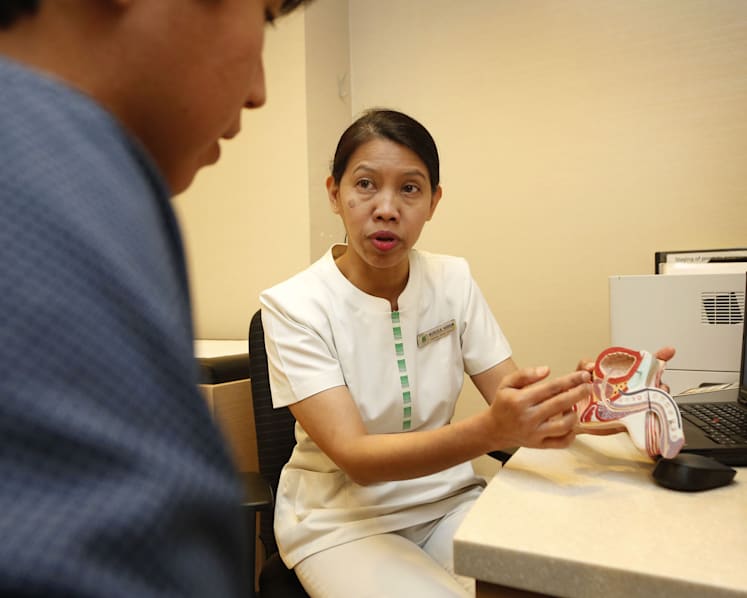
Norlela Hashim is an Assistant Nurse clinician at SGH. She is one of 4 specialist nurses in Singapore trained to provide support and personalised care to prostate cancer patients. Photo: Raj Nadarajan/TODAY
SINGAPORE — “Have you been doing your Kegel exercises correctly?” Ms Norlela Hashim, 52, an assistant nurse clinician at Singapore General Hospital (SGH), regularly asks male cancer patients.
Urine leakage or dribbling is a common side effect following surgery to remove the prostate and its nearby tissues – called a prostatectomy. Regular Kegel, or pelvic floor, exercises can help patients manage the symptoms.
Teaching patients to squeeze the right pelvic muscles and re-train their bladders are all in a day’s work for Ms Norlela, a prostate cancer specialist nurse (PCSN). And no, the veteran nurse does not find such interaction with patients awkward.
“I find that if you explain things to the patients in a factual and professional manner, it’s not (awkward or embarrassing),” said Ms Norlela, one of the four nurses trained to provide personalised care and support to prostate cancer patients under the Singapore Cancer Society (SCS) Prostate Cancer Specialist Nursing Programme. It is part of the society’s Prostate Cancer Survivorship Programme, which was launched in 2013 with The Movember Foundation, a global men’s health charity.





The programme includes support services such as the SCS Walnut Warriors support group for prostate cancer survivors and an exercise programme to help patients cope with symptoms of the disease and treatment.
Specialised cancer nursing care is playing an increasingly important role as cancer incidence rises.
Prostate cancer, which generally affects men aged above 50, is currently the third most common cancer in men here. It has increased five-fold over the last four decades, from about five to 28.5 per 100,000 men.
SCS’s Prostate Cancer Survivorship Programme is a collaboration with SGH, Tan Tock Seng Hospital and National University Hospital.
Introduced at the hospitals from 2015, it costs S$792,000 to run over three years and was modelled after a similar programme piloted by The Movember Foundation and Prostate Cancer Foundation of Australia.
Ms Norlela visited the Peter MacCallum Cancer Centre and Austin Hospital in Melbourne as part of her specialist nursing training.
PCSNs like her juggle a number of duties including educating newly-diagnosed patients about the disease, treatment options and their side effects. They follow up on pre- and post-surgery care, and coordinate patients’ treatment schedules and follow-up care.
The PCSNs have also developed resources such as toolkits, consisting of information booklets and a video, for prostate cancer patients. There are plans to expand the programme to other hospitals here, said SCS’ chief executive Albert Ching.
Prostate cancer is a complex disease, and patients need additional support as they face many difficult decisions from the time they are diagnosed to their treatment, said Dr Lincoln Tan, chairman of SCS Prostate Cancer Survivorship Programme.
“While doctors provide the information about the disease and treatment, there is often insufficient time in the busy outpatient clinic for many men to process the information and different options given to them. The availability of the PCSNs to reinforce the information gives patients time to fully comprehend the information provided and to make clearer decisions,” said Dr Tan.
For some patients, side effects such as urinary incontinence and sexual dysfunction can occur after surgery or radiation therapy. The changes can affect them physically and psychologically, said Dr Tan, who is a consultant at National University Hospital’s department of urology.
Ms Norlela also addresses patients’ concerns on sexual health issues that may crop up after cancer treatment.
“Sometimes, during counselling, when we mention potential treatment side effects like erectile dysfunction, the patients’ adult children will go, ‘Aiyah you don’t have to talk about this to my father, lah. He’s old already’,” she said. “I have to explain to them that this is part of rehabilitation, and they should know what to expect unless the patients themselves don’t wish to talk about it.”
PCSNs provide financial counselling and refer patients to support services within the community – an important aspect of cancer care as survival rates have improved.
Mr Patrick Foo, 73, is one of those who benefited from the SCS’ programme.
Diagnosed with Stage 3 prostate cancer in 2016, Mr Foo felt more “at ease” after receiving support from a PCSN.
“When you hear the word ‘cancer’, it is very frightening. The nurse’s encouragement and explanation of the disease, and recommendation for me to join a support group, helped me tremendously. I know some fellow patients who did not have such a privilege, so I’m grateful for the support,” said Mr Foo.




