







Special shuttles, bus stop beacon lights among new train disruption measures
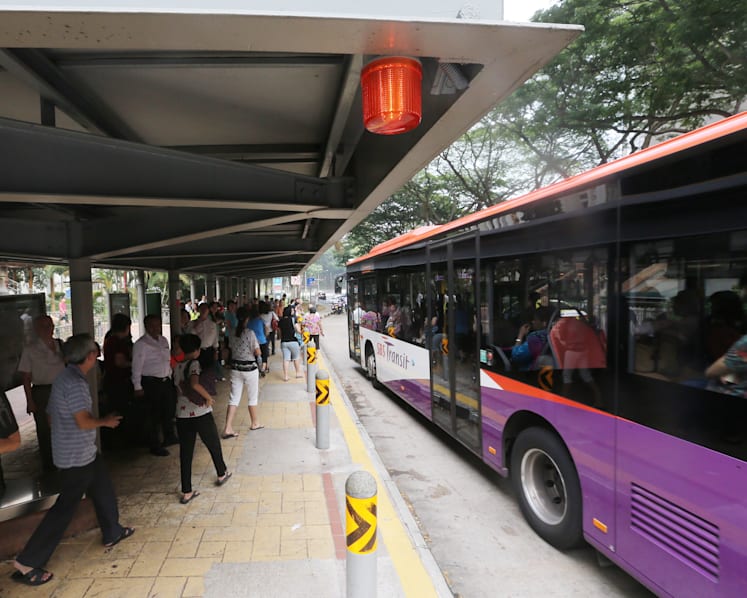
The second new emergency plan involves installing beacon lights at bus stops near MRT stations. The beacons will start flashing when there is a disruption, alerting bus drivers and commuters of a breakdown and indicating that regular bus services will be free. Photo: Ooi Boon Keong
SINGAPORE — When the next major train breakdown happens, special shuttle bus services will be sent to four key stations within 90 minutes to send stranded passengers to main heartland towns across the island. Beacon lights will also be installed at bus stops near MRT stations so as to alert commuters of any disruption.
These two new contingency plans were devised after the unprecedented breakdown of the North-South and East-West lines on July 7 this year. The plans were announced today (Oct 14) as the two public transport operators — SMRT and SBS Transit — and the Land Transport Authority (LTA) conducted a drill simulating a suspension of services on the East-West Line, after a series of power trips. Coordinating Minister for Infrastructure and Transport Minister Khaw Boon Wan, who ordered the joint exercise on Monday, visited Tiong Bahru, Buona Vista and Outram Park stations during the drill, code-named Exercise Greyhound.
In the aftermath of Singapore’s worst-ever train outage in July, which affected an estimated 413,000 commuters, people complained about being unable to board bus bridging services that were deployed or being unaware that two rail lines were down, compounding congestion at the affected MRT stations, among other grouses.
The special shuttle bus services will be activated in addition to the usual bus bridging services and when multiple rail lines suffer a breakdown. These services will ply four routes, in a loop: Jurong East-Choa Chu Kang, Buona Vista-Boon Lay, Bishan-Woodlands, and Paya Lebar-Tampines.





Speaking to reporters after the exercise today, LTA chief executive Chew Men Leong said: “We chose some of these routes to start from major interchange stations where a lot of people will exit, and also to bring them to their homes, largely the heartlands. We expect that this can help disperse the crowd quite effectively.”
SMRT and SBS Transit will run these services unless the disruption stretches beyond eight hours. In such cases, private operators, such as Woodlands Transport, will be activated. For a start, about 100 buses will be activated for such a disruption, at a frequency of 10 minutes.
“As part of our contingency planning for major national disruptions, we’ve identified the services that parallel the East-West Line and North-South Line,” said SBS Transit’s chief executive Gan Juay Kiat, who was also at the exercise. “We will be pulling buses from other services to reinforce these identified services so that we beef up capacity to deal with the expected crowd.”
Woodlands Transport’s general manager Roger Wong said the number of buses and drivers they can provide would hinge on the timing of the disruption. During peak hours, their fleet of 260 buses is fully utilised.
The second new emergency plan involves installing beacon lights at bus stops near MRT stations. The beacons will start flashing when a disruption strikes, alerting bus drivers and commuters of a breakdown and indicating that regular bus services will be free.
So far, four such lights have been installed at two bus stops near Tiong Bahru MRT Station, and the rest will be rolled out “over the course of next year or so”. The LTA could not give an estimate on the number of lights expected to be put up.
Mr Chew said: “We took some lessons from the last incident on July 7. One of the issues that commuters have is trying to find where are the specific locations they can board the bridging buses. As a result, we’ve decided to put the blinking lights at the bus stop, so that commuters can be better guided to board.”
Meanwhile, the LTA is also working on a new mobile app to provide information during disruptions. It will likely be completed close to the end of the year. “The information will include which line is affected, what are the alternative routes as far as other train lines are concerned, where the bus stop is, what are the buses available to support in terms of the bridging to other places, or special shuttles,” said Mr Chew.
During today’s exercise, the LTA also reviewed other contingency measures: The activation of free boarding on regular bus services and support staff to handle the surge in commuters, and the distribution of flyers with details on alternative transport.




