







S’pore economy expands 2.5% for Q1, MAS maintains monetary policy stance
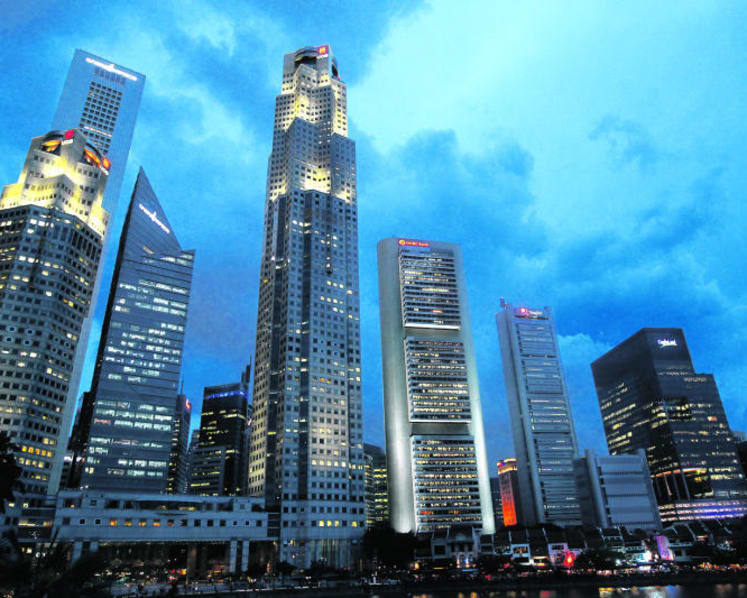
TODAY file photo


SINGAPORE — Growth in the manufacturing and services industries helped Singapore's economy expand 2.5 per cent in the first quarter from a year ago, according to advance estimates released by the Ministry of Trade and Industry (MTI) Thursday (April 13).
On a seasonally adjusted annualised basis, the Singapore economy shrank by 1.9 per cent in the first quarter from the previous three months, in a reversal from the 12.3 per cent expansion in the fourth quarter.
Economists note that growth is still uneven, amid the soft labour market and other structural headwinds that persist.
Thursday's estimates were close to expectations. Economists in a Reuters poll had expected Singapore's gross domestic product (GDP) for the first quarter to grow by 2.4 per cent compared to a year ago, and shrink 1.9 per cent on a seasonally adjusted annualised basis, coming off from a peak in the fourth quarter last year. Last month, private sector economists in a quarterly survey conducted by the Monetary Authority of Singapore (MAS) had expected the economy to expand by 2.6 per cent from a year ago in the first quarter.





"Amid an improving global outlook, the economy remains on track to meet our full year GDP growth forecast of 2.8 per cent.
"That said, the turnaround thus far has been uneven and restricted to just a few clusters. The rest of the economy has yet to feel the uplift and the labour market has also remained soft," noted DBS senior economist Irvin Seah.
"Various indicators such as a falling job vacancy ratio, slowing wage growth and declining re-employment of retrenched workers point to a tough labour market. Indeed, retrenchment hit a seven-year high in 2016, taking a toll on consumption. Moreover, these problems aren't likely to disappear anytime soon. Unit labour costs (ULCs) in Singapore have become elevated, exerting increased pressure on corporate profitability. Deflating ULCs to more reasonable levels will require an extended period of wage restraint and further retrenchment," ANZ economist Ng Weiwen said.
In a separate MAS report Thursday, the central bank said it will continue guiding the local currency on a zero appreciation stance against those of its major trading partners. The width of the Singapore dollar nominal effective exchange rate (S$NEER) band and the level at which it is centred were left unchanged.
MAS' inflation forecasts for this year remain unchanged from October. MAS Core Inflation, which excludes the costs of accommodation and private road transport, is projected to average between 1 and 2 per cent, compared to 0.9 per cent in 2016, while headline inflation is expected to rise to a range of 0.5 to 1.5 per cent from minus 0.5 per cent last year.
Some economists are not expecting a revision of MAS' policy stance in the next policy meeting in October following the central bank's call in its statement that a "neutral policy stance is appropriate for an extended period and should ensure medium-term price stability."
The central bank had noted that the "underlying momentum in the (Singapore) economy remains intact", with output of electronics and its related services segments still at healthy levels, despite the pullback in the first quarter. However, activity across the broader domestic economy is likely to be uneven, and overall GDP growth in 2017 will remain modest. Overall, the economy should expand by 1 to 3 per cent for this year, MAS said.
Breaking down the economy's performance by sectors, MTI said the manufacturing sector expanded by 6.6 per cent in the first quarter this year from a year ago, moderating from the 11.5 per cent growth in the previous quarter.
The sector was helped by "robust output expansions" in the electronics and precision engineering clusters, which outweighed output declines in the biomedical manufacturing, transport engineering and general manufacturing clusters.
The services-producing industries expanded by 1.5 per cent on a year-on-year basis in the first quarter, improving from the 1 per cent growth in the previous quarter. Growth was mainly supported by the wholesale and retail trade, as well as transportation and storage sectors.
Meanwhile, the construction sector shrank by 1.1 per cent year-on-year for the first quarter, extending the 2.8 per cent decline in the previous quarter, weighed down by a slowdown in private sector construction activities, the ministry said.




