







S’pore has to ‘adapt to change, but stay true to our values’, says DPM Heng, as MPs raise jobs, inequality concerns
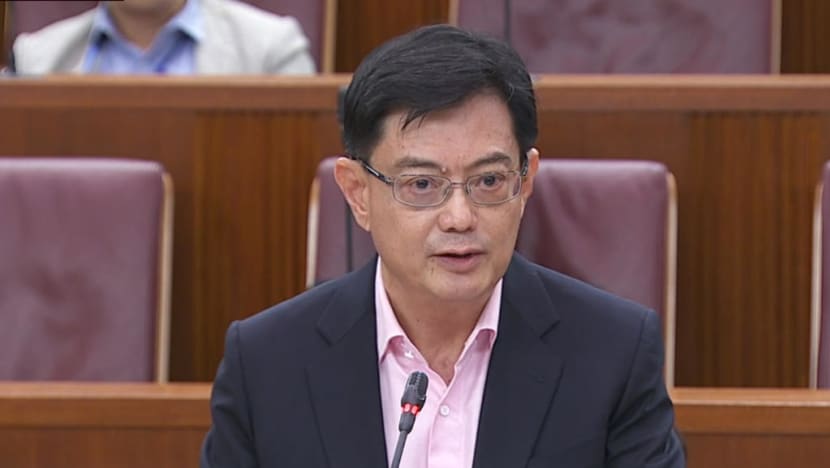
Deputy Prime Minister Heng Swee Keat said that Singapore must forge new forms of connections, and remain open to investment and talent from around the world.
- Deputy Prime Minister Heng Swee Keat said Singapore needs to change to adapt, while staying true to the nation’s values
- During his speech, he also cautioned against polarisation
- Several MPs raised the problems faced by asset-rich but cash-poor Singaporeans
- Opposition Leader Pritam Singh called for greater recognition of the work of tradesmen
- MP Melvin Yong raised the issue of the mental health impact of working from home
SINGAPORE — Singapore needs to adapt to a post-Covid world while staying true to the country’s values and avoiding polarisation, Deputy Prime Minister Heng Swee Keat said in Parliament on Monday (Aug 31).
He was one of 19 political officeholders and Members of Parliament (MPs) who spoke on the first day of a debate known as the Motion of Thanks, which is a response to the President's Address, made by President Halimah Yacob when Parliament reconvened on Aug 24 after the General Election.





Given the economic uncertainties Singapore is facing due to the Covid-19 pandemic, the major themes of the day raised by MPs revolved around jobs, inequality, and the need to resolve emerging issues that may impede social mobility.
Many also touched on a topic that has been in the spotlight in recent weeks: The hiring of foreign PMETs (professionals, managers, executives and technicians).
Five first-term MPs and political officeholders made their maiden speeches in the 14th Parliament that features the widest opposition bench — 10 Workers’ Party (WP) MPs — since Singapore’s independence.
The first political officeholder to speak was Mr Heng, who is also Finance Minister. He focused his speech on the need to “adapt to change, but stay true to our values” to ensure changes do not lead to polarisation.
He also spoke about the need for Singapore to “adapt as an economy, a society and a people”.
ECONOMY MUST CHANGE
When it comes to adapting as an economy, Mr Heng said that to create jobs for people and new opportunities for entrepreneurs, Singapore can build on tripartism — that is, the Government, businesses and the labour movement working together.
“Singapore can (be) a test-bed that creates deeper linkages with an expanded set of stakeholders, including our education and research institutions, our community groups, and interested partners from around the world,” he added.
He also said that the Government must “redouble our efforts to develop everyone to their fullest potential”, adding that about half a million people here took part in SkillsFuture programmes last year.
The Government will invest in incubating and accelerating startups, and supporting established companies to expand their research and development to build competitive strengths.
This would create a vibrant innovation ecosystem that would build up Singapore’s capabilities to find new bright spots amid economic disruption, which is necessary in the transformation of the economy, he said.
“We must find new ways to be a vital node, with rich and deep interconnections with the rest of the world. We must therefore forge new forms of connections, such as digital economy agreements, while deepening our linkages with regional markets,” he said.
“We must also remain open to investment and talent from around the world.”
In terms of social policies, Mr Heng said that the Government will continue to invest in Singaporeans during tough times and match them to new job opportunities.
“With major changes in the economy and labour market, we will need to adapt our social safety nets and keep inequality in check.
“More workers will fall on hard times, and we need to enable them to adjust and bounce back through this crisis and beyond,” Mr Heng said, adding that support for self-employed persons will have to evolve.
The Government must also continue to uplift lower wage workers and enable older workers to continue working, if they wish to do so.
AID FOR PRIVATE ESTATE RESIDENTS
On the issue of government aid, three MPs urged the Government to review the current policy of pegging government assistance to the value of the homes in which citizens reside.
They raised various policy gaps faced by Singaporeans residing in private properties, who are often disqualified from getting government aid because their home values exceed the cut-off for receiving assistance.
These residents have not been spared by the wide-reaching effects of Covid-19 and may also be in urgent need of financial help, the MPs said.
Mr Lim Biow Chuan, MP for Mountbatten Single Member Constituency (SMC), said: “When a Singaporean suffers loss of income, then regardless of his house type, he needs help... During good times, he pays all his taxes dutifully. But when times are hard, should the Government decline to help these people just because they have a house with a higher value?”
Mr Christopher De Souza, MP for Holland-Bukit Timah Group Representation Constituency (GRC), said that some some of these residents may not own the homes where they live, or may have recently sold their homes under difficult financial circumstances and have moved back in with their siblings or parents.
Yet, they were deemed ineligible for various pandemic support grants and relief schemes.
He suggested that support schemes should assess home ownership rather than place of residence, and take into account personal income apart from just household income per capita.
That way, less well-off Singaporeans living with their parents or single parents returning to live with their older parents, for example, would have access to the government aid they need.
For private estate residents who are “asset-rich but cash-poor”, Mr Henry Kwek, MP for Kebun Baru SMC, suggested that the Government work with banks and insurance firms to create reverse mortgage options for private estates and to remove barriers for these residents to borrow against their housing equity, even beyond the age of 70.
“Now is a good time for the Government to do a thorough review, and spell out the core principles of means testing for private estate residents, which can form the basis of a new social compact with our private estate residents,” he said.
MENTAL HEALTH SUPPORT
The realities of working during a pandemic also got an airing. Mr Melvin Yong, MP for Radin Mas SMC, said in his speech that while workplace safety is being improved, health in the workplace should not be neglected.
He spoke about a recent study that found that those who work from home faced higher levels of stress than frontline workers.
“I hope that the Government could expand the list of occupational diseases under the Work Injury Compensation Act, to include mental health illnesses related to work stress.
“I also hope that the Tripartite Advisory on Mental Health can be expedited, so that those who are currently struggling with mental health issues related to work can get the necessary support that they need,” he said.
Mr Yong added that the "right to disconnect" legislation pioneered in France, where employees can negotiate with their employers on answering work calls and emails outside of office hours, should be considered.
“Having a dedicated break can certainly help to reduce employee fatigue and burnout,” he said.
UPLIFTING TRADESMEN
In his first speech as Leader of the Opposition, Mr Pritam Singh said that Singapore should raise the value of the work of tradesmen, saying it will “fundamentally alter our understanding of meritocracy”.
“In Singapore, although our educational institutions train our citizens for such vocations, not enough is done to protect their trades,” Mr Singh said. He gave the example of tradesmen making good wages in Australia, Germany and New Zealand.
“The way to protect our tradesmen is to regulate who can practise each trade… Uplifting our tradesmen will require a paradigm shift in how workers are viewed and trained.
“If it succeeds, it will raise the self-esteem and incomes of Singaporeans, who may not be academically inclined, but who have acquired valuable skills that many of us in this House would not be able to fully master.”
OPPOSITION PARTIES NOT ENEMIES
In addition to economic and social policies, the debate in Parliament also touched on political discourse. Mr Lim, in his speech, urged the Government to be “more open to constructive criticisms and rational debate”.
“I would submit that the Government must not treat politicians from other parties as enemies. They, too, are fellow Singaporeans. We must assume that they also want the best for Singapore even if they do not agree with all the government policies,” he said.
“And where politicians from other parties and even from PAP have good ideas, I urge the Government to acknowledge and consider these ideas,” he added.
Mr Lim said that he hopes for a “less confrontational political system so that Singaporeans can be more united”.
“If we do not get our politics right, there will be continued distrust in the Government and we will not stand united. We will not be able to overcome crises together,” he said.
He also urged the leaders of other political parties to “condemn the destructive criticisms that push falsehood and twist facts out of context”.
“Constructive suggestions build up Singapore. Destructive untruths will bring down our country because it instils hatred against fair and decent leaders,” he said.




