







S’pore’s key test is competent leadership, not ‘right numerical balance’ in Parliament: PM Lee
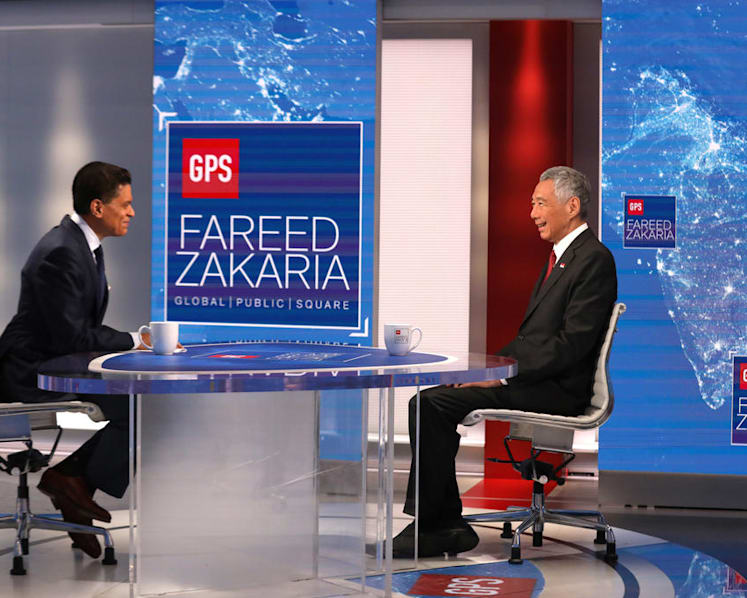
Prime Minister Lee Hsien Loong (right) speaking on current affairs show Fareed Zakaria GP on Oct 6, 2019.


SINGAPORE — Singapore’s key test in the next decade or two is whether it has competent leadership that works for Singaporeans, rather than achieving the “right numerical balance” in Parliament between the opposition and the Government, said Prime Minister Lee Hsien Loong.
“I hope that 10 years from now — even 20 years from now — Singapore will have a system which is functioning for it, which commands respect from the population and acceptance that this is a system which is working for them and delivering good government to them,” Mr Lee said in an interview with global news network CNN, clips of which were uploaded on its website on Tuesday (Oct 8).
The prime minister was answering a question from host Fareed Zakaria on whether Singapore would, a decade from now, have a more balanced and open two-party democratic system. Many people have said Singapore’s political system was too unfairly tilted towards the ruling party, Mr Zakaria noted.
Mr Lee, who was speaking on current-affairs show Fareed Zakaria GPS, said it was not a matter of whether there is the “right numerical balance” in Parliament between the opposition and the Government.





“It is generating a leadership team which is competent, committed and delivering results. I think that is the key test,” he said.
In the last General Election (GE) in 2015, the ruling People’s Action Party (PAP) won 83 out of 89 parliamentary seats. The opposition Workers’ Party took the remaining six.
When asked if Singapore can have “a real democracy” where one party wins 80 per cent of the seats for decades, Mr Lee replied: “If that is how the population votes and that is the will of the people, why should that not be a real democracy?”
But there are arguments that the PAP has unfair advantages, Mr Zakaria said.
Responding, Mr Lee said that every seat had been contested at the 2015 polls. In the 2011 election, it was “almost so” — at that time, all seats were contested, except Tanjong Pagar Group Representation Constituency.
“The population so voted. If they were unhappy with me, I would not be sitting here peacefully, smiling and talking to you,” he said. “I would have other problems on my mind.”
Mr Lee, 67, has said that he hopes to hand over the reins before he turns 70. Deputy Prime Minister Heng Swee Keat, 57, is widely expected to succeed Mr Lee as prime minister if the PAP prevails at the next GE, which is due by April 2021.
Mr Lee, when asked what he plans to do after stepping down as prime minister, said he would “worry about that when the time comes”.
In the wide-ranging television interview recorded on Sept 26, which delved into global and domestic affairs, Mr Lee also spoke about relations between the United States and China and how ongoing tensions between the two global powers are affecting other Asian countries.




