







Spotlight turns to fourth-gen leadership
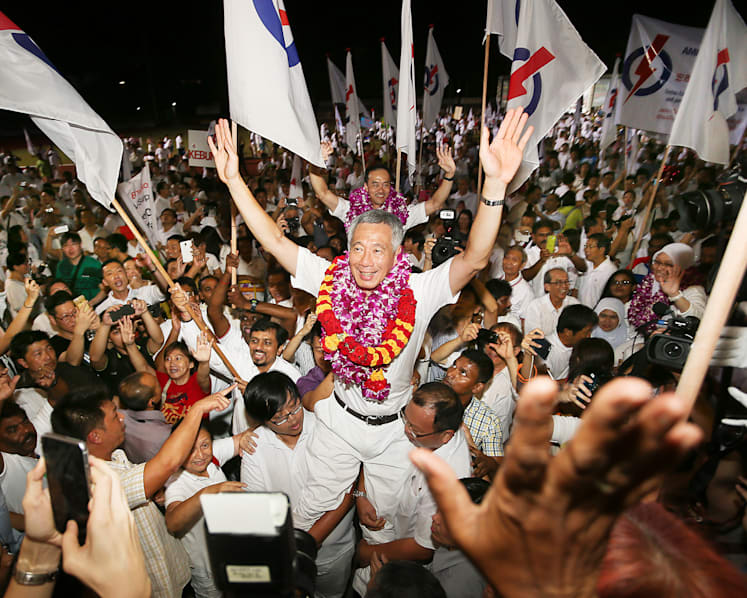
The PAP’s landslide victory in GE2015 has allowed PM Lee to bring in the people he wanted to reinforce the core leadership team. Photo: Ray Chua


If 2015 could be described as a bumper year for political junkies, then 2016 will be a massive one as well, with key pieces of the country’s political landscape falling into place and setting the stage for years to come.
All eyes will be on the fourth-generation leadership, with the clock ticking down for Prime Minister Lee Hsien Loong and senior Cabinet members to hand over the baton by the next General Election (GE) in about five years’ time.
With leadership renewal cited by the ruling People’s Action Party (PAP) as the single most important issue in the recent GE, the PAP’s landslide victory not only allowed PM Lee to bring in the people he wanted to reinforce the core leadership team, but also provided a strong and stable foundation for the group to work on.
How individuals of the core team handle various national issues and the type of assignments given to them will be closely watched, as they seek to establish themselves in the eyes of parliamentary colleagues and Singaporeans at large, political analysts and former Members of Parliament (MP) said.





The transition is well and truly in place, with the younger leaders taking over not just the running of key ministries, but also parliamentary roles — such as the Leader of the House (Ms Grace Fu) and the Government Whip (Mr Chan Chun Sing).
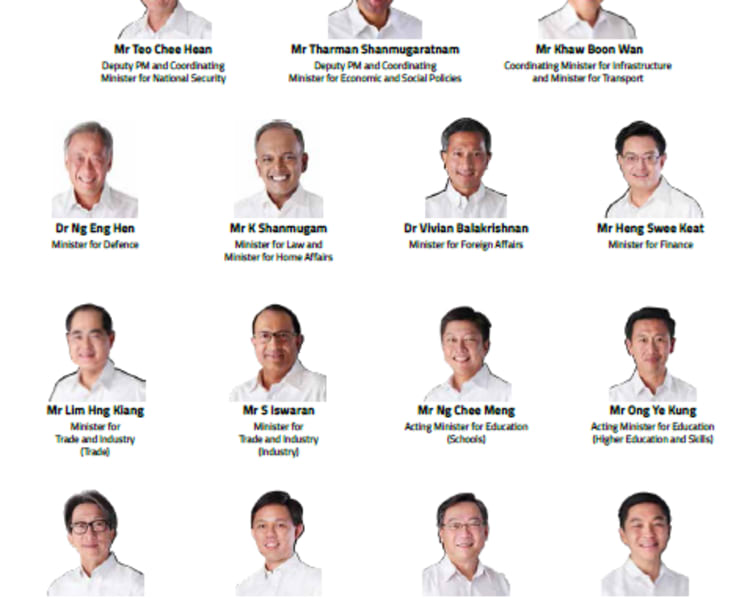
While all the fourth-generation leaders come with stellar credentials, National University of Singapore political scientist Bilveer Singh noted that “to be ‘political captains and commanders’ is a totally different thing and that is what needs to be watched”.
Both former PAP MP Inderjit Singh and Singapore Management University law don Eugene Tan pointed out that time is of the essence, and the younger leaders have to be in the thick of the action and cut their teeth during the term of the 13th Parliament, which will be convened on Jan 15.
“They will have to establish their own identity … the third-generation leadership must also appropriately cede the centre stage,” said Associate Professor Tan.
Describing the current Cabinet as one “of guardians and understudies”, Associate Professor Alan Chong from the S Rajaratnam School of International Studies said the public will also observe how senior Cabinet members mentor their younger colleagues.
HIGH EXPECTATIONS FOR PAP
When the next Parliament begins its term this month, it will be the first time since 1955 that the legislature will be without one of its most distinguished members — former Prime Minister Lee Kuan Yew, who died in March last year. While Mr Lee, who stepped down from Cabinet in 2011, had wound down his participation in parliamentary debates in his later years — his last major speech in Parliament was made in 2009 — he continued to attend the sessions, health permitting.
Nevertheless, political analysts felt that Mr Lee’s absence will be felt as the PAP Government enters the post-Lee Kuan Yew era. The ruling party must now forge its own identity, said Assoc Prof Chong.
“Can Singapore still continue to stay relevant and earn the respect (of other countries) without an equivalent of Lee Kuan Yew?” he said. “SG50 is not a terminal celebration ... (The PAP) may have won a massive mandate (in the GE), but does that mean they fully understand what it means to be in a post-Lee Kuan Yew era?”
Also referring to the PAP’s 69.9 per cent vote share, Assoc Prof Singh noted that there will be high expectations for the ruling party from voters, who have thrown their support behind it.
Agreeing, Institute of Policy Studies senior research fellow Gillian Koh said the electorate will expect the PAP to “continue to make good on its promises to create an economically and socially inclusive society”.
Singaporeans are a practical lot, she added, pointing out that they will look at how the PAP delivers on their desire to see accessible and affordable healthcare, and comfortable retirement for seniors, among others.
“(There) will be pressure for the PAP to work even harder and harder in spite of the Prime Minister’s call to Singaporeans to chip in to create the lives they wish for. Some may roll up their sleeves and relish the chance to be entrepreneurial, whether it is in the business or the social sectors, but others may feel that it is up to the PAP to make good on its promises,” said Dr Koh.
She added that the PAP will also need to work hard to maintain the pace of deep on-the-ground engagement with constituents, or people will sense complacency.
With the PAP moving into a new era — and the country entering its next phase post-SG50 — entrenched “unpopular” policies could be re-examined, said Assoc Prof Tan, adding that Singaporeans increasingly expect greater political space.
WHAT NEXT FOR WP?
While the PAP will be looking to repay the voters’ faith, the Workers’ Party (WP) — having suffered a setback in the GE — will have a point to prove, the analysts said. They added that this is especially so given its muted performance in the 12th Parliament, which some experts had said contributed to its poor electoral showing.
Mr Inderjit Singh, who stepped down before the GE, said the WP has to take a different tack. “If it can change and show it is capable of impressive debates and of suggesting new ideas, it may win back some support,” he said.
Assistant Prof Woo Jun Jie, from Nanyang Technological University’s School of Humanities and Social Sciences, added: “The challenge for the WP is not just to speak up, but also to delve deep into issues and make points that reflect its unique ideological and policy positions.”
Assoc Prof Tan said the opposition party needs to change its previous hit-and-run, guerrilla style of politics. “(The WP) needs to move away from equivocating on contentious issues and be ready to lock horns with the PAP government on these issues in a substantive, sustained and unequivocal manner. Singaporeans need to know who they are or what they stand for,” he said.
With the loss of the Punggol East seat, the WP will have six elected representatives in Parliament. Nevertheless, it could fill all three of the available Non-Constituency MP seats — bringing its total representation to nine, unchanged from the 12th Parliament. “It is not the quantity of representation, but quality of debate,” said president of Association for Public Affairs at LKYSPP Charles Phua.
Assoc Prof Tan felt that compared with 2011 when the WP entered Parliament on a high, following its victory in Aljunied Group Representation Constituency — the first GRC win by the Opposition — the party could actually benefit from less attention and lower expectations this time.
“In a sense, the focus will shift from the WP to the PAP, as Singapore is on the threshold of the third political transition and handover (following those by the first two Prime Ministers, Mr Lee and Mr Goh Chok Tong),” he said. Even so, the WP will not be able to escape scrutiny as Singapore’s political landscape matures, he said. “Will (the WP) move away from a ‘we are not ready to form the government’ strategy to one that seeks to competitively contest all seats and to form the government within a reasonable time span?”
However, Dr Walter Theseira, a senior lecturer at SIM University, argued that the WP’s Parliamentary performance over the next five years or so would be less of a factor compared to its work on the ground. He said: “While parliamentary representation is important, many voters don’t have the time to pay attention to the proceedings … voters don’t seem to prioritise parliamentary performance as an important enough criteria to overcome a lack of connection on the ground.”
Away from Parliament, the WP will be seeking to “re-connect with voters on the ground, ensure that any shortcomings with its town council are fixed, and build up its strength in the areas it wants to contest next time around”, he said. ADDITIONAL REPORTING BY SIAU MING EN AND VALERIE KOH




