







Taking the fight to diseases, superbugs
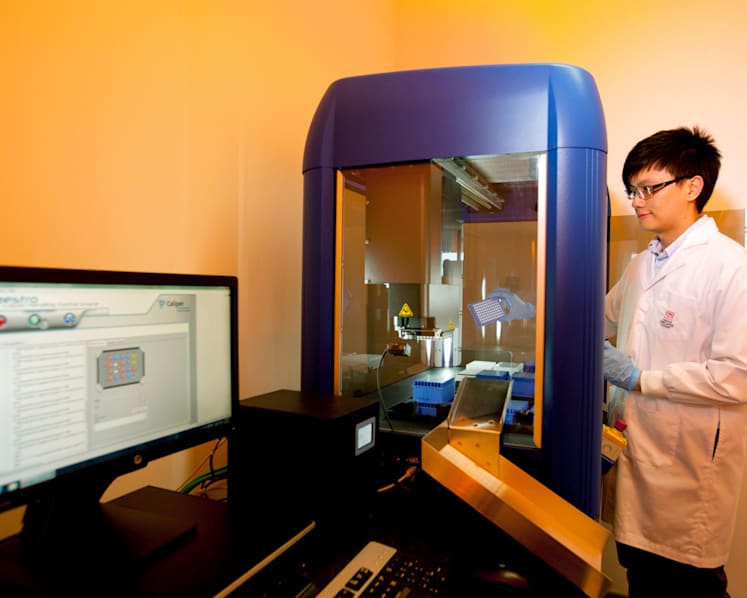
At the National Heart Centre Singapore, a new gene test now allows doctors to screen for mutations in genes known to cause inherited cardiac conditions at a fraction of the time and cost. photo: National Heart Centre Singapore
1. Genomic database for more efficient healthcare
Ever since scientists successfully mapped the first human genome over a decade ago, rapid advancements in DNA sequencing technology have cut the time and the cost required to sequence a person’s DNA, from US$100 million (S$145 million) in 2001 to US$1,000, says the National Human Genome Research Institute.
However, the resources needed to store and catalogue the vast amount of data is not always straightforward.
This will soon change with the Centre for Big Data and Integrative Genomics (c-Big), which was officially launched last month.





A joint collaboration among four institutes at the Agency for Science, Technology and Research (A*Star), c-Big will build a genomic database that would contribute to more precise diagnoses of diseases and treatments, prevention of the next viral pandemic, and tracking down the source of a disease outbreak.
Among its various projects is establishing a 10,000-strong database of homegrown genomes to understand genetic diversity within Singapore.
“We want to do our analysis locally, and not have to borrow insights from other populations. Everything in Singapore is different — from the diets to the lifestyles, genomes, healthcare systems, and compliance to drug regimens,” said Dr Shyam Prabhakar, group leader of Computational and Systems Biology and associate director of Integrative Genomics at A*Star’s Genome Institute of Singapore.
Another c-Big project involves building a sequence database of disease-causing pathogens in Singapore and its neighbours. A larger genomic bacterial database will become publicly available next year.
With the system in place, a hospital-acquired infection or an emerging bacterial outbreak, such as the Group B Streptococcus outbreak in 2015 that affected over 200 people, could be analysed and tracked down in six hours instead of the week it took last year.
“The earlier we know there is an outbreak happening, the easier it is for the public health and medical communities to try to limit or stop the outbreak from getting worse,” said Assistant Professor Swaine Chen from National University of Singapore and senior research scientist at the Genome Institute of Singapore.
2. New gene test for matters of the heart
On the heart-health front, a new gene test now allows doctors to screen for mutations in genes known to cause inherited cardiac conditions at a fraction of the time and cost.
Developed by the National Heart Centre Singapore (NHCS) with Imperial College London, the new test screens 174 genes suspected of causing 17 inherited cardiac conditions.
It is currently available at NHCS for about S$1,000, and patients may get their report in about a month.
“With the old technology, you can only screen two to three genes so you may miss out on some genes, and the long time taken (about six months) may create anxiety in patients,” said Professor Stuart Cook, Tanoto Foundation professor of cardiovascular medicine at SingHealth Duke-NUS Academic Medical Centre.
Inherited heart conditions are caused by gene mutations, and there is a 50 per cent chance of passing on the mutation in first-degree relatives (parents, children, siblings).
An example of an inherited heart condition is hypertrophic cardiomyopathy (HCM), which is a common cause of sudden cardiac arrest in young people including athletes, said Prof Cook.
The new test would offer peace of mind to families of patients with the gene mutation.
Family members who are tested negative for the faulty genes can now avoid lifelong monitoring, which used to be the case with conventional tests. More importantly, the genetic information will translate to better patient care.
For example, some people with HCM, or “thick heart”, have an enzyme deficiency. This can only be identified with a genetic test, and doctors can subsequently give them the appropriate therapy, said Prof Cook.
3. Stimulating the immune system to fight cancer
In Singapore, 37 people are diagnosed with cancer every day. For patients, especially those with advanced cancer, the emerging field of immuno-oncology offers great promise.
Unlike conventional chemotherapy, which works by killing rapidly growing cells and causes side effects due to collateral damage to healthy cells, immunotherapy drugs stimulate the body’s own immune system to fight cancer cells.
President of the Singapore Society of Oncology Ravindran Kanesvaran considers it a major development in cancer treatment that has picked up pace in the last two years.
“There are currently (immunotherapy) clinical trials in nearly every single tumour type. The year 2017 will see the emergence of a slew of clinical trial data, which will be beneficial for nearly all cancer types including bladder, breast, gastric, head and neck cancers,” said Dr Ravindran.
4. Ultra-fast novel bacteria killer
Drug-resistant superbugs have become one of the most pressing problems in healthcare. Conventional antimicrobial agents used in common cleaning products, such as triclosan, kill bacteria without destroying the cell membrane, allowing the bacteria to develop resistance, said Dr Yugen Zhang, group leader at the A*Star Institute of Bioengineering and Nanotechnology (IBN).
Driven by the need to find a more suitable alternative, researchers at the IBN have developed a new material that can kill E coli bacteria within seconds.
E coli is a type of bacteria found in the intestines of humans and animals, and some strains can cause severe diarrhoea, abdominal pain and fever.
The novel synthetic material, known as imidazolium oligomers, can kill 99.7 per cent of the bacteria within 30 seconds — more rapidly than any existing antimicrobial product on the market, such as handwash or surface sprays. Existing products take minutes to hours to kill the bacteria, said Dr Zhang, who led the project.
According to him, the new material can be used in consumer and household products, as well as the coating on surfaces in hospitals, which are common breeding grounds of superbugs. It was also tested and found to be effective against other common strains of antibiotic-resistant bacteria and fungi, such as Staphylococcus aureus, Pseudomonas aeruginosa and Candida albicans.
It was licensed by a multinational firm for commercial development in October.
The researchers’ next step is to further develop the antimicrobial material for use in animal agriculture, where the overuse of antibiotics has led to the growth of antibiotic-resistant bacteria, said Dr Zhang.
5. HIV vaccine in the making
A new clinical trial supported by the National Institutes of Health (NIH) in the United States was launched this year to test an experimental vaccine for the Aids-causing human immunodeficiency virus (HIV).
Known as the HVTN 702, the vaccine is being tested in South Africa, where more than 1,000 people become infected with HIV every day.
It aims to enrol 5,400 men and women, making it the largest HIV vaccine clinical trial to take place in South Africa.
If deployed alongside existing and proven HIV prevention tools, a safe and effective vaccine could be “the final nail in the coffin for HIV”, said Dr Anthony S Fauci, director of the National Institute of Allergy and Infectious Diseases — which is part of the NIH and a co-funder of the trial — in an NIH press release last month.
The National University Hospital and Tan Tock Seng Hospital, which see most of the HIV cases in Singapore, recently started offering a pill known as the pre-exposure prophylaxis, or PrEP, to HIV-negative people at high risk of contracting the disease.
There are about 450 newly reported HIV cases in Singapore each year.
PrEP is one of the newer HIV prevention measures, and has been shown to reduce the risk of contracting HIV from sex by more than 90 per cent when taken as prescribed, according to the US Centers for Disease Control and Prevention.




