







Bloomberg reporter had ‘agenda’ to link ministers to money laundering concerns: Lawyer Davinder Singh
Mr Low repeatedly maintained that money laundering was not the focus of his article.
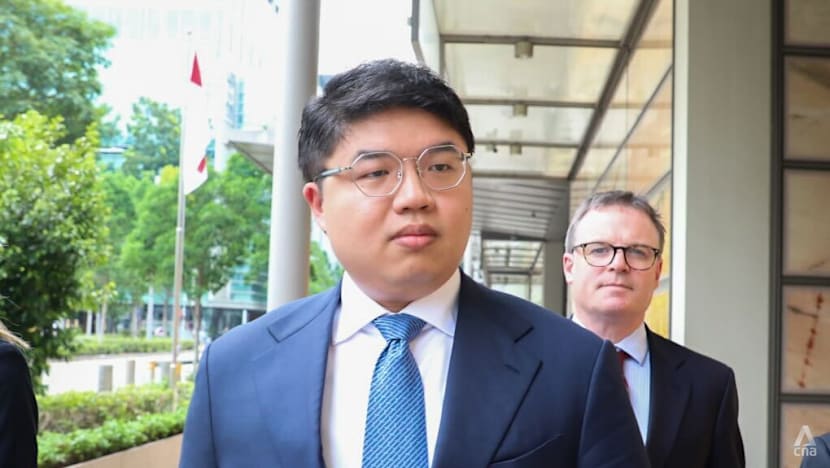
Bloomberg reporter Low De Wei (centre) leaving the Supreme Court on Apr 9, 2026. (Photo: CNA/Alyssa Tan)

This audio is generated by an AI tool.


SINGAPORE: A Bloomberg reporter was accused on Tuesday (Apr 14) of harbouring an editorial "agenda" to link two Cabinet ministers' property deals to money laundering, actively seeking to frame it as a narrative even when his source had not explicitly made money laundering the focus.
During the second day of his cross-examination of reporter Low De Wei, Senior Counsel Davinder Singh pointed to passages linking “under the radar” transactions and low-profile purchases to the S$3 billion money laundering scandal, putting it to Mr Low that these formed a consistent theme in the article.
Mr Singh, who represents Home Affairs Minister K Shanmugam and Manpower Minister Tan See Leng, also said Mr Low had attempted to “spice up” the article with references to money laundering, writing it such that the mention of such crimes was adjacent to references of Dr Tan's and Mr Shanmugam's deals.
Mr Singh said the article portrayed the system as “so opaque”, with “no checks and balances or mandatory disclosure rules” that parties “took advantage of … because of concerns over money laundering”.
Mr Low, who repeatedly rejected Mr Singh's premise, maintained that money laundering was not the focus of his article.
Both Mr Shanmugam and Dr Tan were also present in court on the sixth day of the defamation suit they brought against Mr Low and Bloomberg.
What the trial is about
Mr Shanmugam and Dr Tan sued Bloomberg and reporter Low De Wei for an allegedly defamatory article in December 2024 about Good Class Bungalows (GCBs).
The article mentioned Mr Shanmugam selling his GCB in Astrid Hill for S$88 million to UBS Trustees when he had bought it for S$7.95 million in 2003. It also referenced Dr Tan buying a GCB in Brizay Park for nearly S$27.3 million.
The ministers alleged that the article had defamed them by suggesting that they had taken advantage of the lack of checks and balances and disclosure requirements in carrying out property transactions in a "non-transparent manner".
So far, Mr Shanmugam has testified that he formed the view from a series of internal Bloomberg emails that he was being targeted. The emails show the news reporters wanted to write about his sale early on but needed more information to "wrap around" it.
He claimed the story was presented as an article about a broader trend in GCB transactions but was really meant to justify writing about his property transaction.
Bloomberg's defence lawyer has argued that the minister had been told early on that his transaction would be mentioned in the article, and early "drafts" or iterations of the article did not even mention his name.
The Bloomberg article said that more people are buying mansions using trusts to keep their identities private, and that buyers pay a premium for transactions "under the radar".
Mr Shanmugam said this was "utter nonsense" and that a caveat being filed or not does not affect the price agreed on between the buyer and seller.
The article had also stated that non-caveated deals are "harder to track" because they do not show up in an Urban Redevelopment Authority database. But Mr Shanmugam contended that while a non-caveated deal does not appear in the URA database, it can be found in an SLA database after the deal is completed.
Because transaction records have to be filed with government agencies, not filing a caveat and using a trust for the transaction does not make the transaction a secret one.
Dr Tan testified that he did not understand why his property transaction was described as "off the radar" since it would appear in public records eventually.
The difference between a caveated and a non-caveated deal was that it took some weeks before it showed up in public records, he said.
The defendants produced the senior executive editor of Bloomberg News Madeleine Lim, as well as Mr Low as witnesses.
Under questioning, Mr Low admitted that it was possible for the public to search for property information relating to buyers, sellers and purchase prices through a government-run database, albeit with effort and expense.
MONEY LAUNDERING?
Throughout the cross-examination, Mr Low said his article, titled "Singapore Mansion Deals Are Increasingly Shrouded in Secrecy", was not about money laundering, but had merely made references to it.
He was asked how he came to include a portion in the article which stated: "That’s especially been the case after a S$3 billion money laundering scandal erupted last year and drew attention to how some China-born Singapore residents were staying in mansions that they rented for as much as S$150,000 a month. Ten money launderers have since been convicted, jailed and deported."
This reference follows a quote by Mr William Wong, the founder of a property agency, in the article.
Asked by Justice Audrey Lim if the paragraph was in Mr Low's own words, Mr Low replied that he had been paraphrasing Mr Wong.
Justice Lim then asked if Mr Wong had referred to the entirety of the portion in his correspondence with Mr Low.
Mr Low said "yes", pointing to the phrase "money laundering saga" mentioned in correspondence. This prompted the High Court judge to note that not all the details in that portion, including the reference to China-born Singapore citizens, were said by Mr Wong.
At one point, Justice Lim called on Bloomberg's lawyer, Senior Counsel Sreenivasan Narayanan, to help Mr Low.
Upon further questioning by the judge, Mr Low admitted that Mr Wong had not mentioned China-born Singapore residents or other details in the portion.
Mr Singh then seized on the admission, thanking the judge for her intervention before turning to Mr Low. "Your evidence that you paraphrased him is a lie and you got called out by it because the court asked you to show the reference ... and not even your lawyer could do it."
Mr Sreenivasan immediately stood up to object to the characterisation, telling Mr Singh not to get "personal".
"In other words, you were seeking to mislead the court," Mr Singh said. Mr Low disagreed.
EMAILS WITH EDITORS
For a large part of the hearing, Mr Singh took the court through internal Bloomberg emails about Mr Low's article in its various draft stages.
These emails were between Mr Low and his colleagues, including an editor who raised questions about anti-money laundering checks, illicit flows and whether authorities could identify the ultimate owners behind trust structures.
Mr Singh contended that emails from several Bloomberg editors – Ms Lulu Chen, Ms Emily Cadman and Ms Serena Ng – showed they understood the article to involve issues of government access, disclosure and anti-money laundering checks. The lawyer also noted that Mr Low did not dispute their queries about money laundering.
Instead, Mr Low had engaged with their queries and said he would follow up with the authorities, rather than state that money laundering was not the point of his article, Mr Singh said.
This showed that money laundering was an important topic to the article, Mr Singh argued.
Mr Low disagreed with this characterisation and initially said that he did inform editors, particularly Ms Cadman, that his article had nothing to do with money laundering. He also testified that he had explained to her the focus of the article.
He also claimed that he had followed up with the queries by editors because he was obliged to answer them.
To this, Mr Singh noted that some queries were "irrelevant" given the focus of Mr Low's article, which the reporter had earlier testified was about full disclosure to the public and not disclosure to the government.
The Senior Counsel pressed Mr Low on why he followed up on the queries then.
Mr Low subsequently conceded that the questions raised by Ms Chen and Ms Ng were relevant to the draft. He also acknowledged to Mr Singh that he had not told Ms Cadman that money laundering was not the focus of the article.
This prompted Mr Singh to note the discrepancy in Mr Low's evidence in court. He urged Mr Low to "take your oath seriously", to which Mr Low replied "I am taking my oath seriously but you keep conflating premises Mr Singh".
"That's why you have trouble telling the truth, is it?" Mr Singh asked. Mr Low said "no" to this.
"AGENDA" TO TARGET DR TAN AND MR SHANMUGAM
Comparing the final article to an earlier draft, Mr Singh also alleged that Mr Low had targeted his clients with how he or his colleagues had positioned several paragraphs on combating money laundering.
Mr Singh referred to paragraphs exploring measures in New York and the United Kingdom.
In an earlier draft dated Oct 23, 2024, the relevant paragraphs were before any mention of Dr Tan and Mr Shanmugam, said Mr Singh.
However, in the final article, the paragraphs were repositioned between the mentions of Dr Tan and Mr Shanmugam.
Mr Low agreed that the paragraphs were moved, but added that it could have been someone else who moved them.
"I suggest to you sir, that it was intended by you and your colleagues pursuant to their agenda to target Mr Shanmugam as well as Dr Tan and to link their conduct with a concern over money laundering, that that is the reason these two paragraphs were moved to their location in the final article," Mr Singh said.
Mr Low replied: "I completely disagree with that, we don't have any agenda."
Mr Singh added that Mr Low had put the paragraphs under an irrelevant sub-heading so that a reader was "reminded" that the two Cabinet ministers were "involved in transactions (that) took advantage of the secrecy and opacity".
Mr Low disagreed with this.
The trial continues on Wednesday with the cross-examination of Mr Low.




