







Thum can’t make political points, then hide behind academia: Charles Chong
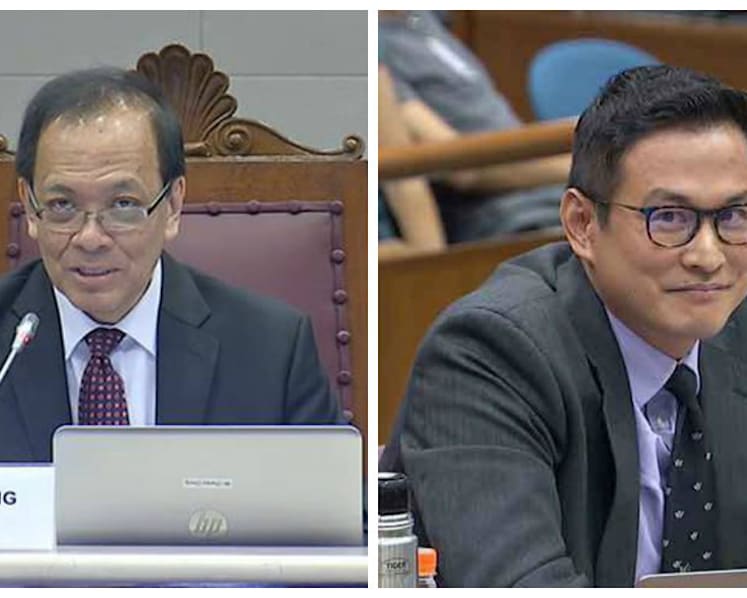
Parliamentary screengrab


SINGAPORE — Responding to an open letter in support of academic freedom and historian Thum Ping Tjin, Deputy Speaker of Parliament Charles Chong on Tuesday (April 17) questioned why “special immunity” should be given to Dr Thum, and took issue with how he sought political mileage while under the cloak of academia.
While Dr Thum is entitled to his views, he “must expect to be questioned about them” when he puts them before a Select Committee, Mr Chong reiterated.
“Indeed Dr Thum wrote that he was willing to appear before us. It is therefore surprising that the letter suggests Dr Thum was questioned ‘without warning’,” said Mr Chong in his 853-word reply.
Mr Chong, who chaired the Select Committee studying online deliberate falsehoods, said it was also “surprising” that the letter argues that Dr Thum’s claims should only have been questioned by other historians, and not by a parliamentary committee.





“Legislators all over the world regularly have robust exchanges with witnesses, including academics. Mr Mark Zuckerberg, the CEO of Facebook, has just finished two days of questioning by United States congressional committees. I do not understand why a special immunity is being claimed for academic historians,” Mr Chong pointed out.
Dr Thum was involved in a marathon exchange lasting about six hours with Law and Home Affairs Minister K Shanmugam — who is part of the 10-member Select Committee — at a public hearing conducted by the committee last month. The session saw both men lock horns over Dr Thum’s interpretation of events in Singapore’s history.
The academic had claimed in his written representations to the committee that historically, there has only been one body that has peddled falsehoods — the People’s Action Party Government, which has been spreading “fake news” about Operation Coldstore, for example, “for narrow party-political gain”.
The open letter had questioned the motive behind Mr Shanmugam’s “grilling” of Dr Thum. “We are writing to express our deep concern at your committee’s treatment of one of our colleagues… and the wider implications for freedom of expression and academic freedom in Singapore,” wrote the letter, whose authors are unknown.
As of Tuesday, the letter has been signed by about 230 academics around the world. Singapore-based academics who signed the open letter include National Institute of Education lecturer Chang Qizhong, Lasalle College of the Arts adjunct lecturer Rachel Koh and Dr Adrian Heok, who is an executive committee member of regional human rights group Forum-Asia.
Also backing the letter was Prof Mohan J Dutta from the National University of Singapore, who was in the news last month after his invitation to Hong Kong-based Singaporean media academic Cherian George to give a talk at NUS was delayed due to an administrative oversight. Prof George also signed the letter.
Other signatories include Dr John Landers, an honorary fellow and former principal of Oxford University’s Hertford College, as well as experts on Singapore politics and history such as Dr Michael Barr and Prof Carl A Trocki.
Calling on Mr Chong to offer Dr Thum a “full apology”, the letter also argued that Mr Shanmugam was “not even qualified to undertake a peer review of Dr Thum’s research”, which has emerged from a “rigorous” process and critical peer review.
In his riposte, Mr Chong said: “If Dr Thum could not defend his claims under questioning, surely this must reflect on the quality of his writings and research, not the process?”
Dr Thum had “charged that the founding Prime Minister of Singapore, the late Mr Lee Kuan Yew, was the primary liar”, said Mr Chong.
But he had made several concessions during the public hearing, including acknowledging that parts of his writing had been misleading. Dr Thum also acknowledged that the British authorities had honestly believed that Operation Coldstore was necessary for security reasons, and he had disregarded the views of some key actors, Mr Chong said. “These concessions substantially undermined his thesis that Operation Coldstore was launched purely for party political advantage.”
Dr Thum had stated in his written representations that he is a research fellow in history and coordinator of Project Southeast Asia at the University of Oxford.
The university has clarified that Dr Thum does not hold any tenured academic position in its institutions, and it is therefore inaccurate to describe Dr Thum as an “academic historian”, Mr Chong reiterated.
Mr Chong, who is a Member of Parliament for Punggol East, stressed: “Let us be clear. It was Dr Thum who chose to use our committee, on deliberate online falsehoods, to make a political point about Operation Coldstore, a security operation that took place 55 years ago, long before the Internet existed. Having done so, he cannot then plead that his claims should not be questioned, or that he should not be judged on his answers.”
He added: “There is nothing wrong with political activism in itself. But it is odd to make political points, as Dr Thum did, and then hide behind the shield of academia when questioned.”
Mr Chong said the letter’s concerns on academic freedom had been “misplaced”. More than 20 academics worldwide had been questioned by the committee, and were entitled to disagree with its views, he pointed out.
“Some disagreed with members of the committee. All were forthright in their views and I would be very surprised if any of them were intimidated by the process. To be sure, individual members of our committee did not always agree with the academics who gave evidence to us. But we all benefited from the learning they brought to bear on the questions before us,” Mr Chong said.
Commenting on Mr Chong’s statement, some of the academics who put their names to the letter maintained that Dr Thum should not have been treated in such a manner.
Speaking to TODAY, Associate Professor Michael Barr, who specialises in Singapore history and politics at Australia’s Flinders University, reiterated that Dr Thum “has done a lot of fabulous work” with the British archives. “Singapore does not release its archives, so that is the best any of us can do,” he said.
He added: “Dr Thum is a young scholar and was treated… like a hostile witness in a court of law… No one expects special treatment for academics before Select Committees, but courtesy and a fair hearing and fair warning of the lines of questioning are not too much to ask.”
Singaporean economist Linda Lim, who is a business professor at the University of Michigan, described Dr Thum as “an academic in good standing as decided by his peers”.
She noted that not having a paid position is “quite commonplace in academia especially in fields such as history where positions are few and far between”. On the issue of academic freedom, she reiterated that the treatment of Dr Thum has “a chilling effect on academics in Singapore and discourages them from undertaking controversial research or participating in civil society activities”. “I am not referring to the other academics who presented before the Select Committee who were not similarly grilled on a particular piece of research,” she said.




