







Transformation of food manufacturing sector will add 2,000 PMET jobs
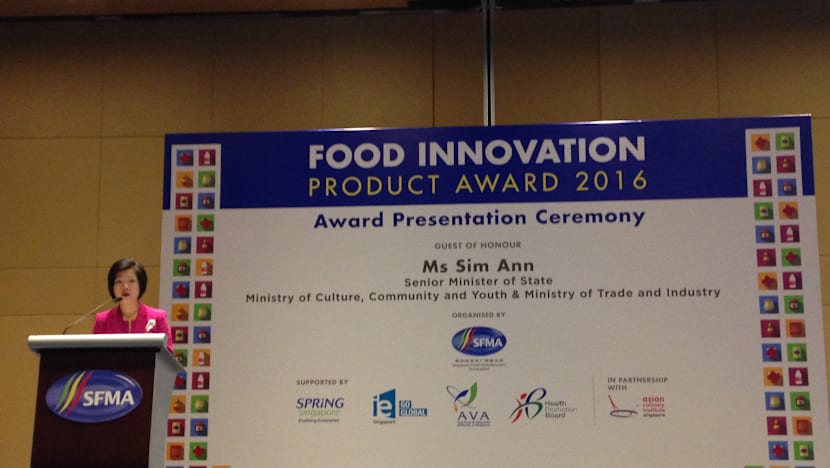
Ms Sim Ann, Senior Minister of State for Trade and Industry, and Culture, Community and Youth at the inaugural Food Innovation Product Award Ceremony. Photo: Angela Teng/TODAY


SINGAPORE – To help develop Singapore into a leading food and nutrition hub, the Government on Friday (Nov 18) launched its blueprint to transform the food manufacturing industry through initiatives such as shared research and production facilities and a larger focus on technology, a move that will add 2,000 new jobs for PMETs (professionals, managers, executives and technicians) in the next four years.
The latest industry transformation map (ITM) – the fifth of 23 such maps under a national programme to transform Singapore’s key industries - was launched by Ms Sim Ann, Senior Minister of State in the Ministry of Trade and Industry, as well as the Ministry of Culture, Community and Youth, at the inaugural Food Innovation Product Award Ceremony. The ITM strives to catalyse a compound annual growth rate of 4.5 per cent in productivity for the food manufacturing industry from now until 2020.
The main thrusts of the ITM include strengthening the ecosystem for food innovation and research and development, driving productivity through automation, redesigning and creating quality jobs and building globally-competitive food companies.
“While the industry is doing well, regional competitors are adopting new food technologies and raising their capabilities in food safety. Although Singapore has built up a strong reputation for quality food, we must still find ways to differentiate ourselves from overseas counterparts,” said Ms Sim.





The food manufacturing industry plays a key role in Singapore’s economy, with more than half of its output being exported to countries such as Japan and China. Last year, the industry contributed S$3.7 billion to Singapore’s gross domestic product and employed about 40,000 workers.
By 2020, Ms Sim said, the Government expects the ITM to create another 2,000 new PMET jobs to support the innovation and export-led growth of the food manufacturing industry. With the greater focus on innovation and technology, there will be a need for more individuals with deep knowledge in food science, food production methods, quality assurance and system operations, she said. In addition, the increased diversification of retail platforms will create jobs in the areas of e-commerce, marketing analytics, franchising, international marketing and other corporate group functions.
The creation of these jobs will be spurred by several transformation strategies for the sector. One key ITM strategy is developing a food innovation cluster to foster greater collaboration and sharing of resources between research institutes and the industry. This will encourage the development and commercialisation of new products and the establishment of shared R&D and production facilities to help small and medium-sized enterprises adopt advanced machinery and processes and overcome obstacles such as high cost and lack of economies of scale.
The ITM also aims to expand the global footprint of its Singapore’s food companies by collaborating with international hotel and restaurant chains and institutional caterers, as well as through activities such as food festivals.
Driving productivity through automation will continue to be a key thrust of the future economy of the food manufacturing sector. To quicken the pace of technology adoption, the Government will be developing the capabilities of system integrators through the national robotics programme, said Ms Sim.




