







Tributes flow as ‘pioneer of S’pore law’ retires
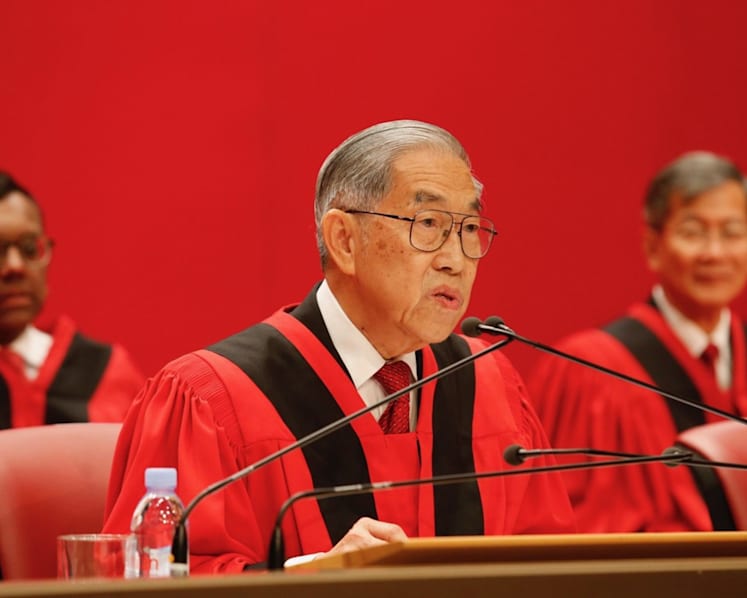
In a rare formal ceremony, the legal fraternity paid tribute yesterday to long-serving Judge of Appeal Chao Hick Tin, who retires today on his 75th birthday after five decades in the public service. Photo: Najeer Yusof/TODAY


SINGAPORE — In a rare formal ceremony, the legal fraternity paid tribute yesterday to long-serving Judge of Appeal Chao Hick Tin, who retires today on his 75th birthday after five decades in the public service.
It was only the second time the ceremony, called a valedictory reference, was accorded to a judge leaving the Bench. First held in 1990 for retiring Chief Justice Wee Chong Jin, a valedictory reference is a formal sitting of the full Supreme Court Bench to mark significant events, usually the appointment of a new Chief Justice.
About 500 lawmakers, lawyers and public servants packed the Supreme Court Auditorium for Justice Chao yesterday, with eight speeches delivered by, among others, Chief Justice Sundaresh Menon, Law Minister K Shanmugam and Law Society president Gregory Vijayendran.
The Singapore Academy of Law also launched a book titled A Judge For The Ages.





The speakers highlighted Justice Chao’s even temperament and humility. Mr Shanmugam said he appeared before Justice Chao as a young lawyer in his first major case in the High Court.
“During the hearing, I had many views on the case and ... I wasn’t very good at sitting down even when it was not my turn to speak. I was a little impetuous then,” he said. But the judge treated him with “patience and kindness”, simply shooting him a quizzical look and telling him to wait for his turn to speak.
Mr Vijayendran also spoke at length about this “humane touch”. “Many lawyers attest to your famed courtesy and consideration towards counsel, party and witness,” he said. “The Bar feared neither a barrier to, nor burial of, justice in your courtroom.”
After being appointed the Republic’s top judge, Chief Justice Sundaresh Menon said he asked Justice Chao to continue serving to tap the latter’s wisdom.
True to his character, Justice Chao had been reluctant for yesterday’s fanfare over his retirement, CJ Menon added.
Starting out as a state counsel in the Attorney-General’s Chambers’ civil division in 1967, Justice Chao quickly climbed the ranks.
He was appointed to the Bench as a Judicial Commissioner in 1987, before being made a High Court Judge in 1990 and a Judge of Appeal in 1999.
He served as Attorney-General for two years, between 2006 and 2008, before returning to the Bench.
Calling Justice Chao a pioneer of Singapore law, CJ Menon said the ceremony was a chance to recall “the honesty with which men and women like Justice Chao devoted themselves to the cause of building a new nation on the rock of faithfulness to the law (and) to inspire young lawyers of what it is possible to accomplish with a devotion to learning”.
Justice Chao’s accomplishments in the domestic and international arenas included Singapore’s Pedra Branca dispute with Malaysia and the water treaties between both countries.
Former Law Minister S Jayakumar said he admired the judge for his robust manner in advancing and protecting the nation’s interests.
In 1968, Justice Chao had represented Singapore at a United Nations conference, where a Malaysian representative had said that the water treaties between the two countries could not be terminated or suspended for political reasons.
“Justice Chao had the presence of mind and astuteness ... he put on official record Malaysia’s express confirmation that our water agreements cannot be terminated whatever political differences might arise,” said Mr Shanmugam.
In response, Justice Chao said he felt “a sense of not really being up to the standards which (the speakers) have so kindly elevated (him) to”.
Dispensing justice in a case has seemed “difficult or elusive” at times, but he expressed satisfaction at having discharged his duties faithfully over the years.
“A judge’s task is to deal with the parties before him and their counsel fairly and impartially ... to ensure that justice in according with the law is ultimately done in every case,” he said.




