







Two new stat boards to drive SkillsFuture movement
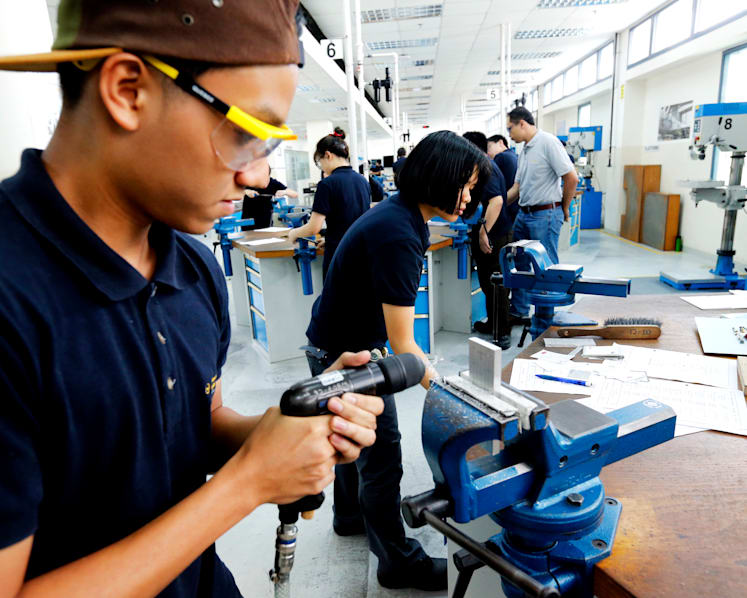
By bringing the SSG under MOE's purview, the Government can tap both institutes of higher learning and private training providers to 'move SkillsFuture efforts forward as part of a holistic system of lifelong learning'. TODAY file photo


SINGAPORE — Two new statutory boards will be formed to drive the SkillsFuture movement and help Singaporeans find the jobs they want, a move welcomed by observers, who cited better alignment across the wide variety of training programmes available and improving quality in the private education sector as among the likely benefits.
The first statutory board, SkillsFuture Singapore (SSG) – overseen by the Ministry of Education (MOE) – will focus on the implementation of SkillsFuture, coordinating both pre-employment training (PET) and continuing education and training (CET) for workers. The Council for Private Education (CPE), currently the regulatory body for the private-education sector, will be subsumed under the SSG.
In response to queries, the MOE said the Workforce Skills Qualification scheme, which was under the Workforce Development Agency (WDA), would also come under SSG’s purview.
The WDA will become Workforce Singapore, overseen by the Ministry of Manpower (MOM). It will retain the WDA’s functions of employment facilitation, career services and industry engagement.





MPs interviewed by TODAY noted the benefits of having SkillsFuture programmes come under the purview of one entity. “It makes absolute sense that if learning is lifelong, then there should be one ministry promoting and coordinating both PET and CET. Working in silos does not make sense,” said Ms Denise Phua (Jalan Besar GRC). Currently, oversight of both PET and CET initiatives is split between both the MOE and MOM.
Ms Phua, who is also Chairperson of the Government Parliamentary Committee (GPC) for Education, added that the reorganisation would also bring about “greater alignment and porosity across the various training qualification systems – in academics, vocational, adult learning and even special education.”
Asked whether the MOE would be missing input about the industry that MOM could provide, she noted that Acting Minister for Education (Higher Education and Skills) Ong Ye Kung, who will be in charge of the SkillsFuture movement, was the chairman of the Employment and Employability Institute (e2i) “for many years” and many of the higher education institutes had links to industry.
Mr Ang Wei Neng (Jurong GRC) said SkillsFuture would still very much be “a tripartite relationship” involving, among others, MOM, MOE and the Ministry of Trade and Industry, ensuring the links with industry are maintained.
In a joint press release announcing the reorganisation today (Jan 12), the MOE and MOM said that by bringing the SSG under MOE’s, the Government can tap both institutes of higher learning – such as polytechnics and universities – and private training providers “to move SkillsFuture efforts forward as part of a holistic system of lifelong learning”.
In a Facebook post today, Mr Ong called the restructuring “a change years in the making”. “Education and Lifelong Learning will be one and integrated,” he said. In October last year, Mr Ong had pointed that the increasing array of higher education credentials — ranging from qualifications from vocational institutions, to university degrees and industry certification — must be aligned to “speak the same language”, and this included ensuring quality.
MPs said the restructuring will support this. “SSG will help to strengthen oversight by MOE of the entire education and training sector to ensure the quality and standards of all training and education providers, including both public and private providers,” said Mr Patrick Tay (West Coast GRC), who also chairs the Manpower GPC.
Mr Ang said with the SSG assuming oversight of the private-education industry, there is a good chance that the quality of training offered by private providers would be raised and private-education providers could also play a bigger role in the provision of SkillsFuture-relevant courses.
Ms Phua noted that the move meant that the offerings of private providers would be “even more relevant and better aligned with industry inputs through the national SkillsFuture movement”, benefiting both students and institutions in the private-education system.
CPE chief executive Brandon Lee echoed this view, noting: “The change will build on CPE’s work over the last five years to establish baseline standards and give us greater focus and more levers to align the private education sector much more with SkillsFuture.”
Subject to the necessary parliamentary legislative processes, the new statutory boards are expected to be set up by the end of this year. In the meantime, WDA and CPE will continue to perform their statutory functions.




