Amid competing demands for land, spaces under flyovers could be the next frontier for sport in Singapore
Venue operators told CNA that while there are challenges, these spaces provide a number of key advantages and could see increased demand in the future.
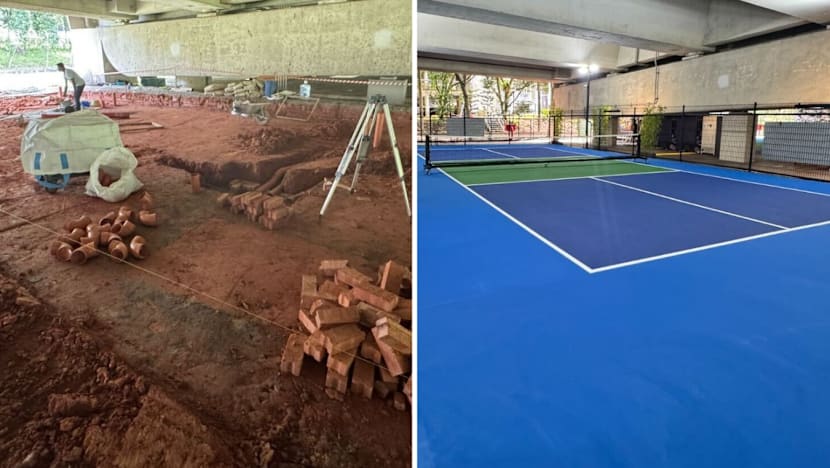
The area under the Gali Batu flyover has been transformed into the Ark Sports Village. (Photos: Ark Sports Village)

This audio is generated by an AI tool.


SINGAPORE: In the northwest of Singapore is a massive 60,000sqft arena in the unlikeliest of spaces.
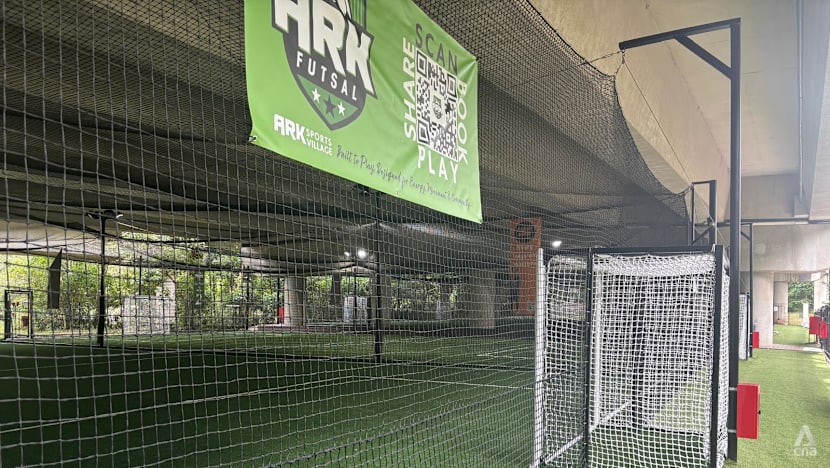
Sandwiched between a Housing and Development Board (HDB) estate and a swath of forest, it comprises five sheltered pickleball courts, four futsal courts and a dedicated functional fitness training gym. Occasionally, there is the rumbling of cars overhead.
The Ark Sports Village is the latest to join a small group of sports facilities in Singapore that have one thing in common - being located under flyovers and viaducts.
Operators told CNA that despite several challenges, these spaces provide a number of key advantages and could see increased demand amid competing uses of land.
BRINGING LIFE TO DEAD SPACES
There are more than 100 flyovers and viaducts in Singapore.
And under them is about 60 hectares – or 84 football fields – of land and dead spaces. These are sterile pockets of land that result from infrastructural development.
Authorities have explored various ways to make use of these “dead spaces”, and one way that seems to have worked is turning them into sports facilities.
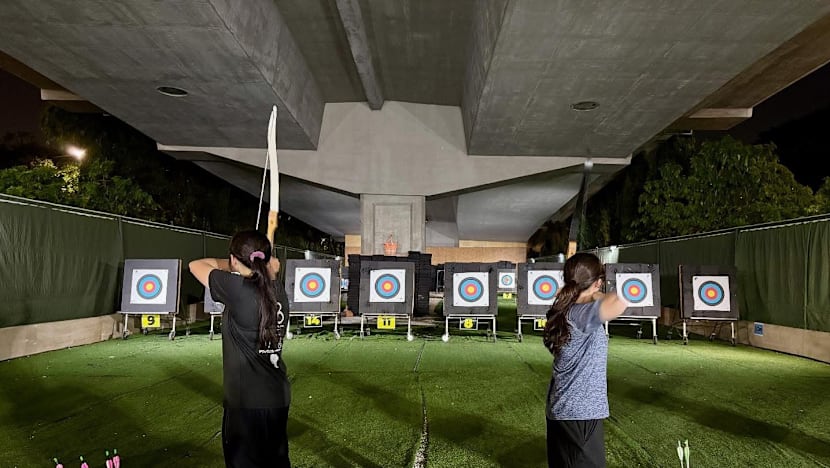
One such facility is under the West Coast viaduct.
In early 2017, it was used to host a night art market, before it became a test-bed for urban farming for a few months.
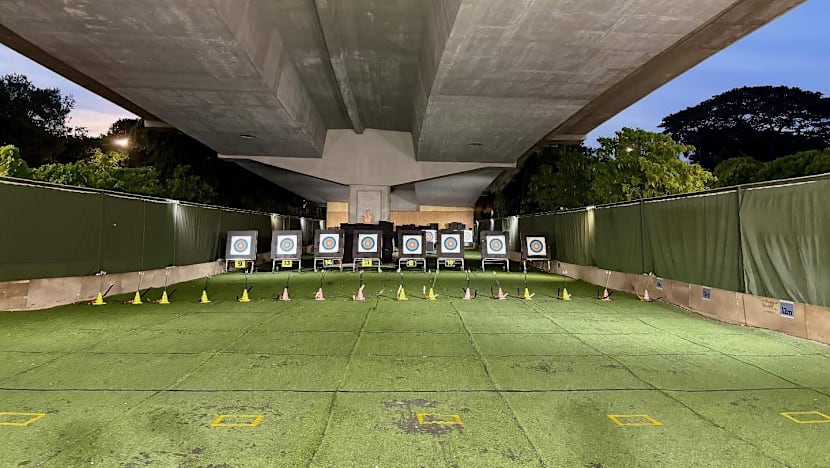
But those temporary uses soon gave way to Salt and Light archery, which found its permanent home under the vehicles.
Founder Tan Si Lie was introduced to the location by a friend.
A former national archer, he recalled how the lack of a sheltered archery range in Singapore meant that training sessions had to end before sunset and whenever there was bad weather. And so his criteria for the range were simple - that it was sheltered and could open at night.
His facility is not the only sporting facility to have taken root under Singapore’s flyovers.
Mr Stephen Pellow’s British Sports touchtennis Academy has called the space under Bukit Merah viaduct home since late 2023.
He told CNA that given the space required for tennis and rising costs, rental can be challenging. As such, the plan was to look at locations that might not be as attractive to others.
“For traditional tennis, it’s not really viable,” said Mr Pellow. “But then we also do mini tennis for kids, and we wanted to introduce touch tennis to Singapore … We thought it would be a great introductory venue for touch tennis to Singapore.”
The latest sports facility to join these ranks is also the largest of its kind to be located under a flyover in Singapore.
Under the hulking Gali Batu flyover and along the Bukit Panjang Park Connector, the Ark Sports Village opened to the public earlier this year.
“When we identified this underutilised space, our goal was to broaden access to sports and active lifestyles for residents,” said Member of Parliament Edward Chia (PAP-Holland-Bukit Timah).
“We approached SLA (Singapore Land Authority) with ideas to activate the area, and I am grateful for their receptiveness to a community-driven proposal.
“Through the collaboration with The ARK Futsal, we have created a dedicated space where local sports interest groups can train consistently, families can come together over weekend matches, and residents from different blocks can connect through a shared love of sport.”
Speaking to CNA, founder of Ark Sports Management Jimmy Beh said that he had been on the lookout for sheltered pitches.
Being located under a flyover eliminated the need to build a shelter over the pitch and any additional requirements which could arise, he added.
“We took up the challenge because it is sheltered, and (the Ark) had not had any sheltered pitch before.
“We looked at the space, even though it is really far out in the west, we feel that the community here will benefit from it. So we took a chance,” said Mr Beh.
“TOO MANY RAINED-OFF LESSONS”
In Singapore’s hot and rainy climate, the weather-proof nature of these facilities is a game-changer, said the founders.
Mr Beh, whose company runs futsal pitches at seven other venues, said that business can dip between 10 per cent and 20 per cent during the rainy season.
“(There’s been) too many rained off lessons really,” said Mr Pellow. “With Singapore, it’s either boiling hot or raining.”
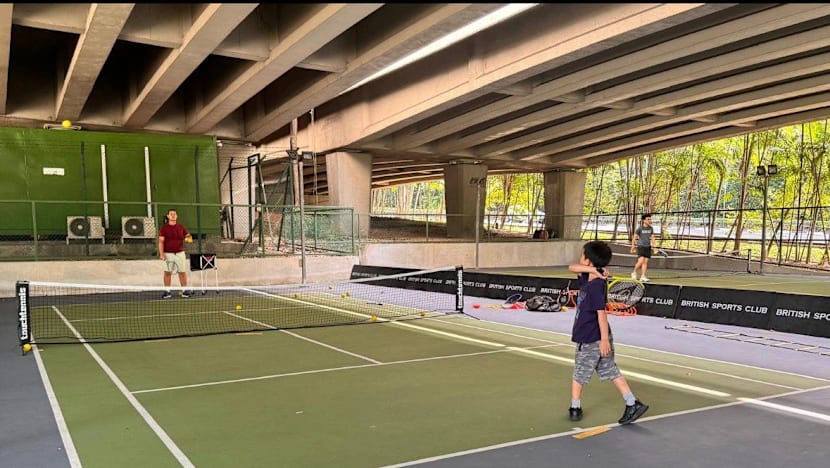
The shelter from the weather means that lessons can be held “all day, every day”, he said.
“Even the little kids are playing … the hot times (of the day). Sometimes they have tuition in the morning and sometimes they have other things in the mornings and afternoons, and typically they have been able to play tennis during (those times),” he added.
“It’s still warm because it is obviously an outdoor sport, but they’re not getting any sun exposure.”
Mr Tan added that Salt and Light archery has seen increased demand in recent times, especially among competitive archers, because they can train at the range at night.
“We get to train like we never used to be able to,” he added. “We even have some students who request to come in very early, like 7am, some request to stay late (as late) as 10pm to 11pm. That’s the privilege we have now.”
In response to CNA’s queries, Sport Singapore (SportSG) said that the Bukit Merah and Gali Batu facilities are “examples of how such spaces can be reimagined for private sport operators to respond to community demand”.
“Complementing these efforts, government-led developments such as the new pickleball courts at the former Little India bus terminal and the Sport-in-Precinct facility at Dover Crescent demonstrate how existing sites can be repurposed as recreational spaces to expand access,” said a SportSG spokesperson.
“This model maximises limited land resources while bringing sport closer to the communities, offering a practical response to Singapore’s space constraints.”
The spokesperson added that SportSG works with partner agencies such as SLA and community stakeholders, including private sport operators, to meet Singapore’s growing demands for accessible sports facilities within its land-scarce environment.
In response to CNA's queries, SLA said that in assessing the suitability of state land under viaducts for activation, it considers various factors.
These include "market demand and feedback on possible community uses as gathered through our engagements with stakeholders, compatibility of the proposed site with surrounding developments, as well as technical requirements of the relevant competent agencies".
"In addition, care is taken to assess the suitability of the existing infrastructure and the adequacy of the transport connections and utility support," it said.
NOISE, DUST AND HIGH COSTS
For operators, getting their venues operational can be a challenge.
This means working with various government agencies to get permissions and permits, as well as forking out large sums of money to ensure venues are equipped with electricity and are fire safety compliant.
Mr Beh recalled how his team had to be flexible and reconfigure the layout of the facility, given that the flyover is sloping downwards.
“We believe that we should be able to pull through (business-wise). But we didn’t know the amount of work involved in transforming the (area under) the flyover into a sports complex,” he said.
For Mr Pellow, the setting up of his facility was less onerous, given that SLA had previously converted the space into a fenced hardcourt equipped with utilities and features such as safety railings and a ramp.
While noise and dust accumulation were not an issue at Ark Sports Village due to the height of the flyover, it was a challenge Mr Pellow and Mr Tan faced at their respective venues.
“We’re obviously quite close to the major roads, so noise pollution from the cars is quite loud and disturbing for the lessons,” said Mr Pellow.
“We’re also quite close to the Singapore General Hospital, so we also get quite a fair few ambulances coming past and they’re quite loud.”
Similarly, the noise generated by heavy-duty vehicles on their way to the Pasir Panjang port can be a distraction for those taking lessons, said Mr Tan.
While clients have got used to the noise, Mr Pellow said that he is considering putting up sound barriers.
“We can probably find a place that is quieter but then you’re in the sun, and you’re having to play in 30 degrees,” he added.
Dust can accumulate on the tennis balls and on the playing surface, said Mr Pellow. At Salt and Light’s West Coast range, equipment is also kept in containers to avoid dust accumulating.
“Some people don’t quite like it because of the noise and dust. They say that it’s inconducive,” said Mr Tan. “We have our theory lessons in (container) classrooms.”
To mitigate any possibility of misfired arrows, safety nets as well as barricades have been set up along the length of the range.
Despite these challenges, operators believe that these underutilised spaces could see increased demand, should they be made available in future.
“With Singapore developing as quickly as it is, with more and more buildings all over the place, we’ve got to be open to these kinds of ideas and … think a little bit outside the box,” said Mr Pellow.
“Sports will have to look at more unique opportunities where (areas) won’t be able to be redeveloped into commercial, residential properties. And we’ve got to try and make it our own little sports hub ourselves. As long as it’s accessible for people and safe, we will definitely be looking for more opportunities.”
Mr Beh believes that despite the challenges he faced with getting the current facility up and running - it is the most he has invested in a venue by far - he would be open to setting up another in the future.
“If there were another flyover open, would we do it? I would do it, because I already know that it can be done.”