







USS John S McCain collision a result of missteps by crew, says Transport Ministry
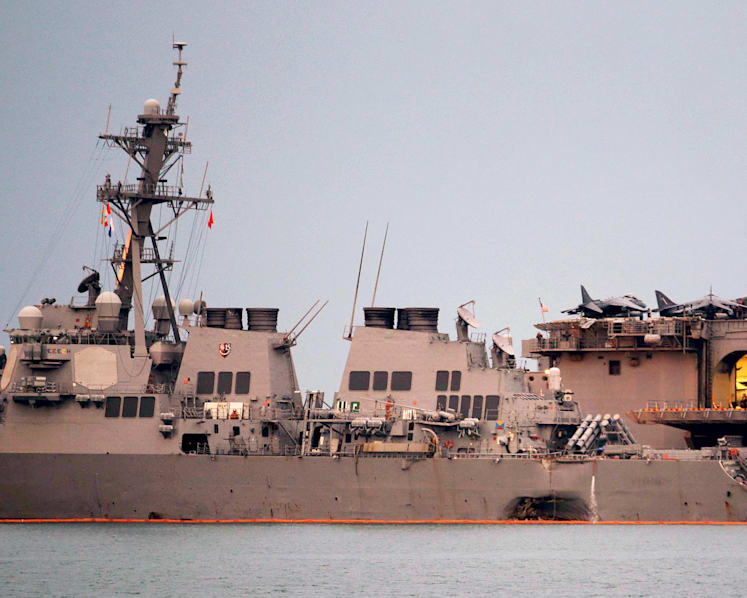
US Navy guided-missile destroyer USS John S. McCain is seen after a collision in Singapore waters on August 21, 2017. TODAY File Photo


SINGAPORE — The collision between United States navy destroyer USS John S McCain and a merchant ship resulted from “a series of missteps” by the crew of the warship that led to a sudden left turn into the path of the Alnic MC oil tanker, the Ministry of Transport (MOT) said in its full investigation report released on Thursday (March 8).
“The collision between JSM (John S McCain) and AM (Alnic MC) as they were transiting through the Singapore Strait happened because of a sudden turn to Port by JSM, which caused it to head into the path of AM,” said the report by MOT’s Transport Safety Investigation Bureau (TSIB) on the August 21 pre-dawn incident that killed 10 American sailors.
“JSM’s sudden turn to Port was due to a series of missteps that took place after a transfer of propulsion controls, which led to a confusion as to which station had steering control, and an unintentional reduction of the Port engine throttle which increased the rate of JSM’s turn to Port.”
When the crew of Alnic MC saw the USS John S McCain turning, it presumed that the USS John S McCain would be able to safely pass ahead, said TSIB.





The actions taken by Alnic MC were insufficient to avoid the collision which happened within three minutes of the turn made by the guided-missile destroyer in Singapore territorial waters about 4.6 nautical miles from Horsburgh Lighthouse, said TSIB.
Part of its 35-page report detailed the confusion on the bridge of USS John S McCain in the minutes before the collision and noted that the team had not anticipated an emergency situation going despite going through a known area of high vessel traffic density.
The crew also “did not recognise the processes involved in the transfer of propulsion and steering control” and lacked the requisite knowledge of the steering control system “due to inadequacies in training and familiarisation,” said TSIB.
“The lack of experienced personnel handling critical equipment like steering and propulsion indicated lack of a robust risk assessment on considering the “what-if” scenario so that appropriate risk mitigating measures could be taken timely,” it added.
“While there was no evidence of a panic on the Bridge of JSM, it is likely that there was a lack of a comprehensive situational awareness amongst the team on what was to come.”
It noted that several sailors on watch during the collision with control over steering were temporarily assigned from another US naval vessel which had steering control systems that were “significantly different” from the American vessel.
“These differences were not compensated for. Inadequacies in training and familiarisation before task allocation may have contributed to the actions on JSM.”
The US Navy had said in October that the collision was preventable and relieved the warship’s commander and his deputy from their duties.
A month later, it released a report outlining how a series of missteps and inadequate preparation by key personnel of USS John S McCain had led to the collision, which came just two months after seven sailors were killed when another destroyer USS Fitzgerald collided with a container ship near Japan.
Among others, the USS McCain commanding officer did not deploy extra personnel to assist in navigation in the early hours of the morning, despite recommendations to do so from other officers.
He also ordered an unplanned shift of duties in the control room that resulted in confusion as well as the ship's loss of steering, triggering an “un-commanded turn" into the path of the Alnic.
Following the two incidents, the US Navy has ordered ship crews around the world to receive more training in basic safety, seamanship and navigation, and directed new procedures to ensure vessels are fully certified for a growing set of complex missions.
A TSIB spokesman said that the investigation team noted that the US Navy and the operator of the Liberian-registered AM Stealth Maritime Corporation S.A. have initiated positive safety actions to prevent a similar incident from occuring.
“For instance, we note that the US Navy is looking into re-introducing manoeuvring boards and putting crew through a Bridge Resource Management course. Stealth Maritime Corporation S.A. has also reviewed its Safety Management System to ensure prescribed requirements for safety of navigation and effective Bridge Resource Management are adhered to,” said the spokesman, adding that its probe was done in accordance with the protocol set out by the International Maritime Organization (IMO).
“The report will be shared with the IMO to prevent similar occurrences in the future,” the spokesman added.
*For full report, visit: https://tdy.sg/2D99UXO




