







Wage growth slows, resident jobless rate rises to 3%
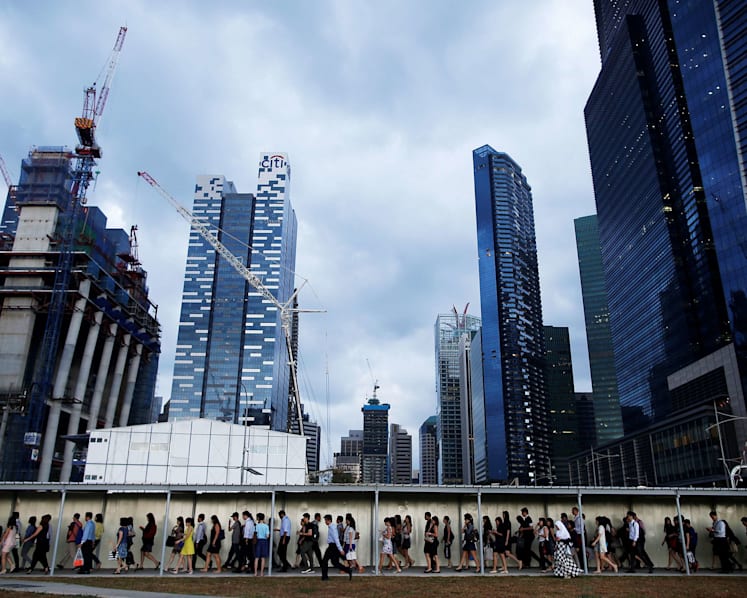
Office workers walk to the train station during evening rush hour in the financial district of Singapore in this March 9, 2015 file photo. Photo: Reuters


SINGAPORE — Wage growth slowed considerably while the unemployment rate inched up this year for the resident labour force, advance figures compiled by the Ministry of Manpower (MOM) show, bearing out the limp economic conditions.
Factoring in inflation, the nominal median monthly income of full-time employed residents here — including Central Provident Fund contributions — grew by 3.2 per cent this year, slower than last year’s 5.3 per cent.
Overall resident unemployment rate, on a seasonally adjusted basis, rose from 2.8 per cent in June last year to 3 per cent this year, the highest since 2010, according to the MOM’s 2016 advance report on the Labour Force in Singapore released on Wednesday (Nov 30). The findings are based on the comprehensive labour force survey conducted in the middle of this year, that received responses from nearly 28,000 households.The full report will be released next month.
The median real income growth for the past five years was 3.1 per cent per annum. Cumulatively, it translates to a 17 per cent increase, from S$3,249 to S$4,056. At the 20th percentile, however, the figure was a more modest 2.6 per cent per annum, or from S$1,733 in 2011 to S$2,106 this year.





As for unemployment, the MOM said the weaker economic environment this year led to higher joblessness for both males and females, after it had stayed stable in the range of 2.6 to 2.9 per cent from 2012 to 2015 on a seasonally adjusted basis.
The employment rate this year for residents aged 25 to 64 was 80.3 per cent, similar to the 80.5 per cent in 2015. But resident labour force participation rate declined slightly this year to 68 per cent. Between 2014 and last year, it shot up from 67 per cent to 68.3 per cent partly due to a temporary boost from one-off policies, said the MOM. These policies are understood to include the Special Employment Credit and the raising of the re-employment age.
Overall, however, the trend was upwards over the last five years.
Economists said the latest figures reflect a weaker economy, but are not a cause for alarm.
“The labour market is obviously softening but ... still holding up. There are pockets of retrenchment but not mass retrenchments. Economic growth is weak, two-thirds of the economy is in technical recession, but we are not in a full-fledged recession yet,” said DBS senior economist Irvin Seah. “That’s the reason why, while there’s been pain in the labour market, we are still seeing modest wage growth.”
There is no sign of a shock to the labour market, unlike during the 2008-2009 global financial crisis when there was a clear and significant uptick in unemployment, said SIM University senior economics lecturer Walter Theseira.
Labour economist Randolph Tan of SIM University added that slower wage growth is sustainable in current conditions. He also noted that growth in gross monthly incomes from work for the lower-earning residents in full-time employment was also continuing.
The higher unemployment rate for this year — which translated to 68,400 residents on a seasonally adjusted basis — is one of the adjustments as Singapore’s economy undergoes restructuring. The raw figures make for uncomfortable reading, given lower rates that Singapore is used to, said Assoc Prof Tan. “Whether we are going to be successful in restructuring will determine whether we can control unemployment and get a good performance in future as we have in the past,” he said.
“I don’t think it’s necessarily the case that we need to be content with a ‘new normal’ in unemployment,” he added. “I think what we should be aiming for, even with slower rate of (economic) growth, is good-quality employment that produces unemployment rates comparable with the past. It’s a major challenge, but not unreasonable, because if we do this restructuring correctly, we will incorporate the participation of resident workers more effectively.”
And while professionals, managers, executives and technicians (PMETs) remained less prone to unemployment than others, the gap has narrowed in recent years, noted MOM. The unemployment rate for PMETs rose to 3.1 per cent this year, up from 2.7 per cent last year.
Unemployment amongst PMETs has been edging up for some time now, said Dr Theseira. The structural factor underlying it is the increasingly specialised nature of skilled work, combined with underlying structural changes to the economy, he said.
“The traditional view was that higher skills and education made for a more stable career; that is not true any longer (if it ever was) because specialised skills are what counts, and demand for specialised skills can change rapidly due to industrial and economic disruption,” he added.




