







Without Mrs Lee, Mr Lee would have been a different person
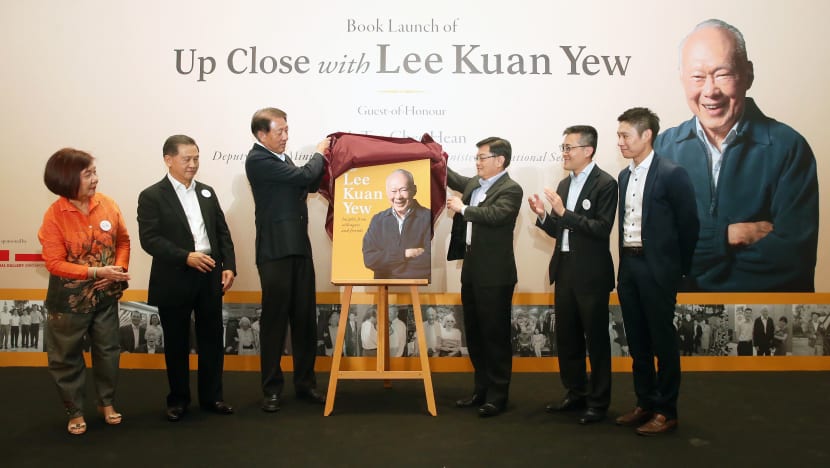
Guest-of-Honour DPM Teo Chee Hean and Finance Minister Heng Swee Keat, who is a former Principal Private Secretary of Mr Lee Kuan Yew, unveiling the cover of "Up Close with Lee Kuan Yew" at the launch of the book at the National Gallery on March 15, 2016. Photo: Ooi Boon Keong
On 2 October 2010, my family was celebrating my grandson’s full month at home when the phone rang. It was an urgent call from Mr Lee, asking me to help compile a video montage that chronicled some of Mrs Lee’s best moments. She had just passed on.
With a heavy heart burdened by sadness over her demise, I spent the whole night scouring through MediaCorp’s archives, as well as my personal collection, to look for the most appropriate clips which could be refined into a congruous storyboard. Mr Lee watched the video the next morning and I remember his eyes turning red.
Even though he had mentally prepared himself for her passing, his true feelings for Mrs Lee were revealed during the funeral service. What touched me the most was the title of his eulogy: “The last farewell to my wife.” The very poignant eulogy said, “Without her, I would be a different man, with a different life.”
To me, that sentence summed up their 63-year marriage. They indeed enjoyed a blissful marital life, one which was anchored by mutual trust and respect. Theirs was a bond that other couples should emulate.





Mrs Lee was a quiet and calm person. She hardly raised her voice. She knew Mr Lee’s temperament best and had her ways of soothing and calming him down whenever he was unsettled or anxious. All his staffers were very grateful for this.
I recall one of my first trips to China as Press Secretary, in 1993 or 1994. The programme was very tight. On one occasion, Mr Lee asked his private secretary to pass me some information for follow-up. Realising that I was just about to have my lunch after a long and hectic morning, Mrs Lee immediately said, “Harry, YY is having her meal. The work should wait.” Mr Lee then told me, “YY, no hurry, give it to me this evening.”
On another visit to China, Mr Lee was to make an important speech at the Confucius Conference. The hall was full and a dozen journalists had broken up our entourage. From afar, Mr Lee instructed me to extend a copy of his speech to a “John Wong”. Standing beside me was Mr Lee’s physician, Dr John Wong. Mrs Lee, sensing my confusion, quickly told me, “YY, not this Dr John Wong. Mr Lee meant Dr Aline Wong’s husband, Prof John Wong.” In the course of my career, I have been grateful countless times to Mrs Lee for saving me from embarrassment.
She was the one who took good care of Mr Lee. She was always by his side at both private and public engagements. If a prepared speech was required, Mrs Lee would be his first reader and final vetter. Her language was simple and elegant, just like her. We knew that all the speeches she vetted would have no grammatical errors, and we would always feel assured whenever she came on a trip with us.
She was the perfect example of “贤妻” (good wife). Because she took care of all his personal needs, Mr Lee could dedicate all his time and his whole life to managing the country. He knew that she was his rock, supporting him along the way and making sure that his daily needs were well taken care of.
Mrs Lee would always sit in during Mr Lee’s Chinese lessons which were held daily. At times, she would surprise us by using Chinese idioms brilliantly. I recall a trip to New Zealand in 2007. After all the official calls were over, Mrs Lee visited Lake Taupo, the largest lake by surface area in the country. She picked up some pumice stones to take home as souvenirs. She also picked up a goose feather, which prompted a puzzled Mr Lee to ask, “Choo, what for?”
Mrs Lee replied in Mandarin, “千里送鹅毛” (a gift of a goose feather from across a thousand miles). Everyone was silent. Those well versed in Chinese understood her. Mrs Lee was trying to explain that her act of giving someone a feather meant “物轻情意重” (it’s the thought that counts despite the lightness of the gift).
I was amazed and asked her where she learnt this 典故 (allusion or saying).1 She told me she had learnt it by sitting in on Mr Lee’s lessons. She showed time and again that she, like her husband, was a “lifelong learner”. In Chinese, this attitude can be expressed as “活到老, 学到老” (one is never too old to learn). Understandably, she supported Mr Lee’s belief that Singaporean Chinese should also know Chinese and that the learning of Chinese can open up a window to a rich culture.
As far as I can recall, Mrs Lee granted only a handful of media interviews throughout her life. The only TV interview was with Radio Television Hong Kong, whose crew filmed her and Mr Lee visiting their alma mater, Cambridge, for a documentary aired in 2002.
Mr Lee, with his distinguished international profile and standing, was one of the greatest politicians of his time. But deep down inside, he was a very private person and so was Mrs Lee. I recall his candid reply to the television interviewer’s question on whether he and Mrs Lee held hands when they were young.
Mr Lee said, “We had a lot of work to do. We did not hold hands. We were too busy then.”
The interviewer pursued this by asking, “But holding hands does not take up much time. Were people very conservative at that time?”
What I found priceless was Mrs Lee’s sharp response to this: “Not everybody, just us. We don’t do these things, not then.”
While drafting his speech for his 80th birthday, Mr Lee thanked everyone who had fought for Singapore with him. However, I noticed that there was no mention of Mrs Lee. I pointed this out to him and when the final text came, he had added a sentence:
“At the end of the day, what I cherish most are the human relationships. With the unfailing support of my wife and partner, I have lived my life to the fullest. It is the friendships I made and the close family ties I nurtured that have provided me with that sense of satisfaction at a life well lived, and have made me what I am.”
In October 2003, after Mrs Lee suffered her first stroke in London, Mr Lee flew back in time for Tanjong Pagar’s Tree Planting ceremony.
From his voice and expression, the audience could sense his anxiety and sadness. To me, this was the turning point in Mr and Mrs Lee’s roles. Mrs Lee once said, “Before my stroke, I took care of him. Now, I enjoy being pampered by him.”
Mr Lee would stay by her side at the hospital, not only to give her moral support, but also to accompany her during her physiotherapy sessions. Doctors noted Mrs Lee’s remarkable recovery which was partly attributed to his presence and support, especially in helping to ensure that she kept to her exercise regime.
Mr Lee was a champion of exercise and keeping fit. He always encouraged Mrs Lee to exercise because he wanted her to have a quality life in her old age.
I recall a trip to the United States in 2006 when Mrs Lee was tired and wanted to skip her afternoon swim. She gave the excuse that since that day was a public holiday in Singapore, she should be allowed to also take a break from swimming. Mr Lee advised her against it, saying that the swim would help her to have a good night’s sleep. He then added that he would join her for a swim later that evening. The smile on Mrs Lee’s face after hearing that is still etched in my mind. While I have never heard them say “I love you”, their actions revealed everything.
After her second and third strokes in 2008, Mrs Lee could no longer accompany Mr Lee on his overseas trips. In a media interview, Mr Lee shared that when he was not travelling, he would read to her before he went to bed every night. If he was overseas, he would talk to her over the phone and let her know who he had met and what had been discussed. The helper at home would turn on the speakerphone so that Mrs Lee could hear his voice. I took a picture of Mr Lee speaking over a mobile phone to Mrs Lee in 2010, after a lunch meeting with Japanese politicians. It was such a touching sight.
I have seen many loving couples during my public service days, but I would say that there were few as compatible as Mr and Mrs Lee. Not only did they excel in their professional lives, they were also successful in their personal lives. To me, they were the epitome of the ideal husband-and-wife team.
Mrs Lee once said, “I did things the way I wanted and I didn’t get involved in the things I didn’t want to get involved in. I think I had the best of both worlds.”
In my 21 years of working in the Prime Minister’s Office, I have observed and felt much. Therefore, I have chosen not to write about Mr Lee, but about Mrs Lee. I must sing for the unsung heroine behind the great man. Without Mrs Lee, Mr Lee would have been a different person, as he himself has acknowledged.
Let us salute the late Mrs Lee, who has helped one Prime Minister of Singapore and nurtured another. We, as Singaporeans, have benefitted much from her contributions.




