







Year of reckoning for Singapore sports
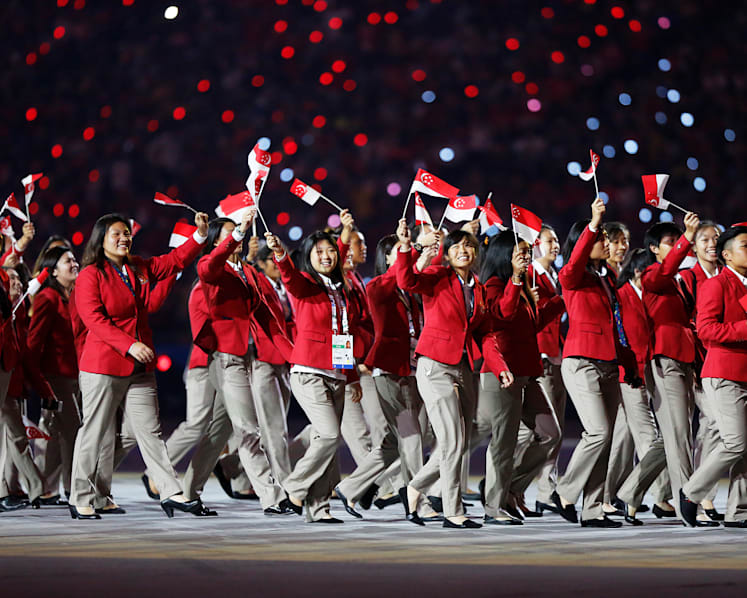
Singapore’s contingent at the 2015 SEA Games. TODAY file photo


In an Olympic year, Singapore’s sporting landscape may well be altered forever by a young man at the Olympic Aquatics Stadium in Barra da Tijuca, Rio de Janeiro.
On the shoulders of Joseph Schooling — just 20 years of age — lies a nation’s Olympic medal hopes.
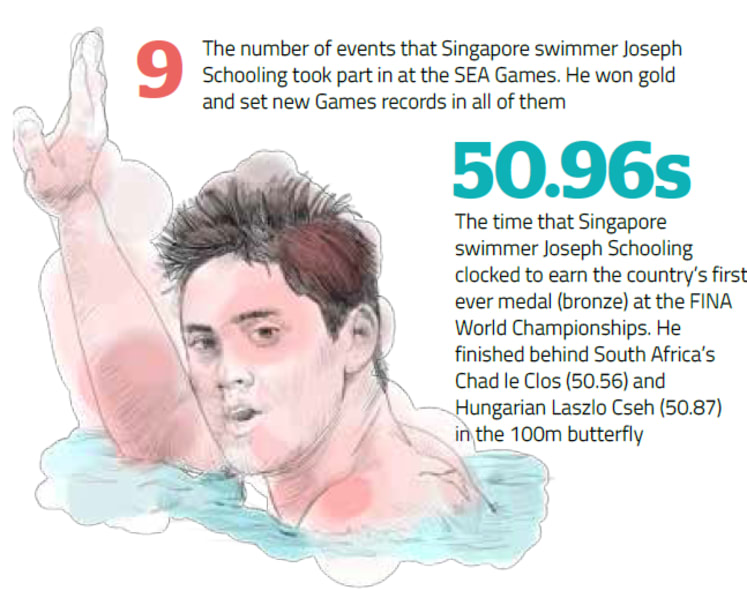
Veteran sports officials and administrators may not want to talk about medal prospects, but it is an undeniable fact that Schooling’s stunning and historic bronze-medal win in the 100m butterfly at the World Championships in Kazan, Russia, last August, does confer medal-contender status upon him at the Rio Olympics.
His time of 50.96sec also currently makes him the world’s fourth-fastest swimmer in the event — behind Michael Phelps (50.45), Chad le Clos (50.56) and Laszlo Cseh (50.87).





Even Schooling is aware of the expectations that are being placed on him. The University of Texas undergraduate told TODAY that he has “come a long way” from the 2012 London Games, and 2014 Asian and Commonwealth Games. He has also become quietly confident of his own abilities after his World Championships performance.
“I think 2015 has been good to me,” he said. “It (the World Championship medal) has helped a tonne. That really gave me the confidence and the motivation I needed to move towards Rio. I was first at the first 50m and usually it’s hard for people to run me down coming home.
“So, with a little more fitness and strength and a change in a couple of things, I’ll be ready.”
But more than just a historic sporting achievement for Singapore, a podium finish by Schooling will also reinforce the growing confidence in Singapore sports’ ability to produce world-class athletes without having to resort to the Foreign Sports Talent (FST) scheme.
There is already growing proof that Singapore can do it.
After all, Singapore Swimming has another potential Olympic finalist in Quah Zheng Wen, who, like Schooling, has also met the ‘A’ qualifying times for three Olympic events (the 100m and 200m butterfly and the 100m backstroke).
In another water-based sport, Singapore’s sailors have already set a new bar of excellence for itself by qualifying for five boat classes (the Laser, the Laser Radial, the Nacra 17, the women’s 470 and the 49erFX) — the most in the Singapore Sailing Federation’s (SSF) history.
That’s not all — the fact that Elizabeth Yin (Laser Radial) and Colin Cheng (Laser) secured their 2016 Olympics slots on their first qualifying meet means that there is an increasing pool of home-grown Olympic-class athletes in Singapore.
As Low Teo Ping, the chef de mission for Team Singapore at the Rio Olympics, said: “We’ll have a historic outing at the Olympics. In three sports, swimming, sailing and table tennis, Singapore will be represented at competitive levels.
“These athletes have not made it to the Olympics via wildcards. They have qualified on their own merit, and this opens up the opportunity for them to put up their best performances ever. Singaporeans can be proud of them, and proud of cheering them on.”
HIGH-PERFORMANCE ECOSYSTEM
All this did not come by chance, though, said Singapore Swimming Association (SSA) secretary general Oon Jin Teik and SSF president Ben Tan. “Achieving world-class results is centred around creating a high-performance ecosystem with all the ingredients for the pool of talented swimmers to consistently be the best in class,” said Oon. Tan added: “Singapore’s sustained sailing results has come about from our efforts over the years to build a talent development system and pipeline that will consistently produce top sailors.”
As the SSA and SSF continue to build on their high-performance eco-systems, the sports authorities have also been going about putting the pieces of the wider sports excellence eco-system in place.
Over the past year, Sports Singapore has been unstinting in its support of athletes via the SPEX scholarships, and the launch of a new and improved Road to Rio financial scheme.
The setting up of a Singapore Sports Institute (SSI) provides athletes the sports medicine and sports science support, while the National Youth Sports Institute will dovetail with the Singapore Sports School’s efforts to give student athletes the best chance of juggling studies and sports.
What this all means is that Singapore is well on the road to creating a system that will continuously produce top-class athletes.
But what it also needs now, said a local sports official who declined to be named, is that one historic sporting result that will signal a new psychological dawn for the Singapore sports excellence system.
“And let’s face it — the one athlete who is currently capable of producing that result is Joseph Schooling,” he said. “That is why come the Rio Olympics in August, many fingers will be tightly crossed that he will succeed.”
PREFERRED SPORTING DESTINATION
Along with the athletes’ quest to become world-class performers, Singapore is also striving to be the preferred sporting destination in the region.
The Republic has enjoyed many good gigs in 2015 — the Singapore F1 Grand Prix, as always, adds to the glam; and who can forget the SEA Games and ASEAN Para Games that united the nation as one?
The coming year will see Japanese Super Rugby franchise the Sunwolves host three of their games at the National Stadium. The same venue will see top rugby nations in action at the HSBC World Sevens Series.
But the bid to add more excitement to the local sporting calendar has recently been hit by several disputes involving the Sports Hub and event organisers.
Already, football’s Merlion Cup and athletics’ Asian Masters Championships have been scuppered, and there is a fear that the prohibitive costs of holding events at the Sports Hub could make other event organisers shy away from Kallang.
How the Sports Hub can strike a balance between national sporting interests and profitability will be a constant challenge the S$1.33 billion sports facility will face in 2016.
One possible solution, said veteran sports administrator Annabel Pennefather, is for the Government to help cover the costs of organising events at the National Stadium. “Maybe (they can) set up some kind of funding pool for NSAs to tap to run events there,” she told TODAY.
“The challenge is sitting down to see how this (public-private partnership) formula (can work) — it needs all the people, the top-end investors to see what can be done.”
IMMINENT REVAMP OF GRASSROOTS FOOTBALL
Thinking of what can be done next, too, is the Football Association of Singapore (FAS). With incumbent Zainudin Nordin stepping down as FAS president, the football fraternity will be keen to see who will be the next man to lead Singapore football forward. Already, there is a new Strategic Plan — devised by technical director Michel Sablon — set to be unveiled by the first quarter of the new year, with emphasis on youth development.
What’s exciting about this new strategic plan is that the FAS will be helping players and coaches secure longer-term attachments — for periods of six months to more than a year — at overseas clubs to aid their development.
Another initiative in the pipeline for local coaches is the introduction of a Coaching Academy — the first of its kind in the region, to provide regular training for the educators of the game.
It is a timely retweak of the current system, especially after the FAS voiced its disappointment at the recent performances of the senior national football team.
The Lions failed to make the next stage of World Cup qualifiers, and there is now a huge doubt whether national coach Bernd Stange will remain in charge when the team continue their Asian Cup qualifying campaign in June.
“Let’s just say that the form doesn’t suggest that he will be staying,” said a well-placed FAS source who declined to be named.
That Fandi Ahmad has reportedly been lined up as a full-time assistant to Stange also indicates that Singapore’s favourite footballing son is in line to succeed the German.
Will it be a permanent appointment though? Not likely, at this point — it seems that the FAS still strongly believes that an experienced foreign coach is needed to take the national team to a new level. As a FAS official said: “We will not be pressured into making a popular decision when it comes to the national team.”
Indeed, TODAY understands that the FAS has already drawn up a shortlist of candidates to take over as national coach. When that person will assume the role — whether before the ASEAN Football Federation’s Suzuki Cup tournament at year’s end — is still unclear.
MORE INCLUSIVE SOCIETY
What remains to be seen, as well, is whether the ASEAN Para Games (APG) succeeded in making Singapore a more inclusive society. There were countless heartwarming stories of human endeavour from para-athletes here and in the region during the biennial APG. But, apart from winning medals in their respective fields, what these para-athletes treasure most is winning the respect and empathy of able-bodied countrymen.
While sports has often been used by the Government to bring citizens from all races and walks of life together as one, the APG has been successful in bridging the social divide between disabled and abled communities here.
Can it last? After all, the feel-good factor was at its strongest during the APG, and there is every chance that feeling may fade in the coming months. But, with Republic’s para-athletes chasing for glory at the Rio Paralympics in August, one can only hope the momentum can be sustained.
There are two reasons for believing that it can: Yip Pin Xiu, 23, and Singapore’s form at the Paralympics since 2008. Thanks to Yip’s world-record time of 1min 01.61sec in the 50m backstroke S2, which she set at the APG, the Singapore Management University (SMU) undergrad is on course to win a gold in Rio, to add to the one she won at the 2008 Beijing Games.

It also helps that Team Singapore has another consistent Paralympic medallist in para-equestrian competitor Laurentia Tan. Since 2008, the 36-year-old, who has cerebral palsy and profound deafness, has won a silver and three bronzes.
Singapore Disability Sports Council vice-president Raja Singh agreed that Yip and Tan’s medal prospects are strong. He said: “If Pin Xiu stays injury-free, and gets all the support that she needs, she is in a good position to strike. “Laurentia has also already qualified for the Paralympics ... so maybe it will be a gold for her this time.”
What is also driving Yip to succeed is the impact that a Paralympic medal win will have on disability sports in Singapore. “This year, with the APG, I think we made a lot of progress in terms of getting heightened interest and awareness in para-sports. Hopefully, the momentum will continue into next year,” she said.
If it does, this new year may be a jolly good one. ADDITIONAL REPORTING BY NOAH TAN, ADELENE WONG




