Figure skating-German duo Fabienne Hase and Volodin seize lead in Olympic pairs on error-filled night
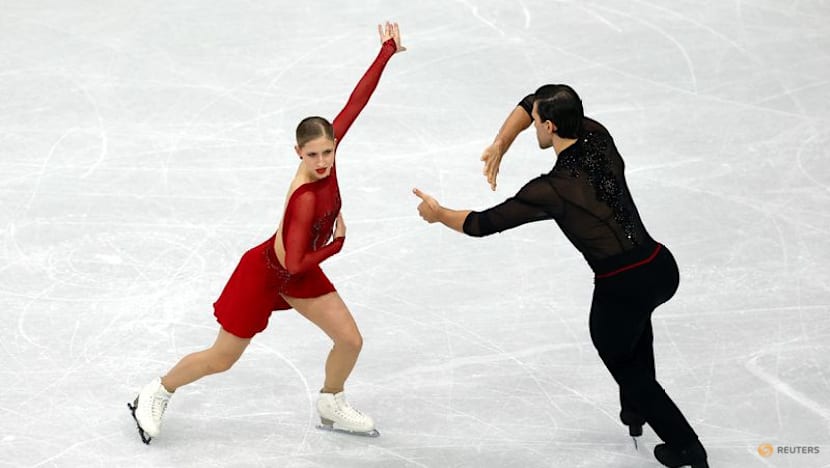
Milano Cortina 2026 Olympics - Figure Skating - Pair Skating - Short Program - Milano Ice Skating Arena, Milan, Italy - February 15, 2026. Minerva Fabienne Hase of Germany and Nikita Volodin of Germany perform during the Short Program. REUTERS/Yara Nardi
MILAN, Feb 15 : Germany's Minerva Fabienne Hase and Nikita Volodin seized the lead after the pairs short programme at the Milano Cortina Olympics in a session defined as much by their precision as by unexpected errors by others.
The reigning world silver medallists capitalised on a rare mistake from Japan's two‑time world champions Riku Miura and Ryuichi Kihara to top the standings with 80.01 points on Sunday, heading into Monday's free programme and blow the competition wide open.
"Our goal was to go out there and feel like we do in practice," Hase said. "So we tried to do that. After the programme, we were happy that everything worked out.
"The crowd was amazing, they supported us a lot. So we are happy overall but it was just the first part. Tomorrow (free programme) we have to do the same again."





European champions Anastasiia Metelkina and Luka Berulava of Georgia were second with 75.46, despite her stumble on the landing of their throw triple flip.
"We made a mistake during our performance. I am not very satisfied about the result," Metelkina said. "I am happy that my partner supported me."
Canadians Lia Pereira and Trennt Michaud were third (74.60).
Skating to "El Abrazo" by Maxime Rodriguez and Frederic Ruiz, Fabienne Hase and Volodin opened with a huge triple twist lift and other than a tiny trip by Fabienne Hase to start their step sequence, they were virtually flawless the rest of the way.
"I think I just thought 'not another mistake now' after we managed to control everything well," Fabienne Hase said.
"Sometimes little stumbles happen. We tried to cover it up well."
The Germans skated last, and after a parade of shaky, mistake‑laden programmes, their performance felt like a breath of fresh air.
Miura and Kihara had arrived in Milan as red-hot favourites but slipped to fifth on 73.11 points after an error on their lasso lift. It appeared as if one of Kihara's arms gave way and she slipped down his back.
A distraught Kihara hung his head after the music stopped. Their coach Bruno Marcotte told him "It's not over" as he stepped off the ice.
"The important thing is not points. The important thing is doing my best, performing best. That's it," Miura said.
The Germans, who are both 26, were making their Olympic debut as a team after a rough 2022 Beijing Games for Fabienne Hase. She and her previous partner Nolan Seegert were forced to withdraw from the team event at the Beijing Olympics after he tested positive for COVID-19.
Fabienne Hase trained alone for 10 days while Seegert was in quarantine, and they eventually struggled to 16th place in the pairs event.
Born and living in Russia, Volodin's career had stalled and he had been skating in exhibition shows for four years before he teamed up with Fabienne Hase in 2022.
Volodin received his German citizenship last year, paving his way to compete at the Olympics.
It was an inauspicious Games debut for Canada's Deanna Stellato-Dudek, who at 42 is the oldest figure skater competing at an Olympics in almost 100 years.
She and partner Maxime Deschamps, world champions in 2024, slipped down to 14th after she appeared to lose her balance and fall backwards near the end of their programme.
Stellato-Dudek, who launched a remarkable comeback after a 16-year break from skating, nearly saw her Olympics dashed entirely after she hit her head in training on January 30.
They missed the team event, arriving for their first practice in Milan on Friday.