Preying on their love? K-pop fans let their emotions rule as they chase after idols and photocards
K-pop became hyper-commercialised as its popularity spread around the world and music industry executives realised that they could make a profit from the loyalty of hardcore fans, one analyst said.
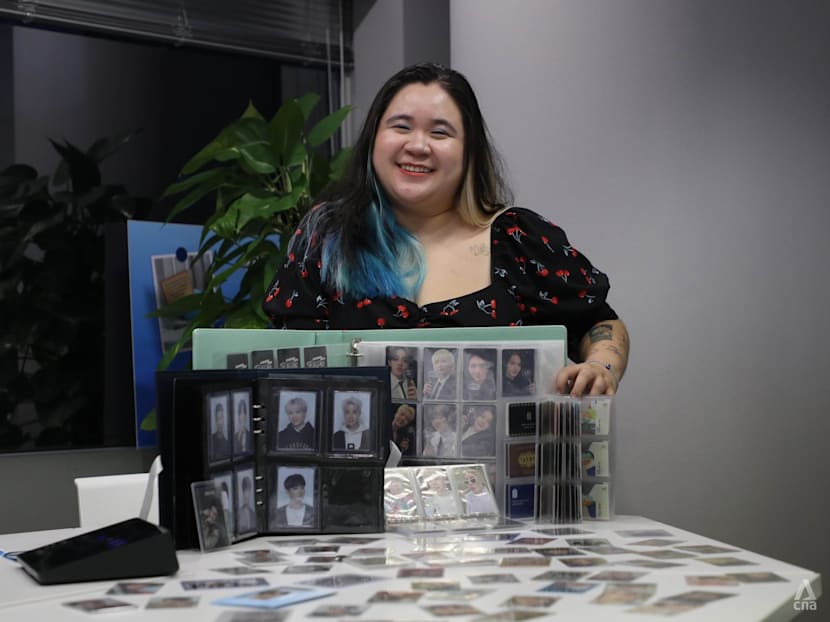
Miss Valerie Chan, 26, and her extensive collection of K-pop photocards, on Dec 30, 2025. (Photo: CNA/Alyssa Tan)

This audio is generated by an AI tool.


One of the most prized possessions of public relations executive Valerie Chan is a black spiral-bound album. In it are photocards of the members from K-pop group BTS, their faces lovingly protected by transparent PVC-free plastic sleeves and housed in individual card slots.
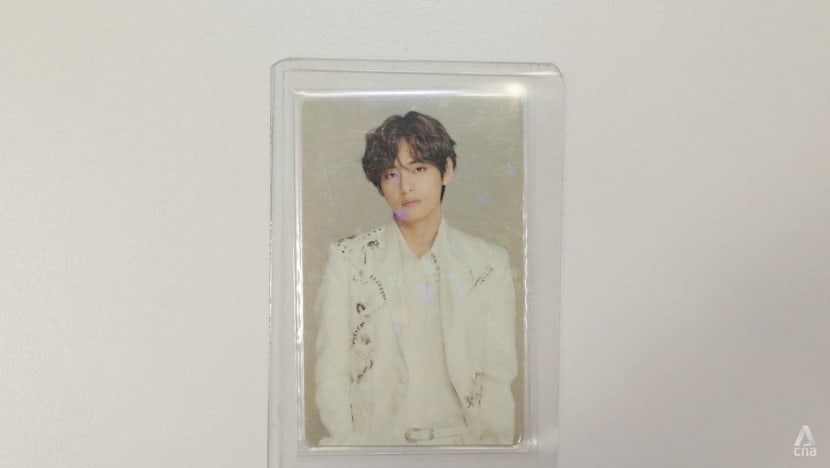
The most expensive card the 26-year-old has ever bought is an official photocard of member V that had been issued at a concert that the group held in South Korea's capital Seoul in October 2019. She spent more than S$300 on this item.
The cards are considered rare, since they were exclusive to the concert and limited in quantity. Although Miss Chan attended the concert, all photocards were out of stock when she reached the venue.
"I really wanted a memento from the show since I went for it, so on the one-year anniversary of the concert, I went online to search for sellers," she said.
"At first, I only bought RM's and Suga's because they're my 'biases'," she said, using a fandom term meaning her favourites. "But once I had them, I wanted to have every one."
A completionist at heart, she then spent eight months sourcing the full set of cards from that show, paying proxies in South Korea for purchasing services, eventually forking out more than S$600 for the seven-piece set.





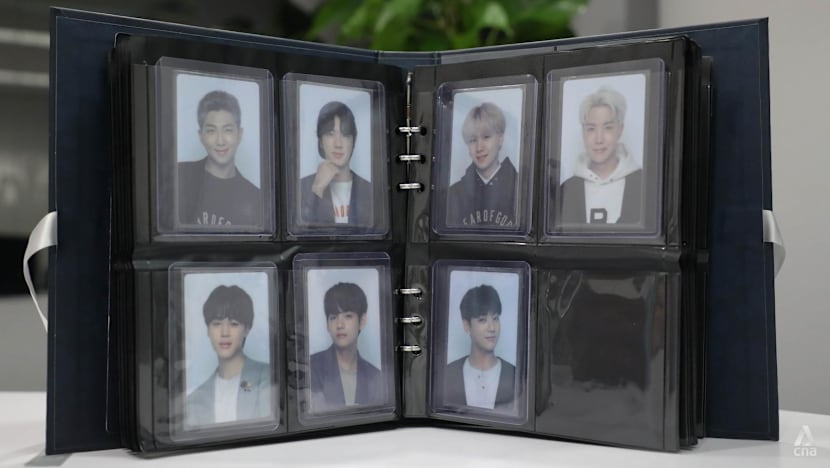
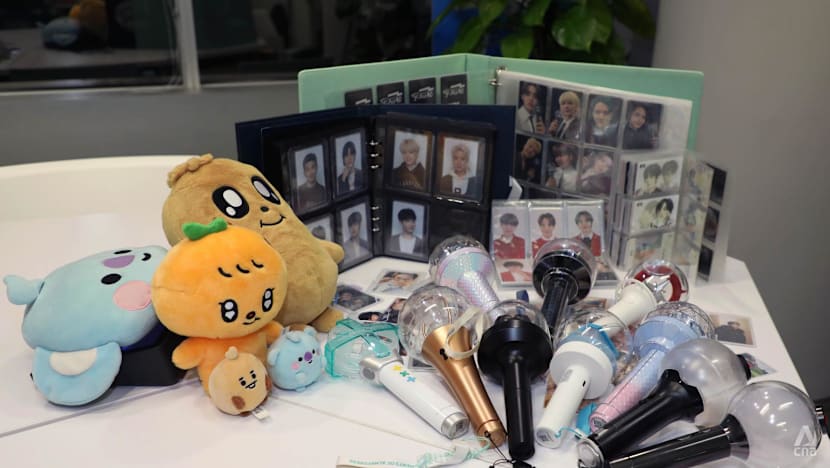
Miss Chan has since spent the mid-range of a four-figure sum buying various photocards, including dropping almost S$850 on all seven members' photocards from the BTS' Permission to Dance on Stage 2021 concerts in Los Angeles, United States.
She is but one of many dedicated K-pop photocard collectors around the world – a subculture emerging from the billion-dollar K-pop industry.
Photocards are ubiquitous in K-pop, often issued as gifts with purchases that include albums and other merchandise. They are also given out at events such as concerts.
They vary wildly in price, going for as low as S$1 for "common" photocards to hundreds or even thousands of dollars for rare cards exclusive to certain events.
A photocard of BTS member Jungkook is believed to be the most expensive on the resale market at present. The card was given out at a series of 2021 events that were only open to a total of 420 lucky draw winners, and is now listed for US$4,990 (around S$6,400) on reselling platform eBay.
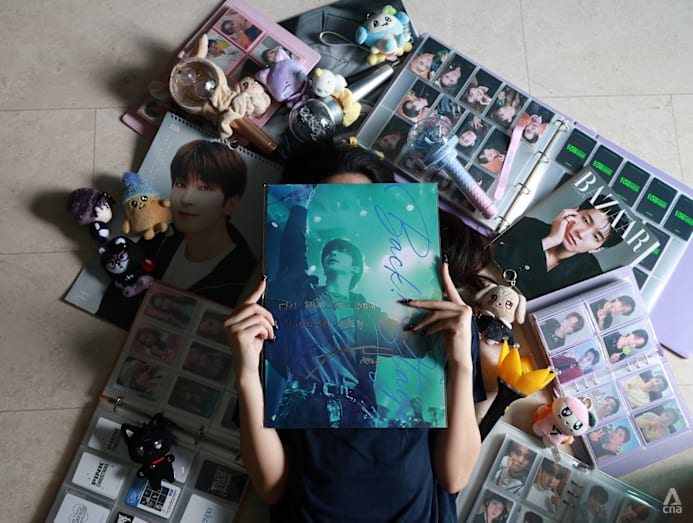
Though cheap to manufacture, photocards are highly sought-after K-pop merchandise, as companies have gamified the process of collection.
Purchases come with random photocards, so fans often do not draw the photocard of their favourite group members and have to buy multiple copies of the item, trade with other fans or seek it out second-hand.
Music labels also sometimes issue different versions of the same album that come with different photocards, and various sales sites often have platform-exclusive photocards that are available only to those who pre-order the album through that platform.
This means that with every new music release, there could be dozens of photocards released for each idol in a group, which encourages hardcore fans to buy more and collect them all.
Miss Nicole Tan, 26, has around 1,000 photocards from over two years of collecting. They feature members of K-pop boy bands Seventeen and Ateez, as well as girl group Aespa.
In total, she estimates having spent somewhere in the "high four-figure range" for her collection.
She likens it to gambling or blind-box purchases.
"It's about the thrill of pulling the one you want. It's that adrenaline and the happiness of owning the card that drew me to collecting," she said.
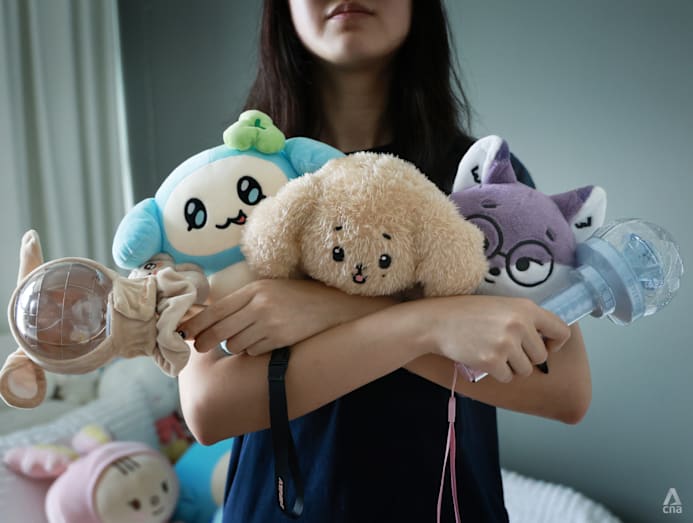
In recent years, this has led to a global surge in fan buying of merchandise.
International live event platform atVenu's 2025 Fan Spending Report found that when it comes to spending on merchandise, compared to other genres, K-pop fans are in "a league of their own".
More fans than ever are spending money on merchandise with 23 per cent of fans in the US doing so in 2025, up from 21 per cent in 2024.
Of a wide variety of genres, K-pop merchandise remains the most popular, with 37 per cent of fans purchasing such mementoes. The second-most popular was hip-hop/rap, with 24 per cent of fans forking out for merchandise.
The report also noted that fan spending on merchandise at concerts held in the US significantly increased in 2025 compared to previous years, with the average fan shelling out US$64 pre-tax on merchandise – up 7 per cent from 2024.
Top genres included electronic dance music (US$15.40 per head) and punk (US$13.67 per head). K-pop fan spending far outstripped these, surging 61 per cent last year to US$48.32 per head.
BUYING THEIR WAY INTO A FAN MEET
Aside from collecting photocards, another major reason fuelling the hyperconsumption in K-pop fandom is the fan sign – a meeting with idols.
Fans are usually chosen from a lucky draw to meet their idols in a group setting, get their albums signed and speak to them one-on-one, usually for a brief minute. These can also be done online in a fan call, which are minute-long video calls with the idols.
These coveted golden tickets to fan signs and fan calls are decided via a lottery system, with each album purchase being one lottery entry. The more copies of an album a fan buys, the higher their chances of snagging a meeting with their idols.
The "cut" – an unofficial minimum number of albums one likely needs to buy to win a slot at a fan sign – varies for each group.
An Ateez fan in her 30s, who wanted to be known only as Yvonne, has attended close to 20 fan signs and fan calls over the course of four years. She declined to reveal her name because she does not want her family to know how much she spends on fan signs.
For the eight-member boy band Ateez, the "cut" is around 60 to more than 200 albums, which generally costs around S$20 to S$30 each.
Even then, the efforts and money spent may not yield any result. Yvonne, who works in the maritime industry, once bought more than 100 copies of an album without winning a slot.
Still, she is continuously drawn to try for fan signs.
"Having this sort of interaction with an idol is something I'd never experienced before," she said.
"When I was younger, I didn't have much spending power, but now I do, and I can go to fan signs and do fan calls. It's just how I like to experience fandom."
To offset the costs of buying so many albums, she teamed up with a fellow fan some two years ago to manage group orders for Ateez releases, and their Telegram channel now has hundreds of subscribers.

K-pop fans outside of South Korea often partake in group orders, making group purchases with other fans to share shipping costs.
Yvonne said that reselling the albums' accompanying photocards and other merchandise within the channel helps her and her fellow Telegram group administrator recoup around 70 per cent of what they spend on trying to get a chance at a fan sign.
Even when they have no plans to attend an upcoming fan sign, they keep the channel active, helping other fans buy and ship merchandise, despite not making any money from doing so.
"We love the group and we want to make it easier for fans here to buy their merchandise, so we want to keep the channel going for as long as we have the time to do so," Yvonne said.
"It also helps us maintain a following so that when we do try for a fan sign, it is easier for us to sell our albums and photocards to cut our losses."
PROMOTES OVERSPENDING AND WASTEFULNESS
Fan signs are one of the most egregious ways K-pop takes advantage of its biggest fans to promote overspending and wastefulness, one academic said.
Assistant Professor Jeong Areum from the Arizona State University, who has herself attended fan signs for NCT 127 member Taeyong, studies South Korean popular culture, particularly K-pop.
"There is a lot of ambiguity around fan signs. No one really knows what the 'cut' is, and it is all hearsay," she said.
"The murkiness even gives rise to unverified third-party sellers who claim to know the 'cut' and sell that information for money."
Companies started realising that they really only need to market to core fans because they will spend money.
Dr Jeong, who was born and raised in South Korea, has witnessed how K-pop has grown hyper-commercialised as it scaled globally.
"In the past, K-pop companies tried to cater to the general public in South Korea, so there were many free and modestly priced events," she said.
Things changed around 2012 to 2013, which was generally regarded as the beginning of the third generation of K-pop. With the help of social media, the genre gained more committed fans around the region and the world.
"Companies started realising that they really only need to market to core fans because they will spend money," Dr Jeong said.
"And that was when merchandising exploded in K-pop, because companies wanted to make things that core fans want and will buy. That was also when concerts and fan meets became increasingly expensive."
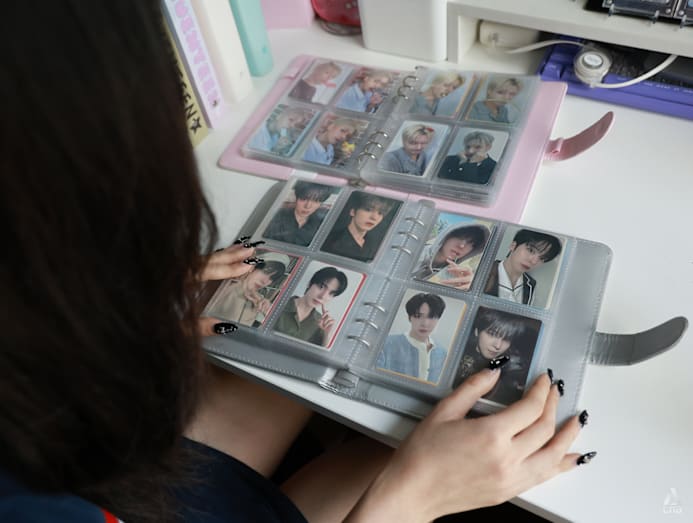
Fans such as Miss Chan and Miss Tan are well aware that K-pop companies prey on their love for their idols, but continue to spend anyway.
"I wish photocards would come only with albums and concerts, because nowadays, the sheer number of cards is quite ridiculous. Some of them look so similar, too," said Miss Tan.
"I definitely could have taken a few more overseas trips if I hadn't spent on these cards."
Still, she has no regrets about her collection and she plans to continue growing it.
"It makes me happy to own these cards. Other people find happiness in collecting watches and buying luxury bags, this is just my version of happiness."